• Welcome to Photrio!
    Registration is fast and free. Join today to unlock search, see fewer ads, and access all forum features.
    Click here to sign up

Kodak Super Ortho-Press dev times?

Recent Classifieds

Forum statistics

Threads
201,903
Messages
2,831,924
Members
101,014
Latest member
photomaximo
Recent bookmarks
0

StoneNYC

Member
Allowing Ads
Joined
Aug 5, 2012
Messages
8,345
Location
Antarctica
Format
8x10 Format
So I just inherited a mini speed graphic 2 x 3 press camera, with one film holder.

Believe it or not, the film holder has film in it, I took it out in the dark and touched the notch codes and look them up, it appears to be Kodak Super Ortho-Press.

Now my question is, I can't seem to find any development times for this particular film, and I know that it's an ortho film, however, the school darkroom that I now have access to runs off of an orange type light and not the old red type darkroom lights, I can't really change out the bulbs or filter etc., it's sort of an industrial piece that I wouldn't want to mess with in the school probably wouldn't want me to mess with either, I do have one red LED light, but again I don't really know what this is sensitive to in reality, it's super old so it's probably super fogged.

However, at least one of the dark slides shows as being exposed, while the other side shows as being unexposed, I really have no idea if there's even an image on here, but I think it would be kind of neat to be able to develop this and potential he find some sound image, so I would like to develop this but I have no idea if anyone has any kind of development times etc., unfortunately the developers I have are mostly modern including the following...

Kodak HC-110 (the new stuff in the 1L bottle that's reportedly less syrupy, Ilfotec HC, DD-X, and of course Rodinal but I would think that wouldn't be good at reducing fog.

I also have some powders but I would PREFER not to have mix those up but I suppose I could....

D-76, old can of DK-50 (or whatever the "50" designation was).

I also have Sprint developer that the school uses.

Thanks for any input on safelight possibilities and dev times.
 

mopar_guy

Member
Allowing Ads
Joined
Sep 12, 2009
Messages
1,176
Location
Washington,
Format
Multi Format
Stone,

My very old Photo-Lab-Index from 1945 suggests 14 minutes in D-76 at 68 degrees F.

Most ortho films should not be sensitive to red light.

You could develop by inspection if you have sheet film.
 
OP
OP
StoneNYC

StoneNYC

Member
Allowing Ads
Joined
Aug 5, 2012
Messages
8,345
Location
Antarctica
Format
8x10 Format
Stone,

My very old Photo-Lab-Index from 1945 suggests 14 minutes in D-76 at 68 degrees F.

Most ortho films should not be sensitive to red light.

You could develop by inspection if you have sheet film.

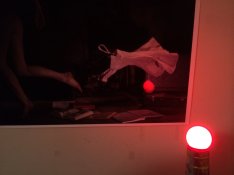
So this red LED light that was suggested to me by another member should work just fine correct?

ImageUploadedByTapatalk1411080528.639867.jpg

ImageUploadedByTapatalk1411080536.985710.jpg

I supposed it should be shielded because of it's brightness?
 

mopar_guy

Member
Allowing Ads
Joined
Sep 12, 2009
Messages
1,176
Location
Washington,
Format
Multi Format
The equivalent of a 15 or 25 watt bulb and a deep red color should be OK.

It would be best to keep the light well away from the developing tray.

You should develop to at east 90% of full time and then you can inspect the film under the red light for no more than one second.

After inspection, you can decide what adjustment to time if any.
 

mopar_guy

Member
Allowing Ads
Joined
Sep 12, 2009
Messages
1,176
Location
Washington,
Format
Multi Format
Oh, the original suggested ASA speed was 100.
 
OP
OP
StoneNYC

StoneNYC

Member
Allowing Ads
Joined
Aug 5, 2012
Messages
8,345
Location
Antarctica
Format
8x10 Format
Thanks guys!!

I'll give it a go tomorrow if I have time.

Question, I have a lampshade that is sort of a little bit toned in yellow color, but would suffice to create a diffusion for this little bulb, my question is, after the light becomes red, if it passes through anything else in there somehow be some kind of magical light color change that will affect the film?
 

MattKing

Moderator
Moderator
Allowing Ads
Joined
Apr 24, 2005
Messages
55,242
Location
Delta, BC Canada
Format
Medium Format
Oh, the original suggested ASA speed was 100.

That is probably the "old" ASA. So in more modern terms, ASA 200 ~ ISO 200 as might be set now on your meter.

But probably way slower now.
 

MattKing

Moderator
Moderator
Allowing Ads
Joined
Apr 24, 2005
Messages
55,242
Location
Delta, BC Canada
Format
Medium Format
Thanks guys!!

I'll give it a go tomorrow if I have time.

Question, I have a lampshade that is sort of a little bit toned in yellow color, but would suffice to create a diffusion for this little bulb, my question is, after the light becomes red, if it passes through anything else in there somehow be some kind of magical light color change that will affect the film?

Filters can only take away colour - they don't add it.

So if there was no blue light before the lamp shade, there won't be any afterwards.
 
OP
OP
StoneNYC

StoneNYC

Member
Allowing Ads
Joined
Aug 5, 2012
Messages
8,345
Location
Antarctica
Format
8x10 Format
Filters can only take away colour - they don't add it.

So if there was no blue light before the lamp shade, there won't be any afterwards.

Great thanks I didn't think so but couldn't hurt to ask
 
OP
OP
StoneNYC

StoneNYC

Member
Allowing Ads
Joined
Aug 5, 2012
Messages
8,345
Location
Antarctica
Format
8x10 Format
If this is your first development by inspection gig, then it would most likely fail under the best of circumstances (fresh film). And if the safelight you're talking about is the bulb in the lamp in the lower right corner of the picture, that bulb is not safe. Look at it. There's so much white light coming out of it you might as well develop in the sunshine. Somebody else has suggested 14 minutes 68 in straight D-76. That sounds like a lot to me. Heck, that's practically Microdol-X 1:3 times for Tri-X almost.
You need to do more research and come up with some genuine Kodak info, or else you're going to end up with a piece of black film. I haven't see a thing in this whole thread I'd agree with (no offense, guys). And that safelight you have there might be a fair Christmas decoration, but I woudn't have a piece of photo paper within a mile of it.

To be fair it might have blown out in the iPhone picture sensor but might not actually be giving off any white, it's an LED that is pure red, so it can't physically give off white to my understanding?

I know people who say they use it.

This would be my second develop by inspection, my first was a piece of ektascan that I enlarged and was going to duplicate to make a contact print and to reduce the original contrast. It came out well but I had to throw it in the stop fairly quickly because I was using print developer at the time, I got lucky but I'm sure doing it again I at least can compare the density of the films in the same light to stop it at the appropriate time?

It will have to wait until next week I think, I don't have time now... Off for the weekend, I'll report back Monday evening when I've had time to develop the film.
 

Ken Nadvornick

Member
Allowing Ads
Joined
Mar 18, 2005
Messages
4,943
Location
Monroe, WA, USA
Format
Multi Format
To be fair it might have blown out in the iPhone picture sensor but might not actually be giving off any white, it's an LED that is pure red, so it can't physically give off white to my understanding?

Not white, but other colors at levels dim enough that they are visually undetectable by the eye within that sea of red light, but still possibly damaging to blue or green sensitive emulsions.

My understanding is that certain dopants introduced at the time of manufacture can possibly cause other wavelengths to be emitted. Why not try the CD/DVD test on your LEDs? In total darkness just observe their reflection from the recorded side of a media disc and look for the telltale very dim bands of non-red color.

When I did this using the 635nm red LEDs now used in my darkroom, I found they were emitting tiny slivers of blue light. Couldn't detect the blue visually. But when tested they were fogging my printing papers. By adding a layer of Rubylith, the blue disappeared and the papers no longer fogged.

Ken
 
Photrio.com contains affiliate links to products. We may receive a commission for purchases made through these links.
To read our full affiliate disclosure statement please click Here.

PHOTRIO PARTNERS EQUALLY FUNDING OUR COMMUNITY:


Ilford ADOX Freestyle Photographic Stearman Press Weldon Color Lab Blue Moon Camera & Machine
Top Bottom