• Welcome to Photrio!
    Registration is fast and free. Join today to unlock search, see fewer ads, and access all forum features.
    Click here to sign up

Jobodrum and final rinsing. Looks like I need a tray too..

Inconsequential

H
Inconsequential

  • 0
  • 0
  • 18
Emi on Fomapan 400

A
Emi on Fomapan 400

  • 5
  • 3
  • 81

Recent Classifieds

Forum statistics

Threads
201,797
Messages
2,830,363
Members
100,958
Latest member
jjjimages
Recent bookmarks
0

BeselerOrNot

Member
Allowing Ads
Joined
Dec 6, 2023
Messages
48
Location
Prague, Czech Republic
Format
35mm
I am slowly building a drakroom. I am planning to develop BW using an old-style Jobodrum, manually for starters (no processor). To simplify life I will start with RC paper. So I was casually browsing the Jobodrum manual once again and suddenly noticed the paragraph I missed earlier: "Pull out the prints and rinse carefully in running water". And the tray picture.

While this procedure sounds totally logical, somehow I thought I can get away with rinsing right in the drum. But looks like I can not.

Folks who use drums for printing, how do you guys rinse? I live in a small appartment and space is precious. So I am natuarlly interested in the smallest footprint possible, maybe some vertical tank.. Also, if that would be a traditional tray, can I use what's matching the print size or I need it next size for rinsing? Aiming at 30x40cm (12"x16") if that matters.
 

MattKing

Moderator
Moderator
Allowing Ads
Joined
Apr 24, 2005
Messages
55,167
Location
Delta, BC Canada
Format
Medium Format
I do one short rinse in the drum, than finish it off in a tray. I use old trays with drainage holes in one end, and trickle running water into them.
That allows me to quickly proceed to the most time consuming part - rinsing the drum out out and standing it to dry.
I have a few Cibachrome drums that I use. Cycling through them means that the drying is mostly air drying.
Your tray size can be matched to the print size. Your shower/bathtub floor is a great location, unless you are fortunate enough to have a big enough sink.
 

BillBaileyImages

Member
Allowing Ads
Joined
Aug 8, 2024
Messages
102
Location
Nebraska, USA
Format
Medium Format
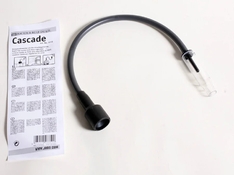
I use this amazing device from CatLabs (Omer is a true JOBO genius) with my JOBO drums. Works extremely well, and no tray is needed. Just follow the directions to set water flow rate for best rinsing performance.

Jobo Universal Forced Turbulence Cascade Film Washer (#3350)
$44.90
 

Attachments

  • 1733278032644.jpeg
    1733278032644.jpeg
    63.2 KB · Views: 47
OP
OP

BeselerOrNot

Member
Allowing Ads
Joined
Dec 6, 2023
Messages
48
Location
Prague, Czech Republic
Format
35mm
I use this amazing device from CatLabs (Omer is a true JOBO genius) with my JOBO drums. Works extremely well, and no tray is needed. Just follow the directions to set water flow rate for best rinsing performance.

Jobo Universal Forced Turbulence Cascade Film Washer (#3350)
$44.90

I knew it! Rinsing prints directly in the drum should be possible, and it is! Thank you.
 

MattKing

Moderator
Moderator
Allowing Ads
Joined
Apr 24, 2005
Messages
55,167
Location
Delta, BC Canada
Format
Medium Format
I knew it! Rinsing prints directly in the drum should be possible, and it is! Thank you.

And how are you going to wash (not rinse) the backs of the prints?
That accessory is for film, on reels.
 

mshchem

Subscriber
Allowing Ads
Joined
Nov 26, 2007
Messages
16,006
Location
Iowa City, Iowa USA
Format
Medium Format
Yes, Matt is correct. The Jobo "washer" is for injecting water (and air) down the column of a film tank. You need to pull the print out of the tube for the final rinse. I seem to recall another fellow member here that is selling a 12x16 monochrome Nova vertical 3 bath processor. That's a great setup. You'll still need a wash tray.
 

Mick Fagan

Subscriber
Allowing Ads
Joined
Sep 13, 2005
Messages
4,434
Location
Melbourne Au
Format
Multi Format
In some places that I lived in, I used a normal plastic bucket, anywhere between 5-10 litres will do the job.

Develop the picture, then do a couple of in the drum washes, then transfer the print into a bucket, laundry tub, shower base with a small towel over the drain hole

You can have the print loosely rolled in the bucket of water, letting it soak for a few minutes. Then pull it out using your fingers on a corner and either hang it up on a string using a plastic clothes peg or anything else you have to hand. I have also held prints by the corner for about 30 seconds to let all loose water to drip off, then placed the prints on a bathroom towel to dry.

Cat litter trays or anything else that can hold some water and cover the print is all you need.

I haven't used fibre based paper for decades, almost always used RC B&W paper. The major reasons are speed of processing, plus really low amount of water for washing is required.
 

Don_ih

Member
Allowing Ads
Joined
Jan 24, 2021
Messages
8,572
Location
Ontario
Format
35mm RF
You could also just do all the processing in a single tray. Put developer in the tray. Put in the print, develop the print, pour out the developer, pour in stop, pour out stop, pour in fixer, fix print, pour that out, rinse under running water. That's what I do for large prints since I don't have room for several large trays.

When doing test strips, you can just develop the strip and rinse it and look at it quickly with the light on.

I wouldn't be able to put up with processing b&w prints in a Jobo. I'd be enraged if I fixed a print that was obviously under- or over-exposed.
 
OP
OP

BeselerOrNot

Member
Allowing Ads
Joined
Dec 6, 2023
Messages
48
Location
Prague, Czech Republic
Format
35mm
You could also just do all the processing in a single tray.

Yeah.. what I am trying to minimize is the dark space, since I will have sort of a cabinet for it. Not a dedicated room, or bathroom. The more I can do with light, the better.

Current plan is to keep all the wet work out of the darkroom.
 

BillBaileyImages

Member
Allowing Ads
Joined
Aug 8, 2024
Messages
102
Location
Nebraska, USA
Format
Medium Format
Yes, the JOBO wash device is for film. However, my intent--which I failed to explain--was to wash the emulsion side of the print first, then remove the print and carefully reinsert the print emulsion side out (instead of in). I was attempting to help you solve your issue of not wanting a tray.
 

koraks

Moderator
Moderator
Joined
Nov 29, 2018
Messages
26,864
Location
Europe
Format
Multi Format
You could also just do all the processing in a single tray. Put developer in the tray. Put in the print, develop the print, pour out the developer, pour in stop, pour out stop, pour in fixer, fix print, pour that out, rinse under running water. That's what I do for large prints since I don't have room for several large trays.

Same here, for big prints; works fine.

And how are you going to wash (not rinse) the backs of the prints?

Yup, that's the reason you can't do the entire process in a drum. There'll be developer and fixer stuck between the wall of the drum and the back of the print even after you've finished washing the print in the drum. On RC paper this is not necessarily detrimental to the print, but it'll leave nasty and potentially smelly stains on the back of every print.

Current plan is to keep all the wet work out of the darkroom.

You could develop and also fix prints in a drum, then wash in a tray. This way you can keep everything that's wet in a different physical room than the one the enlarger sits in. The wet room also doesn't have to be dark. It's cumbersome and time-consuming, and I doubt you'll very much enjoy doing darkroom work this way.

Two alternatives I can think of, are:
1: Figure out a system that allows you to do everything in a single room where you have more space. E.g. find a way to darken the living room and then use buckets of water as suggested by @Mick Fagan. A friend of mine did his enlarging like this for several years when he rented a single room in a student housing complex. He ate, slept, worked and lived in the same room he also did his printing in. He would sometimes take a tray of freshly made prints into a shower cabin down the hall to do further washing, but I think he did this only for fiber based paper.
2: See if there's some kind of community darkroom in your area - or perhaps team up with several others and create such a collaborative space. By joining forces you might be able to afford a nicer space with nicer equipment than you could manage alone - with the advantage that after a session, you can clean up and shut the door, and go back to your undisturbed home.
 

BillBaileyImages

Member
Allowing Ads
Joined
Aug 8, 2024
Messages
102
Location
Nebraska, USA
Format
Medium Format
Historical note: I've processed 30x40 prints AND transparency film in a drum. Kodak made an enormous drum that was loaded into an equally-huge rotation device. Ours was so large, we called her "Brunhilde" (from an opera with a large soprano--absolutely no intended demeanment to anyone with that same name).
We had a film lab with 18 employees, so I'm not making this up.
We didn't have to take the print out of the drum to wash it. I'm guessing the rotating drum, and the possible laminar flow of water on both sides of the print, did the job.
Clients loved the results, and Brunhilde had a place of honor just waiting for her next run šŸ˜….
 

logan2z

Subscriber
Allowing Ads
Joined
Jan 11, 2019
Messages
3,980
Location
SF Bay Area, USA
Format
Multi Format
I am natuarlly interested in the smallest footprint possible, maybe some vertical tank.

I'm not sure anyone has addressed this part of your post, but you could buy an 'archival' print washer like the Nova Washmaster Eco for washing prints. It stands vertically so has a small footprint.

Edit: I see that @Pieter12 just posted a similar comment two seconds before me.
 
OP
OP

BeselerOrNot

Member
Allowing Ads
Joined
Dec 6, 2023
Messages
48
Location
Prague, Czech Republic
Format
35mm
Thank you, guys, this discussion is very useful.

I've checked the Nova washer.. evewatering £359.95 for 12"x16" tank.

They say it's "using less water than any other washer in the World." I am ashamed to admit it, but probably I will look for something less eco-friendly. But it is good to have options.
 

Pieter12

Member
Allowing Ads
Joined
Aug 20, 2017
Messages
8,181
Location
Magrathean's computer
Format
Super8
Looking back at your initial post, you will be printing on RC paper. An archival washer such as the NOVA would be overkill. RC only needs a 2-5 minute wash in tap water, easily done in a tray without anything fancy.
 

DREW WILEY

Member
Allowing Ads
Joined
Jul 14, 2011
Messages
14,872
Format
8x10 Format
I routinely wash big 30X40 inch RC color prints in the drum. It isn't Jobo - they don't make anything as large - but similar in principle. Just as long as there are linear ribs on the inside of the drum wall, allowing solutions behind the print as well as on the emulsion side. Use multiple changes of water. RC prints wash quickly, unlike fiber-based print.
 

pentaxuser

Member
Joined
May 9, 2005
Messages
20,335
Location
Daventry, No
Format
35mm
You are in Europe. Look into the NOVA vertical print washer, they still make them.

Yes that is what I was about to recommend. This is what I did for RA4 prints after the developer, stop bath and then blix in the drum You might find a used one on e-bay but you really need a source of running water such as a tap with a tube that fits on the bottom of the washer slot and a tube on the top outlet that passes the water into a large bucket or sink connected to the outside drain

pentaxuser
 

mshchem

Subscriber
Allowing Ads
Joined
Nov 26, 2007
Messages
16,006
Location
Iowa City, Iowa USA
Format
Medium Format
Historical note: I've processed 30x40 prints AND transparency film in a drum. Kodak made an enormous drum that was loaded into an equally-huge rotation device. Ours was so large, we called her "Brunhilde" (from an opera with a large soprano--absolutely no intended demeanment to anyone with that same name).
We had a film lab with 18 employees, so I'm not making this up.
We didn't have to take the print out of the drum to wash it. I'm guessing the rotating drum, and the possible laminar flow of water on both sides of the print, did the job.
Clients loved the results, and Brunhilde had a place of honor just waiting for her next run šŸ˜….

I know just what you are talking about. Used CP-5 chemistry for Ektacolor Professional Fiber base color paper.
 

mshchem

Subscriber
Allowing Ads
Joined
Nov 26, 2007
Messages
16,006
Location
Iowa City, Iowa USA
Format
Medium Format
Edit the model 30 originally used CP-100 chemistry. These machines worked with RC paper as well. I think stabilizer was the final rinse
 
Photrio.com contains affiliate links to products. We may receive a commission for purchases made through these links.
To read our full affiliate disclosure statement please click Here.

PHOTRIO PARTNERS EQUALLY FUNDING OUR COMMUNITY:


Ilford ADOX Freestyle Photographic Stearman Press Weldon Color Lab Blue Moon Camera & Machine
Top Bottom