• Welcome to Photrio!
    Registration is fast and free. Join today to unlock search, see fewer ads, and access all forum features.
    Click here to sign up

Is this a good exposure?

Recent Classifieds

Forum statistics

Threads
201,879
Messages
2,831,660
Members
100,998
Latest member
mktoy
Recent bookmarks
0

Slowshooter

Member
Allowing Ads
Joined
Dec 7, 2012
Messages
29
Location
Dublin
Format
Medium Format
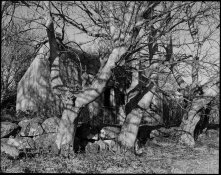
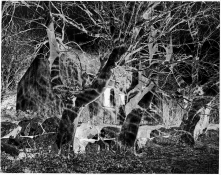
Just got this film processed and scanned at the weekend.

Camera: Pentax 67II.
Lens: Pentax 105mm.
F22, 1/60" (if memory is correct). TTL metering.
Film: Ilford FP4+.
Filter: Lee Orange.
Bright, low winter sun, around 11.00 a.m. Grey sky.

Contrast was increased minimally on the scan.

Maybe I'm imagining it but my images seem to lack 'depth', as in broad depth of field. I probably close down a bit too much and don't quite understand the principles of hyper-focal distance. The man who processed the negatives described them as 'perfect negatives'.

I always imagine I should get a broader range of tones. It's also a fairly busy image, with elements merging into each other, so maybe that has something to do with it.

Am I just being too critical? Critiques welcomed.
attachment.php


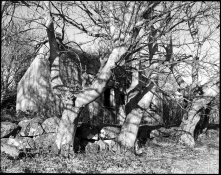
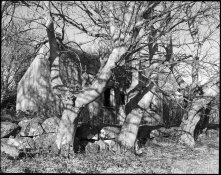
Edit: Having adjusted the black and white points on the scan, this seems to have more punch:
old_house_trees.jpg

Of course, the photograph could be interpreted in any number of ways in the darkroom.
 

Attachments
  • old_house_trees.jpg
    old_house_trees.jpg
    146.4 KB · Views: 439
Last edited by a moderator:
David Allen

Member
Allowing Ads
Joined
Nov 6, 2008
Messages
991
Location
Berlin
Format
Med. Format RF
It looks like you have a good negative with a full range of tones from deep shadow to bright highlights.

The question is how do you now want to interpret the scene?

For my taste (and that is all you will receive from other posters - i.e how they would interpret the image) the image lacks a feeling of weight (possibly what you mean by 'lack of depth') which comes from the mid-tones being too bright. I would keep the shadows and highlights as they are but would lower the mid-tones to a darker shade of grey. In most programmes this is achieved by using the histogram and adjusting the black and white setting (as you have done for the shadows and highlights) and then move the central triangle to the right.

Here is how I would interpret your image (subject, of course, to my monitor settings):

old_house_trees.jpg

Bests,

David
www.dsallen.de
 
OP
OP

Slowshooter

Member
Allowing Ads
Joined
Dec 7, 2012
Messages
29
Location
Dublin
Format
Medium Format
Thank you for that very useful suggestion David. Although you've made the mid-tones much darker than what I would have imagined, I still like your interpretation. Perhaps I'm more used to viewing images on screen; I expect everything to pop out at me.

S.
 

Alex Muir

Member
Allowing Ads
Joined
Dec 23, 2009
Messages
407
Location
Glasgow, Scotland
Format
Medium Format
I don't think there's a problem with your exposure. The difficulty I see is more with the viewpoint. The trees block any real view of the building, and the building, as a back drop, takes away from the shape of the trees. Perhaps a view of the building with the shadows of the trees would have given a better image, with the nature of the setting implied by the shadows? The low sun, whilst creating interesting shadows, has produced similar bright tones on the tree trunks and the building which compete for attention. It looks like an interesting location and I can understand why you would make photographs there.
Alex.
 
OP
OP

Slowshooter

Member
Allowing Ads
Joined
Dec 7, 2012
Messages
29
Location
Dublin
Format
Medium Format
A good point Alex. My idea was to show how nature was reclaiming the house. I see your point in how they're merging into each other. I took some more shots from further left but this was the most interesting view available in a fairly narrow area. It might be a good idea to go back again though and try something different.

S.
 

RalphLambrecht

Subscriber
Allowing Ads
Joined
Sep 19, 2003
Messages
14,935
Location
K,Germany
Format
Medium Format
Just got this film processed and scanned at the weekend.

Camera: Pentax 67II.
Lens: Pentax 105mm.
F22, 1/60" (if memory is correct). TTL metering.
Film: Ilford FP4+.
Filter: Lee Orange.
Bright, low winter sun, around 11.00 a.m. Grey sky.

Contrast was increased minimally on the scan.

Maybe I'm imagining it but my images seem to lack 'depth', as in broad depth of field. I probably close down a bit too much and don't quite understand the principles of hyper-focal distance. The man who processed the negatives described them as 'perfect negatives'.

I always imagine I should get a broader range of tones. It's also a fairly busy image, with elements merging into each other, so maybe that has something to do with it.

Am I just being too critical? Critiques welcomed.
attachment.php


Edit: Having adjusted the black and white points on the scan, this seems to have more punch:
View attachment 101389

Of course, the photograph could be interpreted in any number of ways in the darkroom.

when a lens is set to the hyperfocal distance, then, the DOF reaches from half that distance all the way to infinity.This is often suggested for landscape photography to maimize the DOF.However,there is an issue with that and your negative seems to illustrate yhat issue.the issue is,in this set up, infinity is alwaysat the threshold of sharpness and looks slightly fuzzy,which is aggerratated by diffraction.Uou'd be better offfocusing closer to infinity,leaving theusually less interesting forgroundoutside of the DOF.DOF and sharpness can be very fuzzy concepts.BTW,your negative seems well exposed and processed but for me, the subject matter lacks impact and interest.You did as well as can be expected in this situation.:smile:
 
OP
OP

Slowshooter

Member
Allowing Ads
Joined
Dec 7, 2012
Messages
29
Location
Dublin
Format
Medium Format
Thank you for that Ralph. So, if I understand correctly, you're suggesting focusing close to but not at infinity. In this case, it would be somewhere around the trees behind the house.

They certainly are fuzzy concepts, as you say!

This shot is one in a series of shots I took that day. Some of the others give a better view.

Seán.
 

cliveh

Subscriber
Allowing Ads
Joined
Oct 9, 2010
Messages
7,802
Format
35mm RF

Maris

Member
Allowing Ads
Joined
Jan 17, 2006
Messages
1,594
Location
Noosa, Australia
Format
Multi Format
Just got this film processed and scanned at the weekend...
...F22, 1/60" (if memory is correct). TTL metering.
Film: Ilford FP4+.
Filter: Lee Orange.
Bright, low winter sun, around 11.00 a.m. Grey sky...

Forgive the presumption:

Unless negative processing is very special the predictable exposure for Ilford FP4+ on the brightest, clearest, sunniest day anywhere on earth is f22 @ 1/60 second. The presence of the Lee Orange Filter, and no exposure compensation, suggests the film was underexposed by at least one stop. Ok, for very pale or very dark subjects the standard "sunny day exposure" might need modifying but not for the attractive mid-toned subject you chose.

The picture is so good because of subject choice and because Ilford FP4+ is excellent film that forgives non-optimum exposure.
 

frank

Member
Allowing Ads
Joined
Dec 6, 2002
Messages
4,359
Location
Canada
Format
Multi Format
Biggest flaw here is how busy and chaotic the image is, due largely to the direct lighting and the orange filter which only served to deepen the shadows. Try to revisit this site during a cloudy day, with no filter.
 
OP
OP

Slowshooter

Member
Allowing Ads
Joined
Dec 7, 2012
Messages
29
Location
Dublin
Format
Medium Format
Thank you both.

Maris, it probably was 1/60 second. I haven't dug out my notes yet so I can't say for certain.

Frank, I was experimenting on the day. I had never used filters up until then and wanted to see how they worked. My unfiltered images have always looked flat and lacked contrast, so I thought filters would give me a more contrasty negative. I had used Pan F Plus (ISO 50) without filters previous to that and was quite pleased with the results. See here: https://www.flickr.com/photos/an_solas/8416933675/in/set-72157632614330163

As you say, it's a very busy image.

Maybe using a filter on a bright sunny day wasn't such a good idea. Some people reckon that there should always be a yellow filter in front of the lens.
 
Last edited by a moderator:

David Allen

Member
Allowing Ads
Joined
Nov 6, 2008
Messages
991
Location
Berlin
Format
Med. Format RF
Doesn't the scene have its own voice without the necessity of personal interpretation?


Balderdash! - the 'art' of photography is that the photographer finds something that she/he finds interesting and then interprets it to produce a personal statement of how she/he wants to present what they have found to a wider audience.

If it were otherwise, then all we would need to do is buy a second-hand moon rover and let it loose or, even better still, just steal Google Maps Street View images.

Does a scene really have it's own voice? - well in terms of Quantum Physics this may be true because, at the core of the science, the very act of observing something changes it's state. However, in the Newtonian world in which we live, the choice of subject matter, viewpoint, technique, etc, etc determines what we produce as photographers.

If the scene truly 'had its own voice', then good old Ansel would not have needed to make stunning Wagnerian images of the West (which technically were complete 'lies' about the scene presented but a powerful interpretation of his view of Yosemite) to convince the US Government to finally start to protect it's unique landscape.

Clive, I know you tend to post 'provocative' comments as a way of generating debate on this site but, in this case, you are way off the mark.

One last point, in the images presented by Bill Brandt, Lee Friedlander, Lewis Baltz, Diane Arbus, Edward Weston, Walker Evans, Sebastiao Salgado, Don McCullin, Brian Griffin, Anders Petersen, Mario Giacomelli, Ray K. Metzker, Francesca Woodman, etc you see the 'hand' of the photographer far more than the subject itself.

Bests,

David.
www.dsallen.de
 

Alex Muir

Member
Allowing Ads
Joined
Dec 23, 2009
Messages
407
Location
Glasgow, Scotland
Format
Medium Format
Thank you both.

Maris, it probably was 1/60 second. I haven't dug out my notes yet so I can't say for certain.

Frank, I was experimenting on the day. I had never used filters up until then and wanted to see how they worked. My unfiltered images have always looked flat and lacked contrast, so I thought filters would give me a more contrasty negative. I had used Pan F Plus (ISO 50) without filters previous to that and was quite pleased with the results. See here: https://www.flickr.com/photos/an_solas/8416933675/in/set-72157632614330163

As you say, it's a very busy image.

Maybe using a filter on a bright sunny day wasn't such a good idea. Some people reckon that there should always be a yellow filter in front of the lens.

I really like your shot of the Birches. When I saw the shot under discussion, it reminded me of the West Highlands. Having seen your location, I now realise why.
Alex.
 

RalphLambrecht

Subscriber
Allowing Ads
Joined
Sep 19, 2003
Messages
14,935
Location
K,Germany
Format
Medium Format
Balderdash! - the 'art' of photography is that the photographer finds something that she/he finds interesting and then interprets it to produce a personal statement of how she/he wants to present what they have found to a wider audience.

If it were otherwise, then all we would need to do is buy a second-hand moon rover and let it loose or, even better still, just steal Google Maps Street View images.

Does a scene really have it's own voice? - well in terms of Quantum Physics this may be true because, at the core of the science, the very act of observing something changes it's state. However, in the Newtonian world in which we live, the choice of subject matter, viewpoint, technique, etc, etc determines what we produce as photographers.

If the scene truly 'had its own voice', then good old Ansel would not have needed to make stunning Wagnerian images of the West (which technically were complete 'lies' about the scene presented but a powerful interpretation of his view of Yosemite) to convince the US Government to finally start to protect it's unique landscape.

Clive, I know you tend to post 'provocative' comments as a way of generating debate on this site but, in this case, you are way off the mark.

One last point, in the images presented by Bill Brandt, Lee Friedlander, Lewis Baltz, Diane Arbus, Edward Weston, Walker Evans, Sebastiao Salgado, Don McCullin, Brian Griffin, Anders Petersen, Mario Giacomelli, Ray K. Metzker, Francesca Woodman, etc you see the 'hand' of the photographer far more than the subject itself.

Bests,

David.
www.dsallen.de
Mmaybe but photography is about creating not about finding.:whistling:
 

cliveh

Subscriber
Allowing Ads
Joined
Oct 9, 2010
Messages
7,802
Format
35mm RF
Does a scene really have it's own voice? - well in terms of Quantum Physics this may be true because, at the core of the science, the very act of observing something changes it's state. However, in the Newtonian world in which we live, the choice of subject matter, viewpoint, technique, etc, etc determines what we produce as photographers.www.dsallen.de

But do we live in the Newtonian world or the quantum world? Or both?
 

Sirius Glass

Subscriber
Joined
Jan 18, 2007
Messages
50,835
Location
Southern California
Format
Multi Format
Yes, the expose is good. Ralph discussed the focus and I will leave it to you to compose as you see fit. Nice work.
 

MattKing

Moderator
Moderator
Allowing Ads
Joined
Apr 24, 2005
Messages
55,223
Location
Delta, BC Canada
Format
Medium Format
Forgive me for a little digital trickery, but it is with good intentions.

One of the challenges of your photograph is the number of very light areas of central interest. It does, however have some graphical strengths. The recognizable details seem to conflict with the abstract nature of the composition. I would suggest that you pick one, emphasize that, and go from there.

As an example, this is inverted to a negative and then darkened - abstract only:

attachment.php
 

Attachments

  • 2015-01-14_162832.png
    2015-01-14_162832.png
    411.7 KB · Views: 165

Vaughn

Subscriber
Allowing Ads
Joined
Dec 13, 2006
Messages
10,283
Location
Humboldt Co.
Format
Large Format
Mmaybe but photography is about creating not about finding.:whistling:

It is about seeing...:whistling:

Or finding (seeing), recording, then creating (printing). Six of one, a half-dozen of the other, or three pairs of something else...
 
Last edited by a moderator:

RalphLambrecht

Subscriber
Allowing Ads
Joined
Sep 19, 2003
Messages
14,935
Location
K,Germany
Format
Medium Format
It is about seeing...:whistling:

Or finding (seeing), recording, then creating (printing). Six of one, a half-dozen of the other, or three pairs of something else...

seeing and finding has nothing to do with it.photography is not a hunt!:wink:
 
OP
OP

Slowshooter

Member
Allowing Ads
Joined
Dec 7, 2012
Messages
29
Location
Dublin
Format
Medium Format
Never thought I'd be mentioned in the same breath as Bill Brandt, Lee Friedlander etc.! Good points David.
 
OP
OP

Slowshooter

Member
Allowing Ads
Joined
Dec 7, 2012
Messages
29
Location
Dublin
Format
Medium Format
Thank you all again. Some great advice there. Not sure if I'd go as far as your interpretation MattKing but I'm sure there are possibilities.

I still have so much to learn.

Seán.
 

ME Super

Member
Allowing Ads
Joined
Apr 17, 2011
Messages
1,479
Location
Central Illinois, USA
Format
Multi Format
It has the voice of the photographer, but also the voice of the observer. I dropped in on this thread, and my son looked over my shoulder and said "Whoa! There's three slingshots there." To me at least, this negative looks to be well exposed as I see details in both shadow and highlight. It looks good to me and to my son, but maybe not to someone else.
 

David Lyga

Member
Allowing Ads
Joined
Nov 25, 2007
Messages
3,445
Location
Philadelphia
Format
35mm
Forgive the presumption:

Unless negative processing is very special the predictable exposure for Ilford FP4+ on the brightest, clearest, sunniest day anywhere on earth is f22 @ 1/60 second.

Then WHY, Maris, does Kodak say to expose Tri-X at EV 18 if at a sunny seashore situation? That is THREE stops faster than the ultimate FP4+ designation you gave of EV 15. Maybe in a similar circumstance, an ultimate sunny scene, the FP4+ would be best exposed at EV 16. I do not know the definitive answer, but it is worth asking. - David Lyga
 

Vaughn

Subscriber
Allowing Ads
Joined
Dec 13, 2006
Messages
10,283
Location
Humboldt Co.
Format
Large Format
Probably because the seashore (and snow scenes) are not an average sunny scene (brighter/less contrast). Not many deep shadows, overly bright whites off the sand and waves.
 
Photrio.com contains affiliate links to products. We may receive a commission for purchases made through these links.
To read our full affiliate disclosure statement please click Here.

PHOTRIO PARTNERS EQUALLY FUNDING OUR COMMUNITY:


Ilford ADOX Freestyle Photographic Stearman Press Weldon Color Lab Blue Moon Camera & Machine
Top Bottom