• Welcome to Photrio!
    Registration is fast and free. Join today to unlock search, see fewer ads, and access all forum features.
    Click here to sign up

Is anything finer grained than TMX?

Recent Classifieds

Forum statistics

Threads
202,121
Messages
2,835,442
Members
101,123
Latest member
Jirikid
Recent bookmarks
0

philosomatographer

Member
Allowing Ads
Joined
May 12, 2009
Messages
241
Location
Johannesburg
Format
4x5 Format
Dear Rolleijoe,

I have a problem.

You categorically and unequivocally dismiss all of the fabricated grain film as 'T-mudd'. At the same time, I am having the best results I have ever had, in my prints, from the same films. They are crisp, they are clear, they are sharp, and they are virtually grain free to 16x20" print size from 35mm. I am comparing to films like APX 100, which I used a lot in the past.

<snip>

I concur. I have used many films in the past, and (in 35mm) I am also achieving the best results I ever have with TMY2-400 (the "new" TMAX). I only print 35mm to 12x16in, but the prints, to the casual observer, appear completely grainless. It's a wonderful film, with great exposure latitude, and pleasing contrast in diluted D76 (what I always use). For larger formats, it's HP5 for me all the way, nothing produces better prints - for me.

This particular image produce, to my eyes, a very pleasing 12x16in print that I am quite proud of. The scene had extreme dynamic range. The grain is simply not visible on the print. Sure, a print from 35mm will never compete with larger formats, but it's an extremely competent film. If you see "T-Mudd" in here, I guess you have much higher standards than me.

the_specialists_by_philosomatographer-d37vqba.jpg

(Kodak TMY2-400, 35mm)

Disclaimer: Ilford Pan F is my absolute favourite film in 35mm, but it's much more difficult to get good results with Pan F than with TMAX, due to the greater sensitivity to processing and imprecise exposure:

cheetah___glow_by_philosomatographer-d3b42gb.jpg

(Ilford Pan F+, 35mm)
 

philosomatographer

Member
Allowing Ads
Joined
May 12, 2009
Messages
241
Location
Johannesburg
Format
4x5 Format
Ilford Line Film

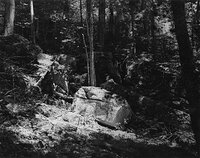
To answer the question posed originally in this thread, the finest grain I have ever been ..err.. exposed to, or is that... the finest grain that I ever exposed... is Ilford Technical Line Film. I got my hands on three boxes (150 sheets) of the stuff in 4x5in, and I really enjoy using it. I cannot conceive of anything finer-grained. I rate it at ISO 6 when I shoot it, and develop in diluted D76.

The grain is so fine, it is simply not visible through a very good grain focuser when I enlarge. Dynamic range is surprisingly good.

Reach_for_the_light_by_philosomatographer.jpg

(Ilford Technical Line Film, 4x5in, scanned 12x16in print)

This stuff, on a big print, is something else. It's like having Tech Pan in large format. I have never seen such acutance. Of course, few LF lenses resolve nearly enough to really justify this resolution, it's that extreme.
 
Last edited by a moderator:
Joined
Jan 21, 2003
Messages
15,715
Location
Switzerland
Format
Multi Format
For starters: try to google panchromatic, superpanchromatic, orthochromatic, orthopan and infrared....
Those film characteristics alone have an impact on the image / subject.
Next would be film speed, but I guess you were aware of that. Try shooting a smooth waterfall with long exposure on a bright, sunny summer day with ISO 400 or even 100. Unless you have a really dark ND filter with you, good luck exposing for several seconds. Pull processing won't help (enough) either.
You answered your own question - ND filters. And if you want orthochromatic film - go ahead and use it. I'm not saying it's wrong to use it. You can do a lot with filters to replicate that type of color rendition in panchromatic emulsions. Infrared - OK you win. It's still not difficult.

But, to get back to your questions:
I generally like smooth pictures with little visible grain, at least for my photography. Only in very few situations I like to have visible grain. That's why I got to use the combination of Acros + HRX3 so much. Produces very fine grain, yet a nice, sharp, crispy image.
Superpan (in RHS) on the other hand needs much longer processing. Way too long for me (and my patience/arms). In HRX3 it won't get a crisp as the Acros. I use HRX3 for TMY, too. Superpan, however, I only use when reverse processing.

So, you like as little grain as possible, while the picture is sharp and crispy. That's exactly what I get from Acros in replenished Xtol.


As an end note:
I am curious - why do you say that you don't believe in films being difficult (or good) in certain situations, when in the same sentence you exclude "specialty" and "document" films? To me, that's a contradiction and proves that films in fact have different characteristics. Document or "specialty" films, of course, are extremes. But why - in your logic - would different characteristics not exist for all other films then? Why would a single manufacturer produce various films with the same speed if they all can handle the same situations and even achieve the same look when processed longer/shorter (or agitated more/less often) like you suggest?
I use mainly two emulsions, Acros and TMY-2. They do everything I want them to do, and then some. I don't have to look elsewhere to get the results I want. I don't care about the plethora of films out there, because changing to a different emulsion doesn't make the pictures better for me. I have tried lots of films in the past, infrared from Kodak and Konica, Tri-X, FP4+, Ilford Delta 100/400/3200, TMax 100 and 400, Plus-X, Foma 100/200/400, HP5+, Pan-F+, Neopan 1600/400/Acros, ORWO, Efke 25/50/100, Agfa APX 100/400... I have pretty much tried most of them. But when I settled for one major emulsion, put on my blind-folds, and just learned how to treat that one emulsion, all of a sudden the quality of my work started going up, because I fully learned how to exploit that single emulsion to the maximum. I can handle night time shooting, extreme contrast, low contrast - any lighting situation by just changing how I expose and process the film, and yield negatives that print easily at Grade 2-3.5 with results that I am more than happy with. I don't even have to think about exposure and development. It is automatic. I can instead focus on the content, the light, expressions, composition, gesture... the important stuff. Film and developing film is just a means to an end, it's a tool. Put too many tools in the tool box, and you'll be thinking about the tools too much. That's my opinion.
The bottom line is that I don't need a film with specific characteristics to get me what I want and need. I get there with technique and a dollop of critical thinking about what's truly necessary.
The addition of one more emulsion to my line-up is so that I have a recourse if the other were to be discontinued; I'm covering my own rear end.

 

ath

Member
Allowing Ads
Joined
Aug 29, 2006
Messages
844
Location
Germany
Format
35mm
For some reason I get the feeling that Rolleijoe would be a great salesman for Rollei products.

+1.
Lots of statements and name dropping, no facts or details.
 

2F/2F

Member
Allowing Ads
Joined
Apr 29, 2008
Messages
8,031
Location
Los Angeles,
Format
Multi Format
To answer the question posed originally in this thread, the finest grain I have ever been ..err.. exposed to, or is that... the finest grain that I ever exposed... is Ilford Technical Line Film. I got my hands on three boxes (150 sheets) of the stuff in 4x5in, and I really enjoy using it. I cannot conceive of anything finer-grained. I rate it at ISO 6 when I shoot it, and develop in diluted D76.

The grain is so fine, it is simply not visible through a very good grain focuser when I enlarge. Dynamic range is surprisingly good.

Reach_for_the_light_by_philosomatographer.jpg

(Ilford Technical Line Film, 4x5in, scanned 12x16in print)

This stuff, on a big print, is something else. It's like having Tech Pan in large format. I have never seen such acutance. Of course, few LF lenses resolve nearly enough to really justify this resolution, it's that extreme.

Sounds akin to Rollei ATP (which is akin to Tech Pan). I didn't know Ilford still made anything like that.
 
Photrio.com contains affiliate links to products. We may receive a commission for purchases made through these links.
To read our full affiliate disclosure statement please click Here.

PHOTRIO PARTNERS EQUALLY FUNDING OUR COMMUNITY:


Ilford ADOX Freestyle Photographic Stearman Press Weldon Color Lab Blue Moon Camera & Machine
Top Bottom