
• Welcome to Photrio!
    Registration is fast and free. Join today to unlock search, see fewer ads, and access all forum features.
    Click here to sign up

IR Uses.

Recent Classifieds

Forum statistics

Threads
203,045
Messages
2,849,102
Members
101,620
Latest member
JasonGO
Recent bookmarks
0

Mearns

Member
Allowing Ads
Joined
Dec 30, 2007
Messages
38
Location
New Zealand
Format
Medium Format
This is what Kodak recommend for their IR film.

# Suggested applications:
* Advertising/illustration
* Aerial
* Corporate/industrial
* Fine art
* Landscape
* Law enforcement
* Medical/scientific
* Photo hobbyist
* Portraiture

Now I'm as unexperienced as they come when talking about IR photography but law enforcement? I've been doing some research on using IR as I'd like to give it a go and from what I've read:
• Its best done at daytime in bright light
• The focus isn't the same as the light is a different wave length
• Sometimes timely exposures are required
• Loading and unloading film needs to be done in complete darkness
• Exposure values are tricky (with special filters etc etc.)
So what I'm wondering is in what situation would IR film be used for law enforcement? What amazing benefit would it have that would out weigh the above mentioned complexities of using IR film???

Just curious, and if any one knows where I can see examples please do link!
 
Kodak has a book on the uses of IR and UV photography for all of the above. If I get a chance, I'll look it up. It is buried here somewhere but is quite interesting.

PE
 
Traffic cmaeras often use an enhanced IR film and an IR flash for traffic cameras. A regular flash would startle drivers. Never heard of Kodak IR being used for that, but it WAS available in 70mm, which is/was common for traffic cameras.

Similarly, it can show the difference between live and dead foliage, such as that used to hide illegal operations like illegal distilleries, drug processing centers, etc. Again, 70mm is a common size for aerial cameras as well.

I'm sure there are other such uses.
 
EIR was used for the aerial detection, but HIE was not as good at this. It was due to the intense color shift of the EIR which is not apparent on the EIR. Be patient with me and I'll try to find the book.

I remember some of the uses for UV and IR included seeing falsified documents and the hidden information and detecting information at crime scenes. Also filming security data at night in dark buildings.

This has all been taken over by digital except for the EIR.

PE
 
• Loading and unloading film needs to be done in complete darkness
• Exposure values are tricky (with special filters etc etc.)
So what I'm wondering is in what situation would IR film be used for law enforcement? What amazing benefit would it have that would out weigh the above mentioned complexities of using IR film???

Loading. Kodak HIE does not have an "anti-halation" backing, so IR tends to reflect and bounce around inside the camera (halation effect), usually causing a halo around light objects. It needs to be loaded in complete darkness, as any light can penetrate through the entire film. Other films, such as Efke 820c, were derived from traffic camera films, and have an anti-halation backing. They don't produce the "halo", on purpose, and can be loaded in subdued light since IR doesn't penetrate the backing very well.

Exposure. Exposure meters, built in or otherwise, are sensitive to visible light and generally do a lousy job telling you how much IR is there. You're back in the pre-meter days -- like 1930s or 1040s, and have to judge exposure yourself. You're even worse off, since your eyes don't register IR. For Kodak HIE with dark red or opaque IR filter, best to start with f11 @ 1/125 in outdoor sunlight and bracket as much as your budget will allow with this rather expensive film.

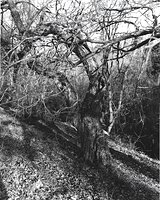
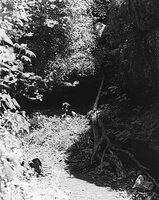
Examples. I have some posted here:

http://richam.smugmug.com/gallery/3014693#163670225

Most of the examples are with digital IR. The Gothic Church was Kodak HIE.

http://richam.smugmug.com/gallery/3166306#174085974

http://richam.smugmug.com/gallery/3302938#183557777

There is also an infrared community on smugmug with many examples:

http://www.smugmug.com/community/Infrared
 
More typical than detecting false foliage is the (attempt of) detection of forgery with inks and dyes, as in handwriting, stencils, paintings etc, the examination of burnt papers, but also in medical forensics.

Any kind of undetectable flash photography. The GDR secret service once built a huge infrared flash system by installing several strobe heads into a car door, covering them with perspex and spraying the new door surface with IR-transmitting paint.
 
The film is not that difficult to use, and remember that professional forensic photographers are -professional- and hopefully know what they are doing! :smile:
Michael


This is what Kodak recommend for their IR film.

# Suggested applications:
* Advertising/illustration
* Aerial
* Corporate/industrial
* Fine art
* Landscape
* Law enforcement
* Medical/scientific
* Photo hobbyist
* Portraiture

Now I'm as unexperienced as they come when talking about IR photography but law enforcement? I've been doing some research on using IR as I'd like to give it a go and from what I've read:
• Its best done at daytime in bright light
• The focus isn't the same as the light is a different wave length
• Sometimes timely exposures are required
• Loading and unloading film needs to be done in complete darkness
• Exposure values are tricky (with special filters etc etc.)
So what I'm wondering is in what situation would IR film be used for law enforcement? What amazing benefit would it have that would out weigh the above mentioned complexities of using IR film???

Just curious, and if any one knows where I can see examples please do link!
 
The film is not that difficult to use, and remember that professional forensic photographers are -professional- and hopefully know what they are doing!

Having worked as a forensic chemist with troopers doing the photography, I'm not going near that statement.

BUT, IR film can be used to find gunshot residue around a bullet hole in dark clothing. I only saw it done during my internship (those guys were good), but it did work ok. The reason to do it would be to see how far away from the target/victim the muzzle of a gun was. In the lab where I worked, we used paper sensitized with chemicals that would react with the residues, so we didn't try the IR.
IR can also be used in document exams, as mentioned. They have very cool gadgets for that now, though.
 
What is the IR-output of ordinary flashes? Maybe an IR-filter over the flash would work?

/matti
 
There were IR filters for the Metz 45 CT-series, and I think for several others including my Vivitar 265.
 
What is the IR-output of ordinary flashes? Maybe an IR-filter over the flash would work?

/matti

In my experience with HIE IR output of electronic flash is same as for sunlight. I've used Photogenics and I meter the flash as for sunlight, personally I used EI of ~80, dev in D76 stock at 20C for the Kodak standard time. A couple of studio pics are in my APUG gallery.
All history now of course since the film is discontinued.
 
Photrio.com contains affiliate links to products. We may receive a commission for purchases made through these links.
To read our full affiliate disclosure statement please click Here.

PHOTRIO PARTNERS EQUALLY FUNDING OUR COMMUNITY:


Ilford ADOX Freestyle Photographic Stearman Press Weldon Color Lab Blue Moon Camera & Machine
Top Bottom
