• Welcome to Photrio!
    Registration is fast and free. Join today to unlock search, see fewer ads, and access all forum features.
    Click here to sign up

IR filtration questions

Beach Girl-3

Beach Girl-3

  • 0
  • 0
  • 20
Bondi Beach Girl-2

Bondi Beach Girl-2

  • 0
  • 0
  • 19

Recent Classifieds

Forum statistics

Threads
202,473
Messages
2,841,259
Members
101,345
Latest member
amass_design
Recent bookmarks
0

Christopher Walrath

Member
Allowing Ads
Joined
Dec 30, 2005
Messages
7,175
Location
Milton, DE USA
Format
Analog
Wirelessly posted (BlackBerry9000/4.6.0.167 Profile/MIDP-2.0 Configuration/CLDC-1.1 VendorID/102 UP.Link/6.3.0.0.0)

Hi, all. I'm going to do some IR for the first time. Eveyone suggests an R72 filter. What is the filter factor for an R72?
 
Wirelessly posted (BlackBerry9000/4.6.0.167 Profile/MIDP-2.0 Configuration/CLDC-1.1 VendorID/102 UP.Link/6.3.0.0.0)

Bump.
 
Chris:

Your question about an appropriate filter factor for an R72 filter isn't as simple as it may seem.

The problem with filter factors, is that they are dependant on the film involved, and the spectrum of the light available.

I refer to two photos in my APUG gallery. Both were shot on the same roll of Rollie 400 on the same day using the same camera, lens and shutter. I used the same meter and metering technique. Naturally, they received the same development.

For the first, I adjusted the exposure by giving it an additional 7 stops:

(there was a url link here which no longer exists)

For the second, I adjusted the exposure by giving it an additional 5 stops:

(there was a url link here which no longer exists)

If you use a different film in the same light, you might need a different adjustment. If you use the same film under different light you again may need another adjustment.

I find bracketing to be critical.

Hope this helps.

Matt
 
So, basically, get some film, shoot it through my red filter, bracketing, and see what turns up. As I was actually planning.

Thanks for the confirmation. I guess I was naively hoping the IR fairy would come doink me on the head and say, 'HERE'S WHATCHA DO!'

Yeah, I knew better.
 
If you're trying IR for the first time you should bracket like crazy to find what works best for you. IR is not an exact science.
 
Kinda what I figured. Another question. Would a stronger filter than a Red with a FF of 4 produce more dramatic results? Not like I have one to try it on but I was just wondering as to general results from others who have used. (You know, in another context that might not sound so good.)
 
Best would be a 89 filter. They are completely black; thus there is no filter as both bright light and dim light would read on on your meter as no light at all.

Ive heard that it should be shot through such a filter at around ISO 3. But with some experimentation im sure you will create your own system/methodology.

Dont forget to keep a detailed log!
 
Depending on the film I am using, I meter for ISO 1.5-6 for filtrating with an R72 filter... 1.5 to really bring out the IR effects for Maco/Efke films, and 6 for Ilford SFX. These settings give me negatives that I can work with in the darkroom without too much fiddling around. As the anticipated effect is not to achieve "natural" tones, I tend not to do very much dodging or burning of my IR images.

Cheers,
 
Yeah. I think a roll of bracketing, maybe two, of different lighting situations and varying subjects is of the order.
 
As the others have said, the exposure index for an infrared film varies with the available light. Filter factors likewise vary. Think of it this way: the denser the filter, the more visible light you cut out. Infrared films are sensitive to some visible wavelengths as well as IR, so what you are removing is visible light. What remains to be discovered is just how sensitive to which wavelengths of IR your film is. Bracket like crazy.

Peter Gomena
 
"Bracket like crazy"

Can meaningful information be gained from bracketing? I mean if you note the EI of each shot (assuming you are bracketing EI's) can that successful EI become the standard EI for that film? Or is it relative to all the other variables such as brightness, time of day, position of the sun, Summer/Winter light, etc.

Seems to me each time you want to make an IR photo you could use 5 frames or sheets of film and only hope one works. Perhaps the more familiar you become with the film the fewer wasted frames there may be.
 
I think you need to become more familiar with different scenes.

The thing is that we do not have a meter to tell us how much IR there is in a scene, except the film we record the scene on.
So you need to take notes of the type of scene, lighting, and all that. But much of that will be recorded on film already :wink:
 
By "bracket like crazy", I mean make a wide range of exposures (say -2 to +2 stops) until you can figure out how the film responds to 1.) the filter and 2.) the amount of IR in an "average" daylight scene. After a couple of rolls or a few sheets, you should be able to reduce the size of the bracket. Take good notes and you will be able to better estimate your exposures under various conditions. It all varies by your latitude, time of day, and weather conditions. It always is a bit of a crapshoot with IR.

Peter Gomena
 
whatever you do dont get a #87, i use it with rollei ir400 and my factor i use (including reciprocity failure) is 20-stops...
 
Well, i plan on bracketing to start until I get used to what whichever film I choose will do with filtration, light quality and subject matter. As mentioned by Bruce, I do not intend to waste EXPENSIVE IR film on trial and error beyond the true 'I have no idea what I am going to get' phase.
 
whatever you do dont get a #87, i use it with rollei ir400 and my factor i use (including reciprocity failure) is 20-stops...

Then you didn't have the right light to begin with. I have shot many times with the Rollei/#87 combination and it was, at worst 14 stops, but more typically 11 or 12. Despite the longish exposures (typically a second or two but well clear of reciprocity issues), the results are very satisfying.
 
I rate Efke IR820 which is 100 ISO at ISO 3. So that is 5 stops. I often bracket a stop above and somtimes below. So as stated above, 6 to 1.5 ISO.

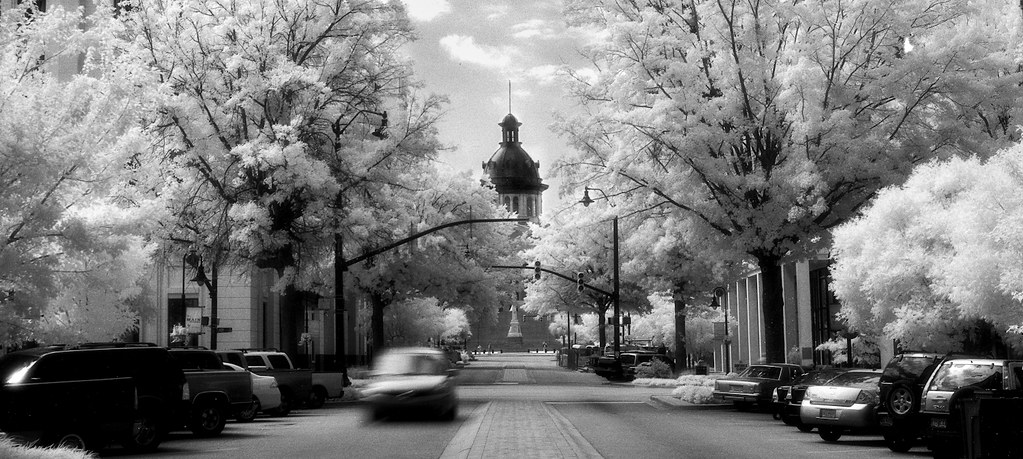
3757199430_7e35f96a9a_b.jpg
 
Well, i plan on bracketing to start until I get used to what whichever film I choose will do with filtration, light quality and subject matter. As mentioned by Bruce, I do not intend to waste EXPENSIVE IR film on trial and error beyond the true 'I have no idea what I am going to get' phase.

I don't disagree with you philosophically, but I think you'll find it's unexpectedly difficult to get a handle on the relationship between visible light and IR under a wide variety of circumstances. In particular, the three-way relationship between IR level, visible-light level, and time of day is maddeningly counterintuitive. (There's actually more IR at midday than at morning and evening, but there's even *more* more *visible* light, so you end up having to downrate your film when the amount of light goes up!)

Basically, your filter factor needs to vary inversely with the ratio of IR to visible light, which is not the easiest thing in the world to develop a good instinct for. I certainly haven't managed it yet.

-NT
 
http://www.digitaltruth.com/store/cart/Spectral-Instruments-IRM-750-Infrared-meter-p-1322.html

I have no idea if this even works but I thought I'd pass along the info

In principle it could work well but you'd need to meter through two filters: one to simulate the cutoff of the film, and the IR filter itself. Otherwise the meter will have too broad a range of sensitivity. Now, obviously metering through the IR filter is easy enough, but the other filter is a specialty item; I had to special order one and it also will never match the film cutoff exactly... and technically, we'd need a different cutoff filter for each different IR film, i.e. one for sfx, one for efke, one for rollei, one for HIE....

For example, just suppose the film's sensitivity cuts out at 800nm, and the filter becomes transmissive at 750nm. So then you really need to meter between 750 and 800. But the meter is probably sensitive over a much wider range of IR light, say 700-1200 nm, and perhaps further down into the visible also. So you'd need to narrow that broad range down or else the metering info will be way off.

Anyway even without the low end cutoff filter, it might be good enough to narrow down the bracket range a bit. Which could save $$$ in the long run.
 
Last edited by a moderator:
I rate Efke IR820 which is 100 ISO at ISO 3. So that is 5 stops. I often bracket a stop above and somtimes below. So as stated above, 6 to 1.5 ISO.

3757199430_7e35f96a9a_b.jpg

BTW, this was my first roll shot on 120 and I developed it Diafine. I rarely use Diafine, but in my opinion it is really nice with Efke IR820.

Jason
 
The starting point filter factor is 32x, requiring 5 extra stops. At first, shoot some to test, and bracket around using that filter factor. IMO, you should go ahead and start at 6 or 7 stops instead of five your first time, since Efke is tremendously contrasty, and only reaches its rated speed of 100 if developed in a speed-enhancing developer. The amount of IR present in each scene will actually determine the "proper" exposure. Try to do it in sunny 16 conditions for a roll, and also try some other conditions on another roll to see if you get anything. Also, try different hours on that "sunny 16" day. (Hint: in scenes low in IR, expect to have to give much more extra exposure.)

With the films available today: 1. You do not get a notable amount of IR exposure unless using an opaque filter, 2. you generally have to be on a tripod to get a sharp shot (assuming the f stops most often used on tripods), and 3. you almost certainly have to experiment to determine the reciprocity maintenance (or rather, the lack thereof) of your film during long exposures (again, assuming the f stops most commonly used on tripods).

Don't forget to refocus your shots after composing. This may not be as necessary with IR820 as it was with HIE, but I always use the red line and the shots look OK.

R72 (the 72 = 720 nM cutoff) is opaque only on films that do not respond to radiation (light) of 720 nM or more. Most films do not. SFX does, and IR films do.

 
Photrio.com contains affiliate links to products. We may receive a commission for purchases made through these links.
To read our full affiliate disclosure statement please click Here.

PHOTRIO PARTNERS EQUALLY FUNDING OUR COMMUNITY:


Ilford ADOX Freestyle Photographic Stearman Press Weldon Color Lab Blue Moon Camera & Machine
Top Bottom