• Welcome to Photrio!
    Registration is fast and free. Join today to unlock search, see fewer ads, and access all forum features.
    Click here to sign up

Interested in experimenting with non-traditional ortho/panchromatic sensitizers

Iriana

H
Iriana

  • 3
  • 0
  • 62
Puddle

Puddle

  • 4
  • 2
  • 101

Forum statistics

Threads
202,734
Messages
2,844,784
Members
101,489
Latest member
Sunnydoran
Recent bookmarks
0

stamasd

Member
Allowing Ads
Joined
Apr 10, 2023
Messages
25
Location
USA
Format
35mm
Hi, I'm new here. :smile:

I've had for a while an interest in the chemistry of color-sensitized emulsions, orthochromatic and panchromatic. I do have a background of biochemistry and a home lab, yet the processes of producing the required dyes is a bit daunting for my practical capabilities, and finding them off-the-shelf has been so far unproductive (except for some very simple ones such as erythrosine)

I have been going through quite a bit of literature including a large number of patents on google and various books.

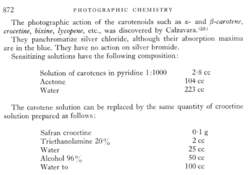
In the Glafkides book "Photographic Chemistry" I found a mention on pages 871-872 of the second volume, on using carotene as a panchromatic sensitizer for silver chloride. It also mentions that it only works for chloride, and has no action on bromide. There is a formula for a sensitizer bath, which is:

-1/1000 solution of carotene in pyridine....2.8ml
-acetone.......................................................................104ml
-water............................................................................223ml

and also a mention that the carotene solution can be replaced with the same volume of a 1/1000 solution of saffron crocetin in a mixture of triethanolamine, alcohol and water.

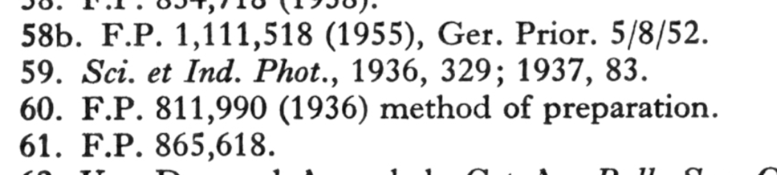
He gives a reference too, Calzavara: Sci et Ind Phot 1936, 329; 1937, 83. Despite my best efforts I was unable to find it. It may be accessible on JSTOR but I don't have access to that.

All my other searches everywhere else, including on this forum, have returned exactly zero results on the subject.

Thus, my question is: does anyone here have any more information on carotene as a sensitizer, or even more importantly has ever experimented with it? Any help appreciated.
 
Last edited:
He gives a reference too, Calvazara: Sci et Ind Phot 1936, 329; 1937, 83. Despite my best efforts I was unable to find it. It may be accessible on JSTOR but I don't have access to that.

Hello and welcome!

Can you clarify/expand that reference and give me the full name of the Journal?

I might be able to get copies of those publications through our reference desk.
 
That is all the reference I have. It's mentioned in the text of the book as ref (59) of that chapter, and ref 59 is exactly what I posted: Sci et Ind Phot 1936, 329; 1937, 83
Thanks with any help!

(I have the pdf of the book but it's big, 600MB so I can't post it here and I don't remember where I got it originally. It's this book: https://books.google.com/books/about/Photographic_Chemistry.html?id=auFTAAAAMAAJ )
I can maybe take screenshots of the paragraph and reference and post.
 

Attachments

  • carotene.png
    carotene.png
    166.5 KB · Views: 125
  • ref59.png
    ref59.png
    123.2 KB · Views: 125
There's a bunch of publications with essentially the same reference to "Sci. et Ind. Photo."; they seem to range from the 1920s up to about 1950. My guess is that it's the abbreviation of something like "Scientias et Industriae Photographiae" (but my Latin is so rusty you could crumble it between two fingers). I've made a few attempts to find more info on this journal, but it seems to have not made it to the online world. Most likely it merged (or split out) into one or several more modern journals on photographic research. A well-stocked physical library is your best bet.

Another route worth looking into is solar cell research. It seems that organic dye sensitization is a bit a thing in those circles and carotene specifically has been brought up once or twice as a possibility. I'd imagine there are publications that go into some of the obvious issues such as application of the compound and its stability, and other practical concerns. It's likely in my mind that such concerns are the reasons why modern film is apparently not sensitized with carotene. After all, given how plentiful and probably cheap to get/manufacture/purify it is, it would make sense to use it if not for some very distinct drawbacks lurking in the grass.

PS: welcome to Photrio, good luck with your research and please keep posting on it! It's very interesting indeed!
 
I have found some references to carotene and dye-sensitized solar cells. It seems that 2 issues with using it are the same as with many other dyes: not efficient enough, and poor long-term photostability. The latter wouldn't really matter much when used in a one-time-use silver halide emulsion, as opposed to a photovoltaic cell that is supposed to maintain performance over thousands of hours of light exposure.

(also as a general note: I cannot reply to private messages yet since I have just registered, and don't have enough posts)

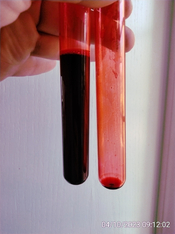
Also I just did a test conversion of fluorescein to erythrosine, seems to have worked. Impure of course, needs extra workup. Probably precipitation with an acid, extraction with an organic solvent, redissolution and column chromatography. I apologize for the bad color balance of the picture, this phone camera is absolute crap.
 

Attachments

  • erythro1.jpg
    erythro1.jpg
    227.5 KB · Views: 111
Last edited:
This is what I got back:

"This refers to the French journal “Science et industrie photographique.” The Library of Congress doesn’t have it, however, and WorldCat lists only a couple of libraries in France with holdings on the title."

Looks like you'll have to look in France...
 
Oh wow, thank you. In French, but I speak that fluently. :smile:
 
Also the second part of the reference is wrong. It should be: 1937,33 (not 83, probably a typo)
Attaching the 2 communiques as pdf files here for posterity. The second one mentions a further paper, still looking for that one.
 

Attachments

  • Calvazara-1936.pdf
    1.9 MB · Views: 125
Last edited:
And the second one. Grr I had to reduce quality to make it fit under the 2MB attachment limit.
Also, it looks like there never was a 3rd paper. I have reviewed a few years of that publication, the next paper by the same author was in July 1939 and it was on cyanine dyes. Looks like he abandoned the carotenes. And the journal ceased being published in December 1940.

He does state very clearly though the principal drawback of the carotenes: they only work for silver chloride, which is overall poorly sensitive and slow. They only fog silver bromide without making it panchromatic.
 

Attachments

  • Calvazara-1937a.pdf
    1 MB · Views: 138
Last edited:
Thanks for sharing this material with us! :smile:

they only work for silver chloride, which is overall poorly sensitive and slow.

Ahh, so there's the catch.

Btw, RA4 paper is relatively fast (for a paper) and it's still a silver chloride emulsion. The notion that silver chloride is necessarily limited to the kind of speeds we associate with e.g. printing-out papers is not accurate. However, how much trickery it takes to coax silver chloride into being faster, I'm not sure. Perhaps sulfur and gold sensitization already gets one going to a decent extent.

On the other hand, I can imagine it's just a whole lot more straightforward to look at other dyes instead so a more common (for film) bromide or bromide/iodide emulsion can be used.
 
True. From what I understand, the author of the papers was the director of research at a major chemical company of the time, thus he must have had access to the latest production methods and decided to switch to cyanines which were accessible to him and being actively developed at the time. I don't have that luxury and will have to take what I can get. :smile: Seems like a weird statement to make 90 years later with all the development that happened since but here we are. Cyanine dyes in this day and age of digital photography are more of a niche of a niche on the way out. Making them in my basement, even with the equipment I have is not trivial, and commercial sources for them are few and far between, not to mention very expensive. OTOH silver chloride/bromide/iodide I can easily deal with, as well as carotene/lycopene/crocetin (though the only sources for the latter ones at a reasonable i.e not-"food supplement" purity I have found are from England).
Weird that in those papers he stops at investigating only silver chloride and bromide papers, and I have not seen any mentions of testing with iodide. Perhaps an avenue of further experimentation.
 
Well, it looks like I can't get my hands on pure carotene either. My one last hope was for a source of it from the UK, but they replied to my inquiry saying that it's diluted with maltodextrin, like all other sources that I have found. I mean, I could attempt to purify it myself from that form but given that it's quite pricy, I was hoping I could avoid that. And at this point given that I'd have to go through an extraction/purification anyway, I may as well start with a less expensive source (carrots).
 
Photrio.com contains affiliate links to products. We may receive a commission for purchases made through these links.
To read our full affiliate disclosure statement please click Here.

PHOTRIO PARTNERS EQUALLY FUNDING OUR COMMUNITY:


Ilford ADOX Freestyle Photographic Stearman Press Weldon Color Lab Blue Moon Camera & Machine
Top Bottom