
• Welcome to Photrio!
    Registration is fast and free. Join today to unlock search, see fewer ads, and access all forum features.
    Click here to sign up

Immigrant photographer

Cool as Ice

A
Cool as Ice

  • 0
  • 1
  • 61

Recent Classifieds

Forum statistics

Threads
202,707
Messages
2,844,527
Members
101,481
Latest member
YYslides
Recent bookmarks
0

graute20

Member
Allowing Ads
Joined
Nov 2, 2023
Messages
4
Location
Sweden
Format
Digital
Hi!
Dont know if this is the right forum for this but..
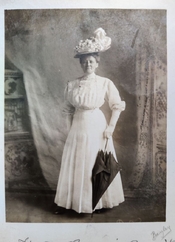
I have a picture of an relative who immigrated to US 1890 and is interested if it it possible to locate where the picture was taken.
Also interested if this type of photo is some kind of fake regarding to the expensive outfit ?
Photo is signed Bayley.

Regards Lars
 

Attachments

  • Lina.jpg
    Lina.jpg
    93.9 KB · Views: 138
Nice studio portrait but unless there is a photographers mark with location, which I assume there is not, the picture is devoid of anything that could indicate location. The better approach would be a genealogical exploration. The 1890 US census was destroyed but you can possibly find her in the 1900 or later censuses. Those are easily searched as they are fully indexed.
 
Nice studio portrait but unless there is a photographers mark with location, which I assume there is not, the picture is devoid of anything that could indicate location. The better approach would be a genealogical exploration. The 1890 US census was destroyed but you can possibly find her in the 1900 or later censuses. Those are easily searched as they are fully indexed.

Thanks. I thought Bayley was the photo studio (could be in Chicago) She traveled back alredy 1892.

/Lars
 
Last edited:
Hi!
Dont know if this is the right forum for this but..
I have a picture of an relative who immigrated to US 1890 and is interested if it it possible to locate where the picture was taken.
Also interested if this type of photo is some kind of fake regarding to the expensive outfit ?
Photo is signed Bayley.

Regards Lars

Welcome to Photrio!

Sometimes the background of studio photographs can give some information. I have late 19th century - early 20th century family studio portraits from eastern Europe and the US, and the background sometimes helps one determine which side of the Atlantic Ocean the photograph was taken.
 
FWIW there was a San Francisco portrait studio operated by W.F. Bayley during the period. The studio markings differ in the couple I spotted via Google but that does not mean much, as the studio may have changed its logo from time to time. It's a good place to dive in, if you want to explore.

In the US, this kind of print was called a "cabinet card." In France, a smaller format was used called a "carte de visite," or CDV. The CDV was a business card of its time, while the cabinet card was a portrait big enough to display on the shelf. It appears that the two terms are used interchangeably in online sources.

These cards were albumen prints and were the dominant form of photographic portraits from 1870 to 1905. One fun fact, from a photographic perspective, is that portrait studios would give out unfixed albumen prints as proofs. If the customer bought the prints, then the studio would make fixed copies. Otherwise, the unfixed albumen proof would fade. (Source: Chicago Albumen Works, Historical and Contemporary Notes, https://www.albumenworks.com/links/CAW_POP_Historical_Notes.pdf .)

Good luck.
 
One fun fact, from a photographic perspective, is that portrait studios would give out unfixed albumen prints as proofs. If the customer bought the prints, then the studio would make fixed copies. Otherwise, the unfixed albumen proof would fade. (Source: Chicago Albumen Works, Historical and Contemporary Notes, https://www.albumenworks.com/links/CAW_POP_Historical_Notes.pdf .)

Good luck.
Just out of curiosity, were the unfixed prints given to the the customer as "charged for" and then fixed for free if the customer decided to keep it or the money returned if the customer decided against keeping it?

Otherwise what's to stop the customer saying he doesn't want it at no charge and not returning it, then getting another processor to fix it for what I presume would be a much smaller charge?

Maybe such under-handed behaviour by the customer was unlikely in those days


Thanks

pentaxuser
 
Luminous Lint
Maybe there would be something helpful here, like finding a matching studio--although you would have to get a subscription.
 
Thanks for info and tip to Sirius, Rolleiflexible, Pentaxusers and Valerie. Pentaxusers (i have a Pentax ME super and had a K100D)
 
Otherwise what's to stop the customer saying he doesn't want it at no charge and not returning it, then getting another processor to fix it for what I presume would be a much smaller charge?

It’s a clever idea and I can only speculate. The cabinet cards ended their run in 1905 or so, coinciding with the rise of popular amateur photography powered by Eastman Kodak’s mass production of cameras, films and gelatin papers. My guess is that prior to 1905, most people had little knowledge of albumen papers, or fixers, or darkroom practices generally. But that is just my guess.
 
Studio Proof (printing-out paper) was made by Kodak into the 1990s, believe it or not. The portrait studio chain where I worked then still offered 'red proofs' on that paper if you had chosen a b&w portrait (all my sittings were on color neg film though). These were made simply by contact-printing the negative. The resulting image was deep red and would fade on extended exposure to light; they were used only for selecting poses and expressions from the different negatives of the sitting.
To make a permanent (and beautiful) print from that paper, first you need an extremely contrasty negative; then you must make the contact print darker than you like, then gold-tone it, fix, wash, and dry it. Far too complex a process for any cheater!
 
Last edited:
Studio Proof (printing-out paper) was made by Kodak into the 1980s, believe it or not. The portrait studio chain where I worked then still offered 'red proofs' on that paper if you had chosen a b&w portrait (all my sittings were on color neg film though). These were made simply by contact-printing the negative. The resulting image was deep red and would fade on extended exposure to light; they were used only for selecting poses and expressions from the different negatives of the sitting.
To make a permanent (and beautiful) print from that paper, first you need an extremely contrasty negative; then you must make the contact print darker than you like, then gold-tone it, fix, wash, and dry it. Far too complex a process for any cheater!

For our high school graduation pictures, we selected our choice from several of these reddish prints. This was in early ‘50s.
My great aunt was a very popular performer in later part of 19th and retired at end of WWI. Not only did she have visiting cards and photos for fans, but most likely because massed produced photographs were still a novelty, small prints were often included in cigarette packages.
 
Photrio.com contains affiliate links to products. We may receive a commission for purchases made through these links.
To read our full affiliate disclosure statement please click Here.

PHOTRIO PARTNERS EQUALLY FUNDING OUR COMMUNITY:


Ilford ADOX Freestyle Photographic Stearman Press Weldon Color Lab Blue Moon Camera & Machine
Top Bottom
