
• Welcome to Photrio!
    Registration is fast and free. Join today to unlock search, see fewer ads, and access all forum features.
    Click here to sign up

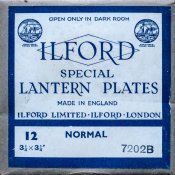
Ilford Special lantern Plates - date/sensitivity/whatnot ? Simon?

Lutheran Cemetery Angel

H
Lutheran Cemetery Angel

  • 0
  • 0
  • 28
Dystopia

A
Dystopia

  • 3
  • 1
  • 47

Recent Classifieds

Forum statistics

Threads
202,945
Messages
2,847,958
Members
101,550
Latest member
Paris-Belle
Recent bookmarks
0

pdeeh

Member
Allowing Ads
Joined
Jun 8, 2012
Messages
4,767
Location
UK
Format
Multi Format
I have box of historical goodies that I'd like to know a bit more about - mostly (very) old papers and plates from Kodak and Ilford.

As a first shot, how about this? I have a couple of dozen of packets of these particular ones, all unopened.

According to photomemorabilia.co.uk, the design of the Ilford "steamer" trademark dates these no later than 1945 and no earlier than 1930.

Any ideas if they are ortho or pan?

What does "NORMAL" mean?

Have we a guess as to what speed they would rate at (in modern ISO, I mean)?
 

Attachments

  • 20141007-1.jpg
    20141007-1.jpg
    244.7 KB · Views: 248
They are plates for contact printing (or using an enlarger) to produce B&W positives for projection. The processed plate would typically be bound up with a blank glass plate and black edge tape for protection. 3.25 x 3.25 inches is one of the old standard sizes for "lantern slide" projectors before the more modern 2 x 2 mounts.

Haven't time to Google for more info at present, but the emulsion would no doubt be similar to a plain blue-sensitive bromide paper emulsion, hence a very low ASA/ISO speed. "Normal" would be the contrast rating, as with printing paper....not "hard" or "soft".

I recall been given an ancient box of these as a school-boy and printing negs onto them with quite good results. With a bit of patient help from my Dad and a glass cutting tool, we made them into 2x2 slides to fit his projector !
 
Ah interesting, thank you ... I did google around but couldn't garner even that much info.

Hmm the sun's out. Time to see if I can find a way to put it in one of my pinhole cams.
 
Based on the labelling of some of the other old Ilford materials that I have collected, if your plates were othochromatic, the label would read "open in dull ruby light". On that basis, I would suggest your plates are panchromatic and should only be opened in total darkness. As for speed, they will be slow - Try ASA 6-10 as a starting point.

Side note: Talking to the guys at the last Ilford tour, I did ask if they could date plates from the batch number and was told to email the data over and they could pin down a date of manufacture. I might just put it to the test :tongue:
 
Were these ever reversal processed to get direct slides for projection?
 
I wouldn't suggest pinhole as a use for these, based on the age, you're talking an EI of about 0.25 based on age and decay of sensitivity. And that's probably being generous.

I've shot some 1947 roll film and that ended up being about an EI of 0.75

But a pinhole image at that ASA would be like 8 hours or more with reciprocity failure etc.

Good luck!
 
But a pinhole image at that ASA would be like 8 hours or more with reciprocity failure etc.

Good luck!

On the other hand, if the pinhole could be placed in some quiet spot, 8 hours or more could provide for some interesting result. Disappearance of people in an otherwise crowded spot could be one...
 
On the other hand, if the pinhole could be placed in some quiet spot, 8 hours or more could provide for some interesting result. Disappearance of people in an otherwise crowded spot could be one...

Not too public a place, you never know what might happen.

If I were you I'd use them as intended, enlarge negs onto them to make projectable slides, then EI won't matter...
 
I don't know about that. It's only 4 stops slower than I usually rate paper negatives, so with a "focal length" of 3 or 4 inches, it would only be about a 5 minute exposure in full sun. I definitely think it's worth a try.

They also might just fit over the film gate of a 116 camera. I can't measure right now because both of mine are loaded, but it would be close (the problem is that 3-1/4 might be just a tad too wide to fit in the camera). That would still make a nice size for contacts, but they would be smallish.
 
I don't know about that. It's only 4 stops slower than I usually rate paper negatives, so with a "focal length" of 3 or 4 inches, it would only be about a 5 minute exposure in full sun. I definitely think it's worth a try.

They also might just fit over the film gate of a 116 camera. I can't measure right now because both of mine are loaded, but it would be close (the problem is that 3-1/4 might be just a tad too wide to fit in the camera). That would still make a nice size for contacts, but they would be smallish.

You usually rate your paper negs at 4 ASA? And 5 minutes is enough? Hmm

This was done at 2 minutes, with 400 speed film, 400ish mm FL on 11x14 400 ASA

It was a significantly bright scene.

ImageUploadedByTapatalk1413198474.904850.jpg

This was ALSO 2 minutes, shooting toward the sun at 400ish mm FL (I can't remember offhand if it was 400 or 500 but I think it was about 475ish to be more accurate).

ImageUploadedByTapatalk1413198514.471351.jpg
 
It would be a shame if a thread about Ilford Lantern Plates became a debate about pinhole photography. It's not in the Pinhole forum for one thing.

I did exchange PMs with Simon Galley about this, but he wasn't able to offer any more information, and thought this type of slide went out of use well before WW2; however as we know from my other pack of plates, they were certainly being produced (or at least packed for use) as late as 1946. Although in that case we don't know the manufacturer as they are packed and marked as Admiralty (RN) issue.
 
Last edited by a moderator:
My box of Paget Slow Dry Lantern plates is H&D 2, that's way lower than 1 ISO, others sold by APM were 6 - 8 H&D, plates for cameras were in the 100 - 500 H&D speed.

H&D 500 is about 12 ISO, H&D speeds double/halve in stops/shutter speeds like ISO's.

Ian
 
The only table I've ever found that tries to relate H&D speeds to ISO is in Dunn & Wakefield, and theirs only goes down to H&D 320 = ISO 12
 
Based on the labelling of some of the other old Ilford materials that I have collected, if your plates were othochromatic, the label would read "open in dull ruby light". On that basis, I would suggest your plates are panchromatic and should only be opened in total darkness. As for speed, they will be slow - Try ASA 6-10 as a starting point.

No, definitely blue sensitive. As I said in my previous post, I used a box of these to make slides by contact printing from negs, as a schoolboy in the late 1960's. Speed maybe slightly faster than contact paper, orange safelight, usual paper developer. (Managed to find the box and slides since my last post, no date on the box, but still quite clean and fresh....I'd guess no earlier than the late 1950's, certainly not pre-war).
 
No, definitely blue sensitive. As I said in my previous post, I used a box of these to make slides by contact printing from negs, as a schoolboy in the late 1960's. Speed maybe slightly faster than contact paper, orange safelight, usual paper developer. (Managed to find the box and slides since my last post, no date on the box, but still quite clean and fresh....I'd guess no earlier than the late 1950's, certainly not pre-war).

Or eg enlarge on easier than reversal processing of in camera film or plates.
 
Photrio.com contains affiliate links to products. We may receive a commission for purchases made through these links.
To read our full affiliate disclosure statement please click Here.

PHOTRIO PARTNERS EQUALLY FUNDING OUR COMMUNITY:


Ilford ADOX Freestyle Photographic Stearman Press Weldon Color Lab Blue Moon Camera & Machine
Top Bottom