
Concerning 120 format films only, which one from ILFORD is the closest to Kodak PanX125??
-
Welcome to Photrio!Registration is fast and free. Join today to unlock search, see fewer ads, and access all forum features.Click here to sign up
You are using an out of date browser. It may not display this or other websites correctly.
You should upgrade or use an alternative browser.
You should upgrade or use an alternative browser.
Ilford closest to PanX125
-
A
- Thread starter tkamiya
- Start date


Recent Classifieds
-
For Sale Stark SST4 Rotation Film developing Processor
- Started by Jammoh
-
For Sale Hasselblad PM45 Prism finder
- Started by Jammoh
-
For Sale Hasselblad Sonnar CFE 180mm
- Started by Jammoh
-
For Sale Nikon D810 w RRS bracket, battery charger, 3 batteries. $800
- Started by ChrisK
Forum statistics
- Threads
- 203,248
- Messages
- 2,851,980
- Members
- 101,747
- Latest member
- Tallphotographer
- Recent bookmarks
- 0
Technologically wise, probably FP4 Plus. However, from what I've read Kodak Plus-X has a distinctive look. As much as I'd like you to reduce the British budget deficit, are there problems getting hold of the Kodak film?
Tom
Tom
Locally.... yes. I don't know of anyone who carries Plus X and I need some for this weekend. I'm usually better prepared than this... honest....
Locally.... yes. I don't know of anyone who carries Plus X and I need some for this weekend. I'm usually better prepared than this... honest....
Understood. Buying film locally can get expensive. 3.15 v 2.59 GBP inc tax for a roll of FP4 Plus '120' in my case.
Tom

- Joined
- Mar 6, 2005
- Messages
- 2,261
- Format
- Large Format
Concerning 120 format films only, which one from ILFORD is the closest to Kodak PanX125??
Kodak did not make a film named "PanX 125".
They made Panatomic X, shortened to PanX, with a film speed of 25.
PlusX 125 is a totally different animal.

Pan-X equivalent Pan F
Plus-X equivalent FP4+
Ian
Plus-X equivalent FP4+
Ian
mike c
Subscriber
Is FP4+ a modern sliced grain film or the older style emulsion like plus x ?

Is FP4+ a modern sliced grain film or the older style emulsion like plus x ?
FP4+ is an older style emulsion. Delta 100 is the newer style.
mike c
Subscriber
Thankyou papagene

Thomas Bertilsson
Member
If you mean Plus-X, FP4+ is the natural answer. As you can see in the attached file, their spectral sensitivity (response to various wavelengths of the visible light spectrum) is about the same, but the Kodak film is more sensitive toward the low end of the spectrum which will yield a different look with more density in the negative at those wavelengths.
Their characteristic curves are largely the same shape, but the Plus-X reaches higher density on the straight line, which means that film has a bit better highlight separation - at least with the developers chosen as the tests were made (D76 for Kodak and Ilfotec HC for Ilford).
The Kodak charts are on top and the Ilford is on the bottom.
Their characteristic curves are largely the same shape, but the Plus-X reaches higher density on the straight line, which means that film has a bit better highlight separation - at least with the developers chosen as the tests were made (D76 for Kodak and Ilfotec HC for Ilford).
The Kodak charts are on top and the Ilford is on the bottom.
Attachments
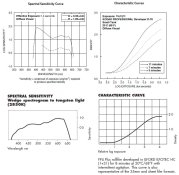

Thomas, the spectral sensitivity chart provided for FP4+ was made with exposure to 2850°K tungsten light, not daylight, as opposed to the one for Plus-X. The charts would be very similar if both were based on daylight (5500°K). That said, both films are sensitive to practically the same range of wavelengths.
You must mean Plus X, not Pan X, because Pan X was slower than 125 speed.
The answer is: Ilford FP4, which also has a 125 ISO speed.
The answer is: Ilford FP4, which also has a 125 ISO speed.
Yes, Plus-X. I keep calling it Pan-X. I don't know why. Thanks everybody!
mike c
Subscriber
T-grain emulsion,that's what I was trying to say.:confused:FP4+ is an older style emulsion. Delta 100 is the newer style.
I miss Panatomic-X, aka PanX.
Nothing else was like it including PanF. Panatomic-X held shadow detail, at least the way I used it, better than PanF.
~Steve Sloan
Nothing else was like it including PanF. Panatomic-X held shadow detail, at least the way I used it, better than PanF.
~Steve Sloan

FP-4 Plus isn't the same as Plus-X... but it's similar. In many ways I like it better.
Somehow I still manage to buy a few rolls of Plus-X occasionally, so I must like something about it too, but I shoot a lot of FP-4 Plus.
Somehow I still manage to buy a few rolls of Plus-X occasionally, so I must like something about it too, but I shoot a lot of FP-4 Plus.
Thomas Bertilsson
Member
Thanks for the correction.
It is amazing how similar the two films are. I have shot scenes that are similar with both of them, and I can't really tell a difference between the two in prints. In my mind, they are interchangeable.
It is amazing how similar the two films are. I have shot scenes that are similar with both of them, and I can't really tell a difference between the two in prints. In my mind, they are interchangeable.
Thomas, the spectral sensitivity chart provided for FP4+ was made with exposure to 2850°K tungsten light, not daylight, as opposed to the one for Plus-X. The charts would be very similar if both were based on daylight (5500°K). That said, both films are sensitive to practically the same range of wavelengths.

DWThomas
Subscriber
Thomas, the spectral sensitivity chart provided for FP4+ was made with exposure to 2850°K tungsten light, not daylight, as opposed to the one for Plus-X. The charts would be very similar if both were based on daylight (5500°K). That said, both films are sensitive to practically the same range of wavelengths.
Curious -- I guess it's a question of the actual method, but it seems to me the sensitivity at a given wavelength should be the same regardless of the source; or are these plotted responses only relative to a "white" light input?
Curious -- I guess it's a question of the actual method, but it seems to me the sensitivity at a given wavelength should be the same regardless of the source; or are these plotted responses only relative to a "white" light input?
The spectral sensitivity curve you'll get, depends on the temperature of the light you'll use. Have a look here, at the 2nd paragraph on page 211.
Last edited by a moderator:
DWThomas
Subscriber
The spectral sensitivity curve you'll get, depends on the temperature of the light you'll use. Have a look here, at the 2nd paragraph on page 211.
Hmmm -- the content appears to blocked here, but I can't read what the (Greek?) message says. Anyway, I believe we're saying a beam of white light is projected through a prism onto the film and the results recorded, but the results at any wavelength are not calibrated against the intensity of that specific wavelength (which I admit would probably be difficult and tedious) but merely against the white light intensity, which can vary in spectral distribution. The key, I suppose, being "wedge spectrogram" defines the method used to those who know about it.
I've had some nice results with Plus-X and have been intending to try some FP4+ one of these days, if naught else than to avoid panic if Plus-X disappears.
OK, I'll go away now . . .

Hmmm -- the content appears to blocked here, ...
Blocked eh? Anyway, what the text basically says that the curve of the shape depends on the temperature of the light. With tungsten 2850°K light, you'll have a bump at the red end of the spectrum. Using daylight on the other hand, will shift that bump to the blue end.
FP4+.

Plus-X = FP4
Any difference in results is probably up to YOU.
Parting Shot: Panatomic-X was wonderful, and obsolete, and replaced for good reason almost 30 years ago by TMX.
In practical shooting, TMY2 can out perform it today.
Tempus fugit.
.
Any difference in results is probably up to YOU.
Parting Shot: Panatomic-X was wonderful, and obsolete, and replaced for good reason almost 30 years ago by TMX.
In practical shooting, TMY2 can out perform it today.
Tempus fugit.
.
| Photrio.com contains affiliate links to products. We may receive a commission for purchases made through these links. To read our full affiliate disclosure statement please click Here. |
PHOTRIO PARTNERS EQUALLY FUNDING OUR COMMUNITY:  |