- Joined
- Jul 5, 2010
- Messages
- 212
- Format
- 35mm
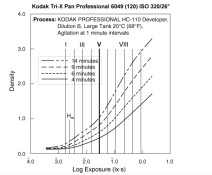
I've been re-reading through some theory and technicalities, and as far as I understand, metering and exposing for an 18% grey card (or using incident meter) will put that zone V at 0.7 density, assuming box speed and normal development time, right?
Now, looking at the data shets of tmax, trix and delta 400, that's roughly just about 2 or 3 stops from the toe. On the other hand, there are at lest 6 stops still available above zone V, which makes no sense for most subjects.
Using a spotmeter, one can of course measure for the shadows and put those in say zone IV (as actually suggested by Bruce Burnbaum on youtube), which would move Zone V to at least Zone VI.
But essentially it seems to me these modern films have so much dynamic range, one could (or should even!) shoot them at ISO 100 and simply measure the light with incident light meter/grey card, and for 80-90% of the scenes the negative will be just fine. On the other hand, shooting at box speed using that method will always lose some shadow details.
Am I correct or did I miss something?
Now, looking at the data shets of tmax, trix and delta 400, that's roughly just about 2 or 3 stops from the toe. On the other hand, there are at lest 6 stops still available above zone V, which makes no sense for most subjects.
Using a spotmeter, one can of course measure for the shadows and put those in say zone IV (as actually suggested by Bruce Burnbaum on youtube), which would move Zone V to at least Zone VI.
But essentially it seems to me these modern films have so much dynamic range, one could (or should even!) shoot them at ISO 100 and simply measure the light with incident light meter/grey card, and for 80-90% of the scenes the negative will be just fine. On the other hand, shooting at box speed using that method will always lose some shadow details.
Am I correct or did I miss something?