• Welcome to Photrio!
    Registration is fast and free. Join today to unlock search, see fewer ads, and access all forum features.
    Click here to sign up

I want to step-up my printing: should I start with fiber paper

Recent Classifieds

Forum statistics

Threads
202,023
Messages
2,833,925
Members
101,075
Latest member
Pouyadidar
Recent bookmarks
0

msbarnes

Member
Allowing Ads
Joined
Jul 23, 2011
Messages
384
Format
Multi Format
I've been shooting/printing for almost 2 years...mostly shooting and scanning (sorry if this is offensive) but printing my favorite images onto RC paper. I look at my prints and honestly, they aren't the best, and I feel that I'm cheating my negatives.

In the new year I hope to begin taking printing more seriously.

Well, I need to order paper and I'm going to order RC for contacts and I think Fiber paper for prints. I'm aware that fiber is more difficult to work with because the dmax is not reached until it is dry and it takes longer to wash. But I'm also willing to put more time into it because I think the results and quality of the paper will be superior. I'm not sure about the advantages of the tonality and archiveability but one thing that I like about fiber paper is that it feels/looks like actual paper. That alone is worthwhile.

I'm sure I can read "the print" by ansel adams or other sources to really step up my printing skills but a few quick questions ( I think these are quick).

-How do I select my paper? Any "recommended" papers/brands? I'm browsing through freestyle and I'm a bit lost. Are there any benefits for going graded?
 
Last edited by a moderator:

blackmelas

Member
Allowing Ads
Joined
Aug 25, 2004
Messages
374
Location
Greece
Format
35mm RF
Perhaps start with something you are familiar with-- if you are using Ilford MG RC, then move to a fiber based equivalent, Ilford MG FB for instance. Then you can branch out and start experimenting from there more exotic papers, if you like. For me its the feel of the paper, its weight and texture, that drew me to fiber versus plastic, but its not only the feel because you can actually see a qualitative difference too.
James
 
Last edited by a moderator:

David Allen

Member
Allowing Ads
Joined
Nov 6, 2008
Messages
991
Location
Berlin
Format
Med. Format RF
The key to developing your printing skills is to pin down a series of variables that include films speed, film development, etc so that you are not trying to get a good print from a bad negative. To achieve this you can look at my previous post here:

(there was a url link here which no longer exists)

I would recommend that you start with Multigrade paper as this gives you the option of varying the contrast of the print to match the way you like your prints to look. Generally, the main mistakes people make when learning to make fine prints are:
  • 'Pulling' the print from the developer too soon - this is where you remove the print from the developer before it has fully developed because it is going too dark because you have over-exposed the print.
  • As above, not developing for long enough. You should standardise on a fixed development time (I find that, for most fibre papers the ideal time is in the 2.5 - 3.5 minutes range) and keep to it.
  • Jumping around using different papers. Any of the papers available today will give good results - the key is to pick one brand and stick with it so that you can really learn how to use the paper most effectively (i.e standardise on one paper and, once you can consistently achieve acceptable results, then ask on this forum about other papers' characteristics by saying what you like and dislike about the paper you have been using)
  • Assessing test prints when they are wet - different papers have different 'dry down' factors (the difference between how the dark tones and highlights appear when wet and once dry) and the only way to correctly judge the correct exposure is to dry the tests. For this I bought a cheap second-hand microwave that dries the prints in one minute.
  • Significantly exceeding the manufacturers' maximum capacity recommendations for the chemicals that you are using. Fresh chemicals give the most consistent results. Where cost is an issue, you can make up your own developer and fixer from raw chemicals at a fraction of the cost of buying ready mixed solutions. It really is easy to do.

Hope that helps,

David
www.dsallen.de
 

phelger

Member
Allowing Ads
Joined
Nov 17, 2006
Messages
110
Location
Luxembourg
Format
Multi Format
RC vs FB is a never-ending discussion, everybody has his own favorite. Talking facts : Dmax is the same if you compare Ilford MG RC and FB (neutral tone). There is an optical difference between glossy and satin - glossy appears darker. As to paper thickness, there is Ilford RC portfolio, same weight as FB. FB is difficult to straighten when it dryes up, the curling can be a real problem. And the whole process is considerably longer with FB than with RC.

For the moment I'm with RC in all formats and sizes, from 5 x 7 to 12 x 16. I prefer the pearl surface. The speed and ease of processing is important to me.
whatever you do I wish you good luck and pleasure with your printing.
Peter
 

blackmelas

Member
Allowing Ads
Joined
Aug 25, 2004
Messages
374
Location
Greece
Format
35mm RF
Peter is right that FB takes longer and will never, unless mounted, be as flat as RC. But its not too difficult to flatten the prints-- there's a lot online about flattening them in a drymount, but without one, there are other methods that work well enough. Sandwiching newly dried prints in museum board under weight, or placing them in a book (probably not archival practice), or weighted in album sleeves. Part of working with organic material is living with minor imperfections, and seeing the imperfections as a positive aesthetic choice.
James
 

polyglot

Member
Allowing Ads
Joined
Jun 12, 2009
Messages
3,467
Location
South Australia
Format
Medium Format
IMHO no. FB is nicer in some ways but its use will not improve your skills at interpreting a negative. Your skills make an order of magnitude more difference than the subtle differences in paper.

The only exception is that papers that tone well are often FB so if you want to get into toning, you have some brand research to do and will probably need to buy some FB paper and deal with its processing (washing/flattening) drawbacks.
 

Rafal Lukawiecki

Member
Allowing Ads
Joined
Feb 23, 2006
Messages
789
Location
Wicklow, Ireland
Format
Multi Format
I'm aware that fiber is more difficult to work with because the dmax is not reached until it is dry and it takes longer to wash. But I'm also willing to put more time into it because I think the results and quality of the paper will be superior.

Msbarnes, you got great advice from others here. With regards to your comment about DMax, you may find, however, that it depends on the paper. With the papers that I have used, primarily Ilford MGIV FB and MGIV WT FB, highlights dry darker, but the shadows tend to dry a little lighter than when wet, so rather than reaching wet DMax, print seems to depart from it. I have, however, heard of papers that showed darkening of shadows, I just don't share that experience.

I second David Allen's recommendation to dry a test print in a microwave, especially when you think you are nearly there with the print, just to check against the dry-down. In time, you may find it more intuitive, but it is a great way to prevent a disappointment in the morning after a long printing session. Dry-down is also affected by the method of drying the print: heat or cold, natural, or stretched, and by toning.

If I may add a couple of personal observations, I would say that you should also investigate the use of a selenium toner, if DMax, or deep shadows, are important to you. Selenium can overcome some dry down limitations. Also, it is worthwhile thinking about your presentation style. If you can dry mount it, fibre will look just glorious.

Do consider reading that copy of "The Print" that you have already mentioned.
 

markbarendt

Member
Allowing Ads
Joined
May 18, 2008
Messages
9,422
Location
Beaverton, OR
Format
Multi Format
The biggest thing I've found to improve the quality of my prints has simply been practice.

The choice of paper can modify the look some, as can playing with developers, as can toners, and bleaches... but all require practice to be used effectively.

One thing that really helped me was having a fresh consistent paper to work with. It simply allowed me to rule out the paper as a problem. I used Adorama's house brand RC VC for this but I'm sure many other papers would work just fine.

Once I "got it" with that paper I actually "got it" with the rest too.
 

Jonathan R

Member
Allowing Ads
Joined
Jan 3, 2008
Messages
86
Location
UK
Format
35mm RF
The only thing I would add to David Allen's wise words is what Ansel Adams advises: always finish and dry all your test prints (including stepwise exposures), and study them carefully in daylight.
 
Joined
Jan 21, 2003
Messages
15,715
Location
Switzerland
Format
Multi Format
To OP: Don't be afraid of what seems like difficult work regarding David Allen's advice. If you really want the best out of your paper of choice, RC or Fiber based, you have to get the film exposed and developed such that it suits the paper.

If you really want to step up your printing, then going to fiber might help you a little bit as far as tonality goes, and personal satisfaction. But if you really want your prints to be better, then it IS a lot about the steps preceding the printing stage that will make a big difference.

Of course you can also become a better printer, and that is all about looking critically at your results and figuring out how to apply the light. But the magic of a negative that is tuned to your paper and paper developer will be a LOT easier to print, giving you an additional magnitude of control over the final result.

Have fun, look critically at your prints, and work hard.


The key to developing your printing skills is to pin down a series of variables that include films speed, film development, etc so that you are not trying to get a good print from a bad negative. To achieve this you can look at my previous post here:

(there was a url link here which no longer exists)

I would recommend that you start with Multigrade paper as this gives you the option of varying the contrast of the print to match the way you like your prints to look. Generally, the main mistakes people make when learning to make fine prints are:
  • 'Pulling' the print from the developer too soon - this is where you remove the print from the developer before it has fully developed because it is going too dark because you have over-exposed the print.
  • As above, not developing for long enough. You should standardise on a fixed development time (I find that, for most fibre papers the ideal time is in the 2.5 - 3.5 minutes range) and keep to it.
  • Jumping around using different papers. Any of the papers available today will give good results - the key is to pick one brand and stick with it so that you can really learn how to use the paper most effectively (i.e standardise on one paper and, once you can consistently achieve acceptable results, then ask on this forum about other papers' characteristics by saying what you like and dislike about the paper you have been using)
  • Assessing test prints when they are wet - different papers have different 'dry down' factors (the difference between how the dark tones and highlights appear when wet and once dry) and the only way to correctly judge the correct exposure is to dry the tests. For this I bought a cheap second-hand microwave that dries the prints in one minute.
  • Significantly exceeding the manufacturers' maximum capacity recommendations for the chemicals that you are using. Fresh chemicals give the most consistent results. Where cost is an issue, you can make up your own developer and fixer from raw chemicals at a fraction of the cost of buying ready mixed solutions. It really is easy to do.

Hope that helps,

David
www.dsallen.de
 

tkamiya

Member
Allowing Ads
Joined
Oct 3, 2009
Messages
4,284
Location
Central Flor
Format
Multi Format
Fiber printing is not any more difficult, really. It does take some care but mostly, it takes more time.

One must transport wet paper carefully from a tray to the next. If you grab carelessly, you can dent, crease, or otherwise damage the paper. These damages do not flatten out when dry.

It takes time because it dries slowly. You *can* quick dry them with microwave ovens and hair dryers but they still change a bit when completely dry the next day. So evaluating contrast and density takes much more time than RC.

When printing fiber, I typically print just one image per session. Then quick dry them and get it close to what I want. Then print 2 to 3 varying density and contrast by just a little. At this point, I'll process them fully by giving it a complete wash, etc, then let dry til the next day.

At that point, I make the final decision to either accept one of them as a final print or make further adjustment.

It's worth my time but I do not do this if I am in a hurry. It takes time to do it correctly.
 

kevs

Member
Allowing Ads
Joined
Aug 21, 2006
Messages
711
Location
North of Pangolin
Format
Multi Format
I've been shooting/printing for almost 2 years...mostly shooting and scanning (sorry if this is offensive) but printing my favorite images onto RC paper. I look at my prints and honestly, they aren't the best, and I feel that I'm cheating my negatives.

In the new year I hope to begin taking printing more seriously.

Well, I need to order paper and I'm going to order RC for contacts and I think Fiber paper for prints. I'm aware that fiber is more difficult to work with because the dmax is not reached until it is dry and it takes longer to wash. But I'm also willing to put more time into it because I think the results and quality of the paper will be superior. I'm not sure about the advantages of the tonality and archiveability but one thing that I like about fiber paper is that it feels/looks like actual paper. That alone is worthwhile.

I'm sure I can read "the print" by ansel adams or other sources to really step up my printing skills but a few quick questions ( I think these are quick).

-How do I select my paper? Any "recommended" papers/brands? I'm browsing through freestyle and I'm a bit lost. Are there any benefits for going graded?

I won't repeat the excellent advice others have posted, though I'll second the recommendations of starting with Ilford MGIV FB, as this is the same emulsion as the RC version which you will expose and control the contrast the same way. Dmax *is* reached before drying, but you'll notice that dry FB prints will look less contrasty and about 10% darker than wet ones - this is called 'dry down' and is caused by the gelatin drying. Dead matt papers dry down the most - glossy the least.

Graded papers another learning curve, but well worthwhile investigating. You need to match the negative to the paper contrast. Graded papers mostly tone more effectively than VC papers in selenium and have differences in tonal rendering etc. They're also in my experience less forgiving of sloppy workmanship. Ilford Gallerie is a very nice paper and it tones like a dream. I'd recommend that you stick with VC papers until you feel your printing has reached a high standard. Graded papers won't magically improve your results.

Before you rush out and buy FB paper, I suggest you try and get the best out of your current RC paper. See if you can find out why you find your prints are lacking - RC papers *are* capable of wide tonal range and deep blacks, and taking shortcuts will compromise your results. Any shortcuts you might use with RC prints (skipping stop bath, pulling prints, underfixing, underwashing etc) will cause real problems with FB and will result in poor print longevity, staining, poor Dmax and other faults. Once you can achieve fantastic results with RC papers, the move to FB will be much less of a learning curve. FB papers aren't a magical solution, so take your time, prepare to slow down and culture patience in the darkroom and you'll be fine - it's an interesting journey.

Cheers,
kevs
 
Last edited by a moderator:

Rafal Lukawiecki

Member
Allowing Ads
Joined
Feb 23, 2006
Messages
789
Location
Wicklow, Ireland
Format
Multi Format
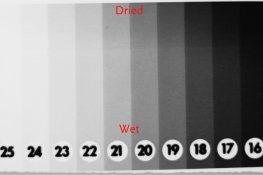
Effect of Dry-down in Highlights, Midtones & Shadows on Fibre Paper

Dmax *is* reached before drying, but you'll notice that dry FB prints will look less contrasty and about 10% darker than wet ones - this is called 'dry down' and is caused by the gelatin drying.

I agree with Kevs that dry-down will reduce the contrast of the print. If you use Ilford MGIV FB, or many other current papers, most, but not all of the print will dry darker, and the percentage difference will vary depending on the tone in question. I found that the highlights and midtones will be darker, in terms of reflection density, by about 0.02–0.04 logD. For a very delicate highlight, say of 0.05 logD, as a percentage, this would represent 40-100% difference. The 0.02 difference on a midtone, of perhaps density 0.60, represents only about a 3% difference.

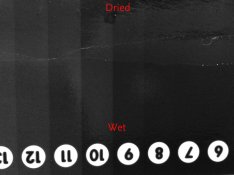
You will find, however, that deep shadows will actually dry lighter, and not darker—by about 0.02 logD, too.

Here is a couple of examples I just did this afternoon, on a previously processed, and fully dried sheet of Ilford MGIV FB WT. I inserted it, part way, into a bath of water for 15 minutes, then I took it out, squeegeed, and snapped with a digital camera, so that you could see the difference between the wet and the dried part. First, let's look at highlights and midtones, focus on the dividing line between the dry and the wet area:

Highlight-and-Midtone-Dry-down-Ilford-MGIV-WT-FB-Rafal.jpg

As you can see, the difference on steps 24–17 is small, but very clearly visible, and would be far more striking in a real picture, than on a step-wedge. This is the key aspect of dry-down that most of us will try solving. Notice, that around step 16 the difference becomes less visible. Now, if we look at the effect on deep shadows, the opposite happens! Deep shadows dry lighter than when wet. Starting at about step 13, the difference should be visible, however not many people care about deepest shadows or dMax, so this aspect of dry-down is usually ignored, but it contributes to the overall loss of contrast. By the way, I had to increase the overall exposure on this photo to make it clearer, limitations of my digital camera, hope you can see through the glare:

Shadow-Dry-down-Ilford-MGIV-WT-FB-Rafal.jpg

As long as you aware of it, you will be able to handle it with ease. The best way is to dry a print, then assess, as others have wisely recommended.

Next to that, you could reduce the base exposure by 4-8%, after you established what yields a good looking print, while it is slightly moist—it is always better to squeegee it first, and to let it rest for a few seconds, to avoid the major glare. Make sure you are using a realistic amount of light when previewing your prints, not too much, and not CFL, preferably not halogen, or anything with too much UV. This exposure reduction solves the problem of muddy highlights, however, this technique does not compensate for the slight loss of contrast. In fact, blindly reducing exposure by 4, 8, or 10% will often lighten the deep dark accent shadows even further, and so it contributes to another loss of contrast, and that sparkle is about to vanish... Selenium toning will help overcome some of that, as it will darken midtones a bit, and shadows a lot, as much as 0.20 logD with this paper. Alternatively, you could just increase the final contrast, using your filter settings—but watch out, as increasing contrast using speed-matched filters (or heads) will also make the highlights a little lighter, so it may not be necessary to reduce the base exposure as much, or not at all, in that case.

Sorry about the awful quality of the photos in my post.
 
Last edited by a moderator:

Neal

Subscriber
Allowing Ads
Joined
Dec 3, 2004
Messages
2,030
Location
Chicago, West Suburbs
Format
Multi Format
Hi msbarnes,

"I want to step-up my printing: should I start with fiber paper?"

In a word, no. You should be able to make really good prints with RC paper. At a company I worked for many years ago we would receive product prints on B&W RC paper from the advertising agency we used. They never failed to impress me. Of course there is no reason not to try fiber based paper. I'm kind of surprised that you haven't yet.

There is a thread somewhere about recommended printing books. There should be lots available cheaply on the used market. If you are anywhere near the Chicago area, there is a Dead Link Removed that has open printing sessions with the members.

Good luck,

Neal Wydra
 
Photrio.com contains affiliate links to products. We may receive a commission for purchases made through these links.
To read our full affiliate disclosure statement please click Here.

PHOTRIO PARTNERS EQUALLY FUNDING OUR COMMUNITY:


Ilford ADOX Freestyle Photographic Stearman Press Weldon Color Lab Blue Moon Camera & Machine
Top Bottom