• Welcome to Photrio!
    Registration is fast and free. Join today to unlock search, see fewer ads, and access all forum features.
    Click here to sign up

I loathe spotting prints.

Somewhere...

D
Somewhere...

  • 2
  • 1
  • 42
Iriana

H
Iriana

  • 5
  • 1
  • 91

Forum statistics

Threads
202,735
Messages
2,844,845
Members
101,492
Latest member
code0312
Recent bookmarks
2

f/stopblues

Member
Allowing Ads
Joined
Oct 6, 2005
Messages
214
Location
Midwest
Format
Multi Format
It seems inevitable no matter how careful I am about dust.. there's always a reason to have to get the itty bitty brush and ink out. In fact, I'm taking a break from doing it to a 20x20" print right now. I hate it. I'm not good at it. There's a particularly large white blob that I wish I could take a sharpie to. The frame is sitting eagerly to the side, just waiting to be complete. I'm feeling some pressure because I need to mail it out by Friday. Sigh.

I'm just ranting.. nothing to see here. Carry on :smile:
 
Yeah..

I have a 45V-XL just waiting for a light source so I can put it in the darkroom. Definitely staying away from a condenser.
 
Not doing so bad with dust at the moment, cold light head. But I am going to hire out my spotting, especially when I get higher volume going.
 
I learned from one of the best. It's definitely an art within itself to emulate the grain structure with the proper density. A lot of factors have to be considered such as the brush, ink, dilution, paper base tint, etc. I found myself oddly enjoying spotting and thus, became very good at it and spent many hours doing it. It's one of the few things in photography I know I can do very well :laugh:...not trying to rub it in or anything.
 
I've NEVER been able to get a single one done right. I just remake the print. I'm fastidious enough that I usually don't have dust but... when I do, all I've ever been able to do is get a darker ring around the spot. The spot pens are the worst in this regard. All they've ever done for me is make the spot look worse. I thought it was because they didn't work well on RC paper until I went to FB and found that works no better.

I think this is something I'd just have to have personal instruction in and watch someone do. I've been trying off and on (between just giving up and re-making my prints, and of course not for the decade off from photography) since the late 70s and if I haven't managed it yet...

It's impossible. Some people only manage because they don't realize it's impossible, so they manage to succeed. :tongue:
 
Hehe, I guess I have ruined more prints trying to spot or knife them than I did due to anything else...
I seem to have a lot of patience in the darkroom, but none whatsoever in this post-darkroom zen exercise.
 
I would normally reprint but it's on the new Ilford Art 300 in 20x24, thus, I cannot afford it!

I managed to get a presentable final print. My saving grace is that it's a Holga photo with lots of deep tones. Spotting lighter tones is more difficult in my opinion.

Hiring out spotting isn't a bad idea! Jordanstarr.. wanna swing through Kansas City and make a little extra cash?? I'm also willing to pay extra in good beer or KC BBQ :smile:

Anyone know a good source for spotting technique? The info I've come across is, well.. spotty.
 
One way to avoid getting a darker spot than desired is to have a piece of the same paper with no image (processed and toned if toning was done) using a sable 00000 brush and working the ink on to that paper until it matches the tone for the spotting then apply to the actual print. Spotting inks can be mixed to get the correct hue. Use magnifying loupes. It can be a slow process but with some practice you will get excellent results.

http://www.jeffreyglasser.com/
 
I always sort of enjoyed spotting. Mostly because it was so great to see a print slowly clean up and become "perfect". I used a 000 brush -- I found anything smaller to be a PITA and the tip of the 000 was small enough for anything I came across. But I was spotting 16x20's, so I suppose a 4x5 enlarged to only 8x10 would have smaller spots. I have an image from NZ that needed a couple hours of spotting, as the negative was hit by high humidity static while being stored with other exposed negs in a box for several months while touring by bicycle. That was a bit much, but the image is worth it.

Don't over-harden one's print in the fix -- that will make spotting more difficult as the Spotone (yes, I still have a nice stash of it) resists going into the emulsion.

I always used a condenser light source. Now I do mostly alt processes and rarely need to spot.

Vaughn
 
Like Vaughn, I enjoy spotting (not that I'd go so far as to end up with dusty prints intentionally!) It's a nice feeling when a white or grey speck disappears under a carefully matched and applied dab of Spotone.

Steve
 
Luckily I don't have to do it very often.

My saving grace is that I print on matte or textured paper, which means spotting is infinitely easier. Compressed air in the darkroom is the best thing I've ever found to get dust off the negative before I load it in the enlarger. Some say always use glass negative carrier, but I just don't, and don't care about the slight inferiority of focus, and it saves me a TON of time in spotting.

I've also learned to store my negatives such that dust doesn't have a chance to get to them until I bring them out to print. They are in PrintFile sleeves in an archival 3-ring binder within an archival box that seals out air flow. This has made a huge difference to me, and I really hate digging out old favorite negatives to print, because they are usually dustier from not having been stored well at the beginning of their lives.

Finally - diffuse light source helps a lot.
 
Like Vaughn, I enjoy spotting (not that I'd go so far as to end up with dusty prints intentionally!) It's a nice feeling when a white or grey speck disappears under a carefully matched and applied dab of Spotone.

Steve


Yeah it's magic!!!

Roger
 
I hate spotting too. I always keep a air bulb at my enlarger to dust off negs. I also extend the bellows of my Beseler 45MX take out the lens board and tap the sides to dislodge dust. As I get older, spotting is less fun. I avoid it like the plague.
 
I would normally reprint but it's on the new Ilford Art 300 in 20x24, thus, I cannot afford it!

I managed to get a presentable final print. My saving grace is that it's a Holga photo with lots of deep tones. Spotting lighter tones is more difficult in my opinion.

Hiring out spotting isn't a bad idea! Jordanstarr.. wanna swing through Kansas City and make a little extra cash?? I'm also willing to pay extra in good beer or KC BBQ :smile:

Anyone know a good source for spotting technique? The info I've come across is, well.. spotty.

Maybe if you were in Cali or NYC I would. Ha.

I actually find the lighter tones a lot easier to work with in my opinion. Deeper is harder to match for me, but the great thing about deeper blacks is that if you don't quite match it and go too dark, it blends in a little better than going too dark on a light spot.

I don't know a good source, but since this has come up quite a bit, I was thinking of making a short instructional video and putting it on you tube (I also thought of doing one with bleaching). It's one of those advanced techniques that you can't find any great information on and even the ones I do find on You Tube don't really teach you a lot. I just don't have a camera that does good closeups and would also need someone to film it for me to do it right.
 
Ah a video would be awesome for spotting and bleaching. You should make that happen, especially since there's such a gap in information out there. I have a print that needs a bump in local contrast in certain areas and bleaching would be perfect.
 
I see lots of tips and "information" about spotting, but what I think I probably need is someone to demonstrate, then watch me try and offer feedback, "no, make the point of your brush smaller...pick up less dye...move it this way...that's right but do this more..." or whatever. A video might be the best thing we can have online and better than just written instruction. I normally do very well with written instructions but some things you just need to see, and motor skills you need to practice doing.
 
I find the best is to spread the spotting ink out to dry in linear artist' paint pallete
I have a glazed ceramic one. A drop of each colour, one per tray spot, left to dry
Then a drop of distilled water to each to wet each slightly and tip the tray and jostle it lightly.
Left to evaporate, the higher up the 'drip spalsh' the fainter is the tone.
I find this makes picking up the right amount of dye easier to judge.

I feel spotting is a necessary evil. I strive to minimize dust. Spotting proficiency is one of those skills I wish I practiced less.
 
A lot of good tips in the above posts - here is my method:
I start with a stack of prints, a very small schnops glass with a drop or three of straight spot-tone, another glass (cowboy style, you know, the kind with hex cut tapered sides, the kind Gary Cooper would use to knock back a shot of rotgut) with clean water, with an eyedropper.
I go through the stack, spotting only the darkest areas, that match the straight (or nearly so) spot-tone. Then I add some water, go through the stack again, and hit the next lighter areas, as the spot-tone gets weaker, and so on till highlights are done, and the spot-tone is very weak at this point. So, very little spot-tone used, and when the strength of the tone matches the value in the print, the dark ring isn't a problem.
I also use a Windsor and Newton 00000 brush, the same one for the last 25 years, stored by taping it to the bottom of a small box so it can't get damaged.
I also keep a small wad of tissue paper in my left hand, to quickly dob excess.
I wear a pair of cheap reading glasses, +3 I think. They don't fix my astigmatism, but they work well for this.
I also use a cold light head, which minimizes dust spots to begin with, and my darkroom is in the basement, enclosed in it's own room, so not much movement, and humidity is never below about 40 degrees.
Ditto Thomas' suggestion re Printfile pages. The negs go in there as soon as they are cut down, and come out only to be printed.
 
I find the best is to spread the spotting ink out to dry in linear artist' paint pallete
I have a glazed ceramic one.
If you don't have one like I do, I use an old white plate. Most of the time, spotting is punishment for not keeping my negs and enlarger clean.
 
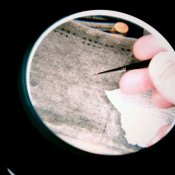
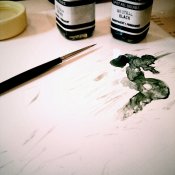
Here's from my spotting session.. It actually went pretty well once I had my magnifier set up and got my technique in order. I wouldn't say I enjoyed it, but I survived! Thanks for all the tips in the thread. They certainly helped!

(cell phone "photos")
6857826237_681b2c0f16_b.jpg

6857826423_eaf2b84bd5_b.jpg

Chris
 
Photrio.com contains affiliate links to products. We may receive a commission for purchases made through these links.
To read our full affiliate disclosure statement please click Here.

PHOTRIO PARTNERS EQUALLY FUNDING OUR COMMUNITY:


Ilford ADOX Freestyle Photographic Stearman Press Weldon Color Lab Blue Moon Camera & Machine
Top Bottom