• Welcome to Photrio!
    Registration is fast and free. Join today to unlock search, see fewer ads, and access all forum features.
    Click here to sign up

HP5 vs Tri-X at 800

Recent Classifieds

Forum statistics

Threads
203,036
Messages
2,848,896
Members
101,608
Latest member
Robert Taetzel
Recent bookmarks
2

horacekenneth

Member
Allowing Ads
Joined
Aug 10, 2012
Messages
515
Location
MD
Format
Multi Format
So I just finished scanning two rolls, both shot at 800 in an XA, developed at 24C in 1:50 Rodinal, one Ilford's HP5 and one Kodak's Tri-X. I was sure I was going to prefer the Tri-X but it seems to have way more grain and contrast. (I know I recently said I was looking for grain, but seriously, that was a lot)
I know the ultimate test though will be printing them and I'm planning on doing that tomorrow night.
Here's a sample of the Ilford:
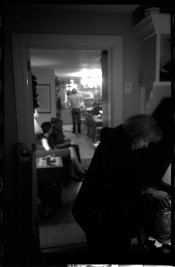
Scan-130101-0035.jpg

And the Kodak
Scan-130106-0016.jpg

How do you think they compare?
 
Hi,

I prefer the HP5 very slightly over the TriX. That said, it appears that both negatives are not scanned very well. It may be the scanner you used, or your contrast adjustment after scanning may be far too harsh. The shadows are completely blocked, and the highlights blown out as well. It would be better to opt for a flatter contrast curve upfront, and then to adjust carefully in post-processing. As posted, your scans don't provide enough information to do a good comparison. I am quite certain your opinion on which film is capable of what will change if you make good darkroom prints at the correct contrast grade for each negative.
 
Try printing both negatives in a darkroom or judge from the negative itself,
my opinion is that films are not made for scanning. I used to judge from my scans for many years and I was wrong because a film that is good for scanning is not necessarily good for printing.
 
From all I have read and based my personal experience, Rodinal is not the best developer for push processing. Tri-X and Rodinal give a very specific look. Salgado used this combination for a long time and many of his prints, while gorgeous, look like they were photographed on sandpaper. Contrast can also build real quickly.

My normal film is Tri-X, but last year I shot a small amount of HP5 for a project. The first thing that struck me about HP5 was that it appeared to have lower contrast than Tri-X, which should work in your favor, if you're push processing. I'm seeing the same in your two shots.

I don't think you're going to get an accurate assessment from this test, because of Rodinal. It's a great developer, but I don't think it's the best choice for push processing. Tri-X @ 1250 in Diafine is pretty impressive. Smooth tonality, good shadow detail and surprisingly fine grain. Obviously there are the usual suspects, Xtol, DDX, Tmax developer or good old D76.


If you're looking for a 400asa film to push I highly suggest TMY-2 400. It has a very linear curve and the grain stays very small. Great stuff.
 
Both look like muddy messes. I'd opt for Delta 3200 or TMAX 3200. Or use flash.
 
There's no question about the scanner, its an Epson 1240 and VueScan and I've never been able to get any shadow detail with it.

I think the HP5 I did 24C for 10min, inverting the first 30 and then 10 every minute, the Tri-X was also 24C for 13min, same inversions. Rodinal was at 1:50
 
If you want to squeeze 800 ISO out of these films, I would recommend Tetenal Emofin, which is a 2-bath developer. A few years ago I abandoned Emofin in favour of home-mixing Barry Thornton's 2-bath formula, for which I rate both these films at 650 ISO.

I agree with the comments about lack of shadow and highlight detail. If you can't coax these out with your scanner, make your comparison with a hand lens from the negatives.

Here is one of each, with the relevant detail, all scanned from 35mm with minimal sharpening.
TriX Emofin.jpg
TriX Emofin detail.jpg
HP5 BT 2 bath.jpg
HP5 BT 2 bath detail.jpg
 
In order to compare the films, you have to develop them to the same contrast index, preferably of the same scene. It takes a lot more than one roll of each to decide any real difference.
Since HP5+ is naturally a little bit lower in contrast than Tri-X, you have to adjust developing time, agitation and so on to compensate for that. YOU control the final contrast of the negative; it's a matter of working with your materials until you have the results you need. Get the final negative contrast the same in both films, and you will have a much better idea of what each film does, both from a tonality and grain standpoint. Print the negatives, at the same contrast grade. Adjust film developing time until both types of film print with similar contrast on the same paper.
 
Some said Rodinal like low temp < 20°C(~ 18°C) and longer development times(no stand development)...
 
I only have little experiance with TriX, and from that I prefer HP5+. It's easy to get EI 1600 from HP5+ f.e. in Emofin or 800 - 1600 in Caffenol-C-L.

#1 HP5+, EI 1600, Emofin 10 + 10 minutes 20 °C constant agitation.

hp5+1.jpg

#2 HP5+, EI 1600, Caffenol-C-L 75 minutes 20 °C semi-stand development

hp5+2.jpg

I like Rodinal, but it is probably one of the worst choices available for this purpose. 24 °C? No go.

Best - Reinhold

PS: negative scan with Canoscan 8800F and Vuescan
 
Last edited by a moderator:
Grommi,
may I ask the lens you used for the second headshot. The lens is giving a very nice look for portrait/tight shots


I only have little experiance with TriX, and from that I prefer HP5+. It's easy to get EI 1600 from HP5+ f.e. in Emofin or 800 - 1600 in Caffenol-C-L.

#1 HP5+, EI 1600, Emofin 10 + 10 minutes 20 °C constant agitation.

View attachment 62285

#2 HP5+, EI 1600, Caffenol-C-L 75 minutes 20 °C semi-stand development

View attachment 62286

I like Rodinal, but it is probably one of the worst choices available for this purpose. 24 °C? No go.

Best - Reinhold

PS: negative scan with Canoscan 8800F and Vuescan
 
Hp5 is a far superior film for pushing. Though every developer will produce different result, and it will be best if you use the best suited developer for each film, HP5 usually wins out in most cases. http://www.dr5.com/graphics/hp51000aad1.jpg

For conventional developers it usually is. I like Tri-X in Diafine though. EI 1000-1250. If that's fast enough, that's what I use. If it isn't fast enough it's time for D3200 (or my remaining stock of TMZ.)
 
I have a slightly off topic question...

I find the cupping of Tri-X ( Arista Premium ) to be a real pain, is HP-5 better in this regard, in terms of lying flat?
 
Photrio.com contains affiliate links to products. We may receive a commission for purchases made through these links.
To read our full affiliate disclosure statement please click Here.

PHOTRIO PARTNERS EQUALLY FUNDING OUR COMMUNITY:


Ilford ADOX Freestyle Photographic Stearman Press Weldon Color Lab Blue Moon Camera & Machine
Top Bottom