• Welcome to Photrio!
    Registration is fast and free. Join today to unlock search, see fewer ads, and access all forum features.
    Click here to sign up

How to diffuse condenser head - De Vere 504 w/ Varicon head

Greens

A
Greens

  • 3
  • 1
  • 7
Cyanotype stereo card

A
Cyanotype stereo card

  • 1
  • 0
  • 24

Forum statistics

Threads
203,131
Messages
2,850,316
Members
101,690
Latest member
nisherii
Recent bookmarks
0

gamincurieux

Subscriber
Allowing Ads
Joined
Jan 19, 2009
Messages
297
Location
Melbourne, A
Format
35mm
(De Vere 504 w/ Varicon head)
Hi there..... Can anyone suggest the best way to diffuse my condenser head? Either there's an accessory that can be slotted in that I don't know about, or perhaps you can suggest the best kind of material I should get to make my own. Don't get me wrong, I want a condenser enlarger, but I just want to have the option of diffusing on the odd occasion with the odd negative, by putting something in between the negative & the condenser lens. If I have to make my own, I wouldn't have a clue what to make it out of! Would be very grateful for suggestions.
Many thanks,
Paul
 
Thank you. But, that's not what I was asking:

Can anyone suggest the best way to diffuse my condenser head? Either there's an accessory that can be slotted in that I don't know about, or perhaps you can suggest the best kind of material I should get to make my own. Don't get me wrong, I want a condenser enlarger, but I just want to have the option of diffusing on the odd occasion with the odd negative, by putting something in between the negative & the condenser lens. If I have to make my own, I wouldn't have a clue what to make it out of! Would be very grateful for suggestions.
Many thanks,
Paul
 
I don't have any condenser heads, but if I did, I'd use a piece of ground glass (homemade) under the last condenser lens. There will be a trade-off between how much diffusion and loss of intensity depending on how much you grind the ground glass. A piece of white plastic diffusion material (from the bottom of a junk dichroic head mixing box) would also work but may cut the light intensity too much to be useful.

BTW to you have any spare 504 lensboards?
 
Look at the dichro head. Do you see that it uses something called a mixing box? That's how the diffusion happens. It's not the same as throwing something in front of the condensor. You could attempt something with a diffused transmission medium but it's definitely going to cut down brightness.

BTW I have a dedicated condensor enlarger (Kaiser VPM) and a 504 w/ dichro head. There is near zero difference in sharpness so don't fool yourself there if you think that's why you need a condensor enlarger.
 
Thank you Clayne.

ic-racer, thanks very much for your response. It was more what I would have to make one out of that had me going than anything else. Whatever it will be made out of will cut down on brightness somewhat, but more so plastic I'd also thought. So, I'd be willing to give ground glass a try - now to figure out where to put it (obviously sitting ever so close just above the neg carrier, yet thin enough to slot under the condenser lens) and where close by I could get one made up (homemade is a little beyond me I'm afraid). I suppose any glazier would do it.

Ah.... I just have 2 lensboards, for the 50 & 80. You on the hunt for one, or?

Paul
 
I suggest a piece of translucent white acrylic. I do not know about availability in Australia but here; white is available with serveral levels of light transmission. As it has no grain, there is no danger of possibly having the ground glass texture in focus at small aperatures.
 
Thanks Richard, good point on the texture. Could try both, just have to think where's best to go for it. I also emailed both Odyssey and KHB to ask on the off chance that they have or can suggest something.
 
Paul

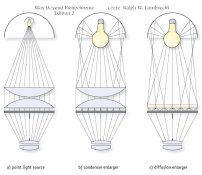
Take a close look at the attached illustration. Adding a translucent object under the bottom condensor will diffuse the light source. It will, however, swallow a lot of light, and it needs to be uniform and clean or it might show up in the print, being so close to the negative.
 

Attachments

  • LightSources.jpg
    LightSources.jpg
    76.2 KB · Views: 384
Thanks Ralph. Yes, will have to be very fussy about what I would use. You know, could be that the nice white photocrescenta lamp is diffuse enough anyway without having to go to all this bother. I'll find out soon enough............ I should add that I haven't even tried this enlarger yet, as I just moved house & am waiting for new blackout screens to be made before I can get to printing again.
 
I can't off the top of my head visualise the DeVere condenser head, so I can't think where you could slip diffusing material into the light path. It may be difficult to fit a sheet of acrylic (or similar) plastic in there. But anyway, as other posters have said, acrylic may diminish output too greatly.

I'd use a piece of diffusion gel - you can find it in the Rosco catalogue if you can't source it locally - it's calibrated in 'stops' according to diffusion density. I'd get a sheet of '1/4 stop' then double it up until I found a happy medium between diffusion and light loss. A 50cm square shouldn't cost more than ÂŁ5(UK) and I guess you could tape it to the flat side of the bottom diffuser.

If you can't source it locally from a photo store either try a disco lighting hire shop or a video supplies wholesaler - there should be one in Melbourne to supply the TV industry there.

You could also try graphic arts 'trace' - just make sure it doesn't have any visible grain.

Regards
Jerry
 
Jerry got it right. I use Lee lighting gels because that's what the local rental house carries. Both Lee and Rosco diffusion gels are grainless and aberration free. What's more, unlike acrylic, they're designed to take the heat generated by a light source. Full stop white diffusion (Lee 216) is probably overkill. I use half-stop (Lee 250) and find that it gives me the same quality of light under my Durst condensers as the dichroic mixing box on my color enlargers. It's available in 18" x 24" sheets at any lighting supply or Calumet. For my Durst 138 I have a sheet cut to the same size as the glass in the carrier. Lay it right on top. Why someone would want to mess with uneven "cold light" heads is beyond me.
 
Pardon me, I should have said 'tape it to the flat side of the bottom condenser'.
Sorry to have caused any confusion.

Jerry
 
... You know, could be that the nice white photocrescenta lamp is diffuse enough anyway without having to go to all this bother. ...

Very true. No enlarger is 100% specular or 100% diffuse. A condenser is typically right in between the two.
 
Hi, Paul,
Try Rosco diffusion filter(s). I use them for that purpose, and they they work very well. They are tough, heat resistant, and durable. Thing is, you need to choose the one that's right for you, as they make a great many. Some diffuse more evenly than others. I believe the one I use is half white diffusion. Rosco used to send out a sample pack of gel swatches on request, you could try them out under lamps first to judge their diffusion properties. When you decide on the one(s) you need, you can buy different size sheets, and they are very economical for this application. Good Luck, Mike.
 
Look at the dichro head. Do you see that it uses something called a mixing box?

Actually the mixing box is for mixing the colors, which usually always come in from one side. It also provides diffuse light, but you don't need a mixing box to get diffuse light falling on the negative.
 
The Rosco diffusion filters sound like a good idea. Anyone with a condenser enlarger and a glass negative carrier should try that.
 
Thanks everyone, These Rosco filters look like the way to go, I'll look em up today............ :wink:
 
I've used translucent acrylic, and it cuts down on the light an awful lot. Ground glass sounds better, but difficult. Frosted Mylar sheets are available in art and blueprint supply stores very cheaply. Try cutting a piece to fit in the filter drawer (if you have one) or right below the condensers and heat absorbing glass.
 
Photrio.com contains affiliate links to products. We may receive a commission for purchases made through these links.
To read our full affiliate disclosure statement please click Here.

PHOTRIO PARTNERS EQUALLY FUNDING OUR COMMUNITY:


Ilford ADOX Freestyle Photographic Stearman Press Weldon Color Lab Blue Moon Camera & Machine
Top Bottom