A couple of observations/comments.
1. Prints made at maximum aperture may not be as sharp as prints made stopped down a couple stops just because the lens won't be as sharp at maximum aperture.
2. Unless you're getting sharper prints using one grain magnifier than the other, having used both on the same print at the same aperture (and making sure nothing moves in between, such as negative popping etc.), you're not comparing apples to apples.
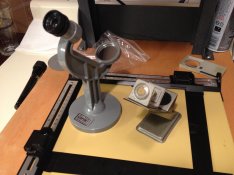
3. If you are getting sharper prints from one magnifier, the other is likely not focusing as accurately, or you are having difficulty focusing with it. In the former case, you can try shimming the bottom of the magnifier to make it agree with the better one. This only works if the error is in that direction, i.e., the mirror on the magnifier is too low. If the error is the other way around, you're likely out of luck. Ditch the magnifier; it's not worth the effort to try to fix it. I don't know of a single grain magnifier with adjustable mirror height. (Note, that if a front-surfaced mirror on a magnifier has been replaced with a back-surfaced one, there will be a substantial error that could be corrected by shimming the bottom of the magnifier to correspond to the thickness of the glass.)
4. Adjusting the eyepiece so that the reticle is sharp is what focuses your eye on the image. If your magnifier does not have a screen on which the image is projected, the image is an aerial one. If you don't have a reticle to focus on and your eyesight does not agree with the way the magnifier is focused, you may, indeed have a focus discrepancy (I'm assuming here, perhaps incorrectly, that eyesight will affect the perceived focus of an aerial image; I'd love to have more info on this - anyone?). If there is no way to adjust the eyepiece in such a case, the magnifier is simply unusable by you. Pass it on and get a better one.
Best,
Doremus