
• Welcome to Photrio!
    Registration is fast and free. Join today to unlock search, see fewer ads, and access all forum features.
    Click here to sign up

How precise electronic SLR shutters from late nineties?

The bowling green

A
The bowling green

  • 0
  • 0
  • 13
Indian ghost pipe plant.

H
Indian ghost pipe plant.

  • 3
  • 1
  • 28

Forum statistics

Threads
202,942
Messages
2,847,846
Members
101,549
Latest member
mennojim
Recent bookmarks
0

snikulin

Member
Allowing Ads
Joined
Aug 20, 2015
Messages
78
Location
San Jose, CA
Format
Medium Format
How do they work?
Do they have any dependency on a potentially decaying-over-time element (master spring, escapement) or everything controlled purely by electronics?
In other words, can some old shutters be relied upon as a precise source of small time intervals without any CLA?

I know from my personal experience that older mechanical shutters can't be blindly trusted because of the possibly gummed escapement and/or weakened master spring. Any hope for Canon Elan II likes?

Basically I need a reliable and cheap source of small time intervals and though maybe an old "late" SLR for like $20 will do.

Yes, I know about gravity shutters. They are my plan "B" so far.

Thanks!
 
I think yes, you will probably find the manual speeds of that era camera is driven by quartz so is likely accurate from 1 second to nearly the sync speed... Once you near the sync speed you are back to the point where mechanical features affect the speed.
 
>In other words, can some old shutters be relied upon as a precise source of small time intervals without any CLA?

Actually no.

Maybe if you are sure the camera uses quartz control and depending on what accuracy you are looking for you 'might' be OK but it's not safe to say any electronically controlled shutter of the late nineties will be accurate.

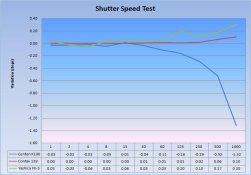
Below is three shutter speed tests I've just pulled from my records and put together as a comparison. The best is the Contax 139 which was introduced in 1979, uses an electronically controlled Copal shutter and was the first camera with quartz timing. The second best is a Yashica FX-3 (first model) from the eighties which has a Copal mechanical shutter. The worst is the Centon K100 from the late nineties which uses an electronically controlled Seiko shutter but doesn't (as far as I can ascertain) use quartz control. The K100 was also very inconsistant at 1/1000.

Also, as Bill says, mechanics can affect even electronically controlled shutters (once the curtain is released, in most cases, it's still a spring that causes the curtain to travel, though there are shutters with electrically driven curtains about) so you can still get issues with even the most accurately timed shutters.

FX3-v-139-v-K100.jpg
 
Last edited by a moderator:
The small electromagnet (and any mechanical latches) can gum up and slow on old lubricant just like an all mechanical shutter.

If you don't use them regular expect problems.
 
In the 1940s, one group of astronomers seeking reliable and accurate shutters for time-lapse photography of Solar flares chose Univex Mercury camera shutters over Leica and Contax. The simple focal plane rotary Mercury shutter with speeds from 1/20 to 1/1000 was far more accurate and consistent, especially at the top speeds.
 
The small electromagnet (and any mechanical latches) can gum up and slow on old lubricant just like an all mechanical shutter.

If you don't use them regular expect problems.

Is you Enter key gummed up?:tongue:
 
I'm afraid, at least in a film camera, an electronic shutter is still a shutter with physical components to move. As such, it is still subject to the bugaboos that affect delicate mechanical devices. It is potentially more accurate within its design range because it uses relatively precise timing from quartz crystals or similar devices and doesn't depend on the inertia of little tiny wheels, links, levers and pinions.

And then, what is done, versus what could be done, is always tempered, sometimes severely, by manufacturing costs and price competition.
 
They are excellent for the low speed but I don't think they are better in the high speed as compared to the fully mechanical shutter. The reason is that although electronically timed they are still spring driven devices and spring tension, friction, etc.. play very important part in their accuracy at high speed.

For example the 1 sec speed they are off by less than 1% but I doubt that the top speed is better than %25 or so.
 
Many thanks to all of you!
It looks like a gravity shutter is the most reliable and predictable choice.
 
I read comments here where the author implies the focal plane shutter gets faster as shutter speed increases -- whereas I understood that shutter curtains always travel at the speed, and that we think of as "speeds" are in fact the width of the slit created by the opening curtain and the following curtain. So do the curtains actually vary speed as "speed" increases?
 
I read comments here where the author implies the focal plane shutter gets faster as shutter speed increases -- whereas I understood that shutter curtains always travel at the speed, and that we think of as "speeds" are in fact the width of the slit created by the opening curtain and the following curtain. So do the curtains actually vary speed as "speed" increases?

As far as I know, after certain speed (flash sync speed?) the curtains' speed is fixed and the only variable is the slit width.
 
As far as I know, after certain speed (flash sync speed?) the curtains' speed is fixed and the only variable is the slit width.

The curtain speeds are always fixed and they are adjustable by changing the spring tension. The electronics only time the time between the release of the first curtain and the release to the second curtain. If the speed of the curtains are wrong the speed won't be accurate for the high speed. Slow speed like 1 sec etc.. the curtain speed is almost irrelevant because they are too short as compared to the actual exposure time. For high speed like 1/8000 if the first curtain travel slight faster than the second curtain then you have a larger slit which result in longer exposure time (if it's slower than the second curtain then it's shorter time, if it's too slow the the flash sync speed is off too) even if the electronic releases the 2 curtains at exactly 1/8000 second interval.
 
it's easy enough to test.so why don't you.
Because I want to calibrate my measurement device :smile:.
It's a metrological chicken and egg problem. I need something independently calibrated and trusted.
I've built a receiver from Dead Link Removed PDF and a modulated transmitter from this site (both are my very first schematics, both are successful, I found a new hobby!).
Now I want to know how far are my measurements away from the reality.
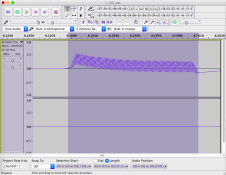
Here is one of my 1/125 shots on a newly obtained Yashica D (12 milliseconds vs 8 expected):

attachment.php
 

Attachments

  • Screen Shot 2015-11-08 at 9.33.40 PM.png
    Screen Shot 2015-11-08 at 9.33.40 PM.png
    91.8 KB · Views: 177
Last edited by a moderator:
electronic shutters are (in my experience as a camera technician) not just more accurate than mechanical shutters, but also more consistent.

If you set up a electronic shutter to run at 1/1000 second it would run at that speed +/- 3% all day.

I've never seen a mechanical shutter (even on a new camera) run better than +/- 10%.

Having said that no one would ever notice the variation in exposure in their photographs.
 
snikulin,

When measuring shutter speeds, you need to consider the opening and closing.

The Yashica D is a leaf shutter and needs to spend some of that time in a partially-opened state, and some in partially-closed state. To obtain an exposure that is the equivalent of a perfect shutter speed of 1/125, it may be necessary to start earlier and end later.

When I tested a shutter recently, I used three factors. I had a turntable spinning a white line on a black background, and I computed the angle of rotation recorded on film. Then I used an electronic shutter with photocell. The third factor I used was a grayscale (in conjunction with a sensitometric exposure) to judge the density.

At the lowest speeds (1 second, 1/2 second etc.) the rotation and electronic timer were in best agreement. At the highest speeds, only the density result test was reliable.

Of course as soon as I had done all that, the mainspring broke.
 
I read comments here where the author implies the focal plane shutter gets faster as shutter speed increases -- whereas I understood that shutter curtains always travel at the speed, and that we think of as "speeds" are in fact the width of the slit created by the opening curtain and the following curtain. So do the curtains actually vary speed as "speed" increases?

Generally the curtain velocity is constant, (at least at the higher, non escapement speeds for most designs), and, as you have pointed out, the effective speeds are achieved by the actual distance between the two curtains as they travel across the film gate. There are exceptions, though. Eg. The early Contax shutter, which preforms the width of the slit (and in the process, eliminates tapering or capping) but also varies the curtain velocity at various speeds.
 
Photrio.com contains affiliate links to products. We may receive a commission for purchases made through these links.
To read our full affiliate disclosure statement please click Here.

PHOTRIO PARTNERS EQUALLY FUNDING OUR COMMUNITY:


Ilford ADOX Freestyle Photographic Stearman Press Weldon Color Lab Blue Moon Camera & Machine
Top Bottom