• Welcome to Photrio!
    Registration is fast and free. Join today to unlock search, see fewer ads, and access all forum features.
    Click here to sign up

How many of you use filters?

Forum statistics

Threads
202,944
Messages
2,847,898
Members
101,549
Latest member
mennojim
Recent bookmarks
0

Which filters?


  • Total voters
    187
I have lots of filters, but the ones I use most frequently are yellow, orange, and a polarizer, occasionally a grad, warming filters and color correction filters when I shoot color, but I only ticked off the ones I use often in the poll.
 
I most commonly use a C-Polariser in rainforests (to reduce spectrals), warmtone in shaded environments with RVP and skylight 1B for seaside imaging. There are also red, yellow and green B&W filters and a tiny Wratten rear-slot skylight filter for my 17-40 lens.
 
The filters I use

How many of you use filters?
Which ones and how often?


The filters I use are: UV/skylight, polarizing, and enhancing (didymium, red).

UV/skylight: mainly to protect the front element from scuffs or scratches (although I also like the warmth the skylight gives to my colour prints.

I have read many threads/posts arguing the benefits/disadvantages of using these particular filters: why the "advantages" are illusory and the disadvantages real. However, lately I have been collecting/examining (in a small way) numbers of veteran lenses and cameras, and it becomes very obvious which lenses have had the benefit of a filter to protect them from the ravages of time and which have not. This experience has -I'm afraid- entrenched me very firmly in the pro-filter camp, sorry.:smile:

Polarizing: I love the colour-saturation and blue sky-effect this filter produces. I dislike the "reveal all the crap at the bottom of the lake/stream/water" effect, and the elimination of the sparkle from water surfaces.

However, used appropriately, I find it quite good to have -as another option.

Another use -I find- is to reduce the SBR where skies are involved (brings it within the film's dynamic range (er.., latitude).


The Didymium filter is great in shots of autumn foliage, as it enhances all the warm tones, especially the reds.

I have some neutral density and soft-focus filters also, but haven't got around to using them, so far.
 
90% of all my filter work (for black and white) is done with an orange and or polariser filter. I also own a yellow, green, and deep red filter, but use these rarely. It's always fun to dream of all the filters that you'd love to own, but when it comes down to carrying them, remembering filter factors, then add in step up rings, it can become too much. Keep it simple.
 
I never used filters. I am thinking of using the polarizer but I haven't even use it yet.
 
A didymium enhancing filter is supposed to enhance the warm tones selectively without changing the cool tones like a warming filter would do. The effect can get kind of wacky, but sometimes it works.
 
I've been using (in order of frequency) yellow, orange and red with B&W. I used to use a polarizer a lot with color but less so lately -- maybe it's because the last one I bought was so expensive I'm afraid to take it out of the box! :D

DaveT
 
UV on just about all my lenses for protection, Y2 for about 90% of b/w film work, and a funny mix of circ polariser plus ND2 or ND4 for things equestrian (but that is almost exclusively digital so not applicable here)

wayne
 
I use skylight or UV filters for protection sometimes.

The last filter I used to modify light was an R72 - I guess I like working blind :smile:.

I've used polarizers when the subject called for it.

Actually, I plan on experimenting more.

Matt
 
I often use yellow or yellow-green, sometimes orange, sometimes ND grads, occasionally red, polariser, also an IR filter.
 
Yellow, Orange and Red very regularly.

Green from time to time

Pola when I shoot slides, which is not very often.
 
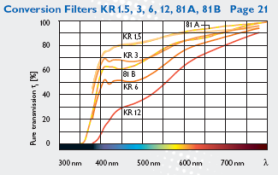
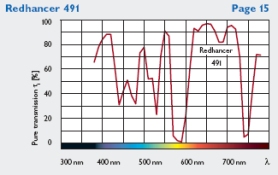
How is a red-enhancing filter different from a warmtone?
Here are the B+W curves. As you can see, there is a big difference in the smoothness of the transmission curves.

I find a redhancer kills blue skies, and I'm not that thrilled with the way it does fall colors. It has the appearance of lowering the color gamut like a digital camera on many shots. Luckily it also acts to kill the prominent emission lines from sodium vapor lamps and can knock down the light pollution they cause for astrophotography.

Lee
 

Attachments

  • warming.png
    warming.png
    20.4 KB · Views: 114
  • redhancer.png
    redhancer.png
    11.3 KB · Views: 115
Only use'em when there is blowing debris, etc to protect; not all the time.
 
UV as protective, always. Polarizer, Warmtone and Gradient when required (but only then) and Yellow for B&W landscapes. The UV on the lenses I use the most are replaced every 3-4 years, when I see the first damages.
 
In order, orange, yellow, red and green. Orange is about 50% and green very rarely (but when you need green, nothing else will do)...the rest about evenly split. I almost never use them in 35mm (avoid the sky generally) and at least half the time when the camera is on a tripod.
 
With very few exceptions I always have a Nikon L37c with colour or the L39 filter with B&W as a standard set-up.

Usually though I have an orange on for most exterior building pictures, especially if there is stonework. I prefer the orange for landscapes in general, but not always.

Next filter that gets used a fair amount is light yellow for portraits, or if I need to bring out some clothing colours and/or texture, I use the yellow/green.

Next is the deep yellow and both light and deep green, they really can make a difference in B&W sometimes. The light green for portraits, has sometimes surprised me.

The polarising filter is probably the least used, but it is a killer when it is required I use it carefully.

I very rarely use a red filter, but I do have it in my bottom pocket just in case.

ND 2x / 4x / 8x.

With colour negative portrait work outdoors, I generally use an 81C in preference over the 81A.

Of late I have been fiddling with a soft spot on my 85 f1.4 Nikkor, shooting at f2.8 for interesting out of focus surrounds.

Mick.
 
Usually either a B+W Circ-Polarizer, or an R60, if I'm in B&W mode. Otherwise, I tend to shoot with my lenses naked.

-J
 
the main filter i use is a dirty window,
but i don't think that counts as a filter ...
 
Well it looks like the majority of posters said they use filters.. Do you feel they affect the sharpness/contrast of your images at all?
 
Well it looks like the majority of posters said they use filters.. Do you feel they affect the sharpness/contrast of your images at all?

However it is likely that non-filter users did not even bother to look at the thread. What can be said is that of those who voted, the usage is as stated in the thread ...

Steve
 
Photrio.com contains affiliate links to products. We may receive a commission for purchases made through these links.
To read our full affiliate disclosure statement please click Here.

PHOTRIO PARTNERS EQUALLY FUNDING OUR COMMUNITY:



Ilford ADOX Freestyle Photographic Stearman Press Weldon Color Lab Blue Moon Camera & Machine
Top Bottom