• Welcome to Photrio!
    Registration is fast and free. Join today to unlock search, see fewer ads, and access all forum features.
    Click here to sign up

How does paper age?

Forum statistics

Threads
203,273
Messages
2,852,175
Members
101,753
Latest member
Janek201
Recent bookmarks
1

WetMogwai

Member
Allowing Ads
Joined
Oct 29, 2009
Messages
152
Format
Multi Format
I recently acquired a 500 sheet box of old Ilford Multigrade III RC Rapid 5x7 paper. The price tag says $125. The store was nice enough to give it to me on the condition that I would pay $25 if it is usable. There is no date, so I can't tell how old it is, but it has been in the shop for a long time.

I exposed a few sheets tonight with really poor results. My first problem is the safelight. The box says it works with a brown light. I only have red. My paper was badly fogged. It also didn't seem sensitive enough. Contrast was extremely low. I was unable to see any detail in the subject's knit sweater. He was holding a baby. It was hard to tell where the baby's head ended and the sweater began. I even used the strongest contrast filter but I was unable to get any detail. I used a much newer sheet from another box and made a nearly perfect print with the detail I wanted on the first try.

Is this how paper ages or is something else going on? I was using Ilford Multigrade developer at 1+14 dilution for 2-3 minutes.
 
The paper is no good. That stuff is exactly how bad paper behaves. Good of them to let you try it (though they should have just given it to you).

It depends on storage conditions, usually. I have a box of MG III glossy that works like new. The strange part is that it was stored in a hot southern California garage for who knows how long, though.....weird.
 
I've had Kodak Polymax - Fine Art in the 16x20 size (50 sheet box) go bad on me when stored in "ideal" conditions. It exhibited the behavior you describe. On the other hand, I've had equally old Fine Art in the 8x10 size stored in the same conditions that worked well. My Ilford paper hasn't gone south yet. It may have to do with the conditions the paper suffered before I got my mitts on it. From the manufacturer to the distributer, to the retailer. Lots of people had a chance to screw with it.
 
Easy test for old papers. Just tear a sheet in half, put one half directly in the fix and process the other half as normal. Compare the two halves. To get rid of the fog, add some 2% Benzatriazole solution to your developer. Try 30cc/liter. If that doesn't do the trick try 60cc/liter and so on. Once the fog is gone, try to make a print with the paper and your new "anti-fog" developer.

You can also search for some threads Randy Libersky has written on "Old Paper."

Were it me, I would NOT through this paper out. I once purchased a 500 sheet box of Kodak paper, either Polymax or Fine Art on Ebay. Another photographer sent me a private e-mail and warned me to check to paper for severe fogging. I did, and it was severly fogged. I contacted the retailer and they refunded my $$. I then threw the paper in the trash. I now regret that, because later on that paper could be run through a fix, then used for alternative processes or recoated with another homemade emulsion. I'll never throw out "bad" paper again.

Good Luck,
 
Does freezing paper help slow the aging process down like it does with film or is that a waste of time?
 
I had thought of fixing it all, but I hadn't thought of keeping the paper afterwards. That seems like a good idea. I was going to just try to reclaim the silver. Any suggestions on how much fixer it would take and how to recover the silver from it afterwards?
 
There is a recent thread on silver recovery, and many old ones on the subject.
The easiest way to get metalic silver would be a device called a "Silver Magnet" which is sold by an apug Sponsor; (there was a url link here which no longer exists)

Specs for fixer from Kodak, Ilford, etc. should say how many sheets, or square inches of material can be fixed in a given volume. It would be a matter of doing the math for the amount of paper you have. You might need to stay under those specs a bit, because they are probably based on fixing typical film or prints which have some percentage of silver that would not get removed. Since you would be looking to remove all of it, you will likely exhaust the fixer faster.
 
About the safelight: Red safelight is usually the safest of them all and works with just about every b/w process there is. The reason for using yellow/brown/green/... safelight is because you can see better when the room is lit in these colors. The eye have very few receptors (?) for low level red light.

//Björn
 
Freezing paper does slow aging, as it does for film.

I think MGIII RC was still a developer-incorporated paper, so there is probably no saving it, but as a general rule, if you do have fogged paper and want to experiment with it, try benzotriazole as John Bowen recommends, but also reduce development time significantly (usually to under 1 min, depending on the paper and developer. For MGIIIRC in a typical developer like Dektol, probably 20 sec. or less).
 
Does freezing paper help slow the aging process down like it does with film or is that a waste of time?

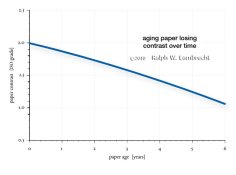
It does, but so does keeping it in the fridge without freezing it. Still it loses contrast and speed, which can be compensated for with harder filtration and extended exposure until it is fogged. Attached are the results of a MGIV aging test.
 

Attachments

  • PaperAging.jpg
    PaperAging.jpg
    24.8 KB · Views: 111
Photrio.com contains affiliate links to products. We may receive a commission for purchases made through these links.
To read our full affiliate disclosure statement please click Here.

PHOTRIO PARTNERS EQUALLY FUNDING OUR COMMUNITY:


Ilford ADOX Freestyle Photographic Stearman Press Weldon Color Lab Blue Moon Camera & Machine
Top Bottom