Has anyone noticed how the cyanotype layer is still active or photosensitive after the cyanotype is made?
Maybe thats not the question, im sure its noticeable, that's why people recommend the print to be stored in a dark room to recover it. Or maybe I misread that.
After watching some Analogue Andy videos on gum over cyanotype I thought to give it a try with PVA chiba. It works but has a weird side effect and I don't know to to expand the dynamic range. Each time you expose the new layer over the cyanotype, the cyanotype layer bleaches out and then comes back during development. Its both neat and annoying. But I didn't see that happening with Andy's gum prints. The dynamic range is too small using mica powder as pigment. I use mica because its what I have but also it florecess under UV for easy manual registration.
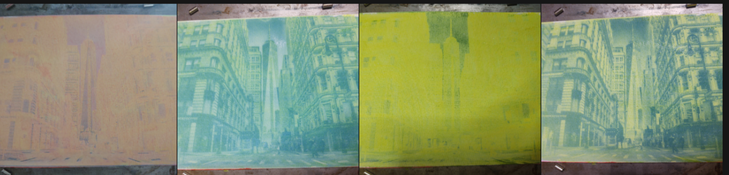
You can see the images below starting right to left after I applied the yellow layer, exposed it, then applied magenta and exposed that. I got very little to zero experience. I'm trying the calibrate the process at the same time. At this particular size and full aperture a square grid of linearly increasing gray shades produces a generally solid yellow that only shows shades from 0 to square 25. I'll post those images tomorrow.
Questions: what, why? do I add more pigment to block the light? Less pigment to increase dynamic range? Do I close down the aperture to reduce exposure? Decrease exposure time? Increase sensitizer amount to prevent light passing layers?
As a reference, the light source is a projected image at 850nm that can take Mike Ware's New Cyanotype to prussian white in 5 minutes with added citric acid, 15 minutes without.
I need to stick to making grid exposures until I can figureout how to extend the dynamic range. Once this system can make an acceptable image, I want to summarize it.
Maybe thats not the question, im sure its noticeable, that's why people recommend the print to be stored in a dark room to recover it. Or maybe I misread that.
After watching some Analogue Andy videos on gum over cyanotype I thought to give it a try with PVA chiba. It works but has a weird side effect and I don't know to to expand the dynamic range. Each time you expose the new layer over the cyanotype, the cyanotype layer bleaches out and then comes back during development. Its both neat and annoying. But I didn't see that happening with Andy's gum prints. The dynamic range is too small using mica powder as pigment. I use mica because its what I have but also it florecess under UV for easy manual registration.
You can see the images below starting right to left after I applied the yellow layer, exposed it, then applied magenta and exposed that. I got very little to zero experience. I'm trying the calibrate the process at the same time. At this particular size and full aperture a square grid of linearly increasing gray shades produces a generally solid yellow that only shows shades from 0 to square 25. I'll post those images tomorrow.
Questions: what, why? do I add more pigment to block the light? Less pigment to increase dynamic range? Do I close down the aperture to reduce exposure? Decrease exposure time? Increase sensitizer amount to prevent light passing layers?
As a reference, the light source is a projected image at 850nm that can take Mike Ware's New Cyanotype to prussian white in 5 minutes with added citric acid, 15 minutes without.
I need to stick to making grid exposures until I can figureout how to extend the dynamic range. Once this system can make an acceptable image, I want to summarize it.