
• Welcome to Photrio!
    Registration is fast and free. Join today to unlock search, see fewer ads, and access all forum features.
    Click here to sign up

Help to identify this Kodak film

Recent Classifieds

Forum statistics

Threads
203,219
Messages
2,851,589
Members
101,729
Latest member
Luis Angel Baca
Recent bookmarks
0

werra

Member
Allowing Ads
Joined
Mar 12, 2007
Messages
332
Location
Tallinn, Est
Format
Multi Format
Hello there.

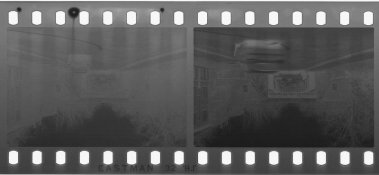
Bought allegedly Agfa Isopan IF from 1977. Turns out, the can is reused to hold some Kodak film. Can someone identify this film by racord print? Sprocket holes look like cinema film to me, correct if I am wrong.
The sensitivity on the can is marked 29DIN, which makes about 640 ISO/ASA. The optimal EI as of today seems to be 25-50.
 

Attachments

  • E32-Scan-101101-0001a.jpg
    E32-Scan-101101-0001a.jpg
    34.4 KB · Views: 505
I can't help you with what the emulsion is, but you are correct that the sprocket holes look like MP film.

As a side note, you should take a look at how you are agitating your film during processing. Those pix are, unfortunately, ruined by the agitation streaks.
 
The marking after Eastman 32 could be interpreted as "HS" (High Speed?) but that is just a wild guess. I can't find anything useable on the net. The Background-X sounds plausible but iso 32 isn't very high speed. Unless you work with wetplates. :smile:
 
Last edited by a moderator:
The marking after Eastman 32 could be interpreted as "HS" (High Speed?) but that is just a wild guess. I can't find anything. The Background-X sounds plausible but iso 32 isn't very high speed. Unless you work with wetplates. :smile:

If you look closely, you'll notice that it's not "HS". I had to identify an old film recently and I found this site. At the bottom of the page there's a table with "slit markings". The markings on the film are 20, followed by 5, whatever might that mean. The page also lists date codes with circles, crosses, squares etc, which might help to determine the age of this MP film stock. "EASTMAN 32" doesn't appear in the list of this site.
 
Yes from the sprocket holes this is MP film. At regular intervals along the edge of the film you will see a film number of the form 52XX. For example Eastman Double-X is 5222. If you don't see one then develop a bit more film. Kodak publishes a list of numbers on the web to identify film based on the number. Go to their website and search for the number.

All Kodak 35mm MP films are numbered 52XX while all 16mm are 72XX.
 
Rule out the b&w reversal films, afaik they wont process to a negative.

I would bet on Double-X.


The can sensitivity marking would have been for the Agfa film.
 
Isopan IF was 17DIN/40ASA, this is striked thru and 29DIN is written with the marker. As there is no excessive fog, I guess this 29 is just for some film that was in the can after IF and before Kodak.

Might have been ISO 800 Daylight / 640 Tungsten?

The only film I know like that is 4-X Reversal though, but that is ISO 400 Daylight and ISO 320 in Tungsten. I got 2 tins of it in 16mm here.

And afaik Doulbe-X is 250 Daylioght and 200 Tungsten.
 
It's a shame Kodak dont have the information on their films on their site, even the names of films on their discontinued list is simply omitted for a lot of them
 
Last edited by a moderator:
I'm going with Background-X also. And that does not say "H.S".
 
Eastman camera films have an identifying letter in front of the footage marks, which are printed in ink. Background-X was "B", Plus-X was "H", Double-X was "C", and XT was "F". Most, but not all, of the older Eastman motion picture films have these footage numbers and identification. If yours does, it will quicky lead to the film characteristics. The perforations are Bell & Howell style, which is generally used with negative films, duplicates, and special effects. "Eastman" usually indicates a motion picture of television film rather than a still camera or instrumentation film. A search of the Kodak website on32 H-I led me to KODAK EKTACHROME 100D Color Reversal Film 5285/7285, but I can't make the connection from the data presented. In any case, processed 5285 should have the product code "EA" and the number 5285 along the edge. Most Eastman films have this sort of identification on them. This film has no keycode (barcode), indicating that it may be an older film type, but I have nothing corresponding in some data from 1966. The film appears to be low contrast, so a duplicating or intermediate film is possible. Some idea of film speed would help. I'm afraid this has not been of much elp, but maybe someone else has some ideas.
 
Another idea (nothing more than that): looking at the signs of the http://www.historicphotoarchive.com/f1/ekcode.html link I think it now looks like a code for first "20" and then the number "5", which to me looked as HS. Mea culpa...

Not that I make any better guesses out of "20" and "5", either.
 
I think this might be Super-XX. The film code was 5232, and it was available as an MP film for much longer than as a still film.
 
The Number between EASTMAN and SAFETY FILM is the Slit, (which of the 32 or 38 strips came off the master roll. It is MP film by the EASTMAN name and the Bell and Howell Perfs.

Look for a number printed in INK on the back of the film. it might be something like 45 G12342. it will read right from the back of the film.

The EASTMAN films varied over the years, and Only Double-X 5222 is still available, but Current film would have a bar code. Other choices for Camera film would be XT pan, Plus-X and 4X negative. Some lab films also have the B&H perfs.
 
Charles, atleast in 135 that's the case. Tri-X 7266 reversal is available in 16 and 8mm.

Sad.. but let's not let this get into another one of those state of affairs threads.
 
Without getting into the 'state of affairs' B&W reversal is generally for immediate display/projection.

Not really something thats done with 35mm.
 
yes, lets not worry about the 16 and smaller

Charles, at least in 135 that's the case. Tri-X 7266 reversal is available in 16 and 8mm.

Sad.. but let's not let this get into another one of those state of affairs threads.

Yes, I was thinking directly about 35mm. The Tri-X reversal and the recently discontinued Plus-X reversal were only for 16mm and smaller. TXR is still made in Super 8, and 16mm - and I belive also on special order in 400ft rolls of Double 8. You can buy the double 8 from a few dealers like "international FIlm" but when they repackage it they are not allowed to use the Kodak or Eastman name.

http://zerelda.com/internationalfilm/internationalfilm.html for example calls it SUPER CINEX N8(2X8MM)ASA200 25ft SPOOL 7266

BTW, I think it has been briefly mentioned but between the EASTMAN and SAFETY there should be a code with 1,2, or three symbols picked from a plus sign, an X, a dot , a square and a triangle. That would be the date code. The mark that looks like 1+1 with some dots is rumoured to be a code to show the month, or perhaps week of manufacture, but IFAIK it has never been documented by Kodak.

BTW2 - The footage numbers are found every 18 inches on camera negative film. They may be in ink, but some films have them as a latent image. It is posible that films intended for use in a film lab may not have the footage numbers.
 
One thing that has my curiosity - many of the B&W movie films have "frame Line" marks between the perfs every 4 Perfs. These can be seen even before the film is developed, as ink marks on the back. They seem to be missing on this sample. I am now curious as the the prsense or absence of "footage Numbers" (normaly every 18 inches or 1 second of Movie.)
 
Photrio.com contains affiliate links to products. We may receive a commission for purchases made through these links.
To read our full affiliate disclosure statement please click Here.

PHOTRIO PARTNERS EQUALLY FUNDING OUR COMMUNITY:


Ilford ADOX Freestyle Photographic Stearman Press Weldon Color Lab Blue Moon Camera & Machine
Top Bottom
