

NowhereMan
Member
I recently got myself a Nikon F-801s and I've only just finished the first test roll. One of the few complicated things about this camera is flash photography. Especially what Nikon calls the Matrix Balanced Fill-Flash I find difficult to understand. Maybe someone who knows the camera can shed some light on this?
Here's a table of the various TTL flash modes available with the F-801 (the left SB-24 column represents fill-flash mode, the right SB-24 column represents standard TTL mode.)

As I understand it, Matrix Balanced Fill-Flash basically adjusts flash output so that the main subject is well balanced with the background - and for doing that it relies on brightness and contrast information from the Matrix Metering system and distance information from the lens. Does that sound about right?
Well here are some of the things I don't understand / would like to know:
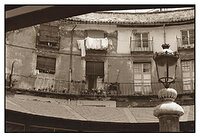
1. When the camera is in Matrix Metering and one of the automatic exposure modes it shifts exposure as soon as a flash unit is connected – sometimes quite dramatically. So for example on a sunny day it will underexpose the scene by around 1.3 to 1.7 stops. In manual exposure mode the light meter reading will change by the same amount as soon as a flash is detected. This results in shots with a correctly exposed subject and an underexposed background. This doesn't happen in Center-weighted Metering. What's the rationale behind this? It seems to be the exact opposite of what the Matrix Balanced Fill-Flash is supposed to do. Of course I can override the cameras settings in manual exposure mode but it's annoying having to switch off the flash every time I want to meter the light. Here's an example of what I mean (picture taken in A prio mode):

2. According to the table, Matrix fill-flash is possible in manual exposure mode with an SB-24 flash unit but not with the older flashes. Why would this be the case? All the flash unit needs is a start and a stop signal, this should be possible with any of these flashes.
3. I mostly use manual exposure mode for flash photography. So what is in this case, technically speaking, the difference between using Matrix fill-flash and standard TTL flash? Doesn't standard TTL also use exposure and distance information?
4. Which TTL modes are you using most with the F-801? I also have a Nikon FE2 that only has center-weighted TTL and I am actually quite happy with the way it works. With some experience you can tell in which situations you need to adjust the flash by how much. So I am wondering whether I should bother with Matrix flash at all.
Here's a table of the various TTL flash modes available with the F-801 (the left SB-24 column represents fill-flash mode, the right SB-24 column represents standard TTL mode.)
As I understand it, Matrix Balanced Fill-Flash basically adjusts flash output so that the main subject is well balanced with the background - and for doing that it relies on brightness and contrast information from the Matrix Metering system and distance information from the lens. Does that sound about right?
Well here are some of the things I don't understand / would like to know:
1. When the camera is in Matrix Metering and one of the automatic exposure modes it shifts exposure as soon as a flash unit is connected – sometimes quite dramatically. So for example on a sunny day it will underexpose the scene by around 1.3 to 1.7 stops. In manual exposure mode the light meter reading will change by the same amount as soon as a flash is detected. This results in shots with a correctly exposed subject and an underexposed background. This doesn't happen in Center-weighted Metering. What's the rationale behind this? It seems to be the exact opposite of what the Matrix Balanced Fill-Flash is supposed to do. Of course I can override the cameras settings in manual exposure mode but it's annoying having to switch off the flash every time I want to meter the light. Here's an example of what I mean (picture taken in A prio mode):
2. According to the table, Matrix fill-flash is possible in manual exposure mode with an SB-24 flash unit but not with the older flashes. Why would this be the case? All the flash unit needs is a start and a stop signal, this should be possible with any of these flashes.
3. I mostly use manual exposure mode for flash photography. So what is in this case, technically speaking, the difference between using Matrix fill-flash and standard TTL flash? Doesn't standard TTL also use exposure and distance information?
4. Which TTL modes are you using most with the F-801? I also have a Nikon FE2 that only has center-weighted TTL and I am actually quite happy with the way it works. With some experience you can tell in which situations you need to adjust the flash by how much. So I am wondering whether I should bother with Matrix flash at all.

 Can't believe it's still online and as confusing as ever. Pure Web 1.0.