• Welcome to Photrio!
    Registration is fast and free. Join today to unlock search, see fewer ads, and access all forum features.
    Click here to sign up

Help analysing results of Tri-X reversal, please

Moonlit Driveway

H
Moonlit Driveway

  • 0
  • 0
  • 0
Autumn Play

A
Autumn Play

  • 2
  • 0
  • 9

Recent Classifieds

Forum statistics

Threads
202,017
Messages
2,833,815
Members
101,072
Latest member
anec76
Recent bookmarks
0

mr.datsun

Member
Allowing Ads
Joined
Oct 27, 2008
Messages
379
Location
The End of t
Format
Sub 35mm
I need help understanding how to improve my first (successful) Tri-X reversal process test, please. I'm a bit hazy on how to think about the dev/exposure relationships within reversal processing.

Process:
I have run a test film strip of exposures on 35mm with 200ASA as the base and EVs of +1, 0 - 1.

The film was dev'd in strong Rodinal of 1:15 at 10 mins according to helpful suggestions from poster Tofek. The rest of the process was as the Foma Reversal Kit suggests. I reduced the Potassium Permanganate by 40% to help save the Tri-X emulsion from going too soft. (I am using the Foma kit to get started).

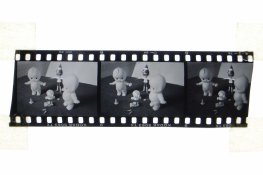
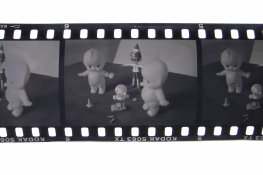
I cannot scan today but have photographed these on a light box. I think you can see the gist of the results. I can post close-up of each frame if needed.

I'm very happy and excited that I got a reasonable result but want to address the weaknesses of the process. What I am seeing is weak blacks and grey-looking hi-lights. An overall flatness. The -1 EV frame has the strongest contrast.

Questions:
I'm guessing the exposure is OK - at least at EV 0 or -1. Is that right? The EV+1 seems to have no greys in the upper range.

Can adjusting the dev time improve the image and contrast? And if so which way?

Or do I just need to use a more vigorous, high contrast developer like Ilford PQ, for example. I guess I'm getting low contrast by using the TriX.

Is there another factor, I'm missing?

NB:
I may switch to D94 and mixing my own chems in the long run but at the moment I'd like to try and get what i have working to it's best advantage, if possible. I have Rodinal and Ilford PQ.


_0029747small.jpg
 
Last edited by a moderator:

Tofek

Member
Allowing Ads
Joined
Nov 8, 2010
Messages
61
Location
Paris
Format
Multi Format
That's quite grey as compared to what I get..The thing I sometimes do to increase contrast is to have the first developer at 24°C (adjust the time to the temperature, 7:15 for me) : in reversal process, Rodinal reacts nicely to changes in temperature in the 1st development. I've never tried touching the exposure though.
 

Tofek

Member
Allowing Ads
Joined
Nov 8, 2010
Messages
61
Location
Paris
Format
Multi Format
Huh sorry, I meant 6:45. Anyway, those times don't tell much, I change it everytime I do a test strip before developing the entire roll...the water must be changing quite often!! :D
 
OP
OP

mr.datsun

Member
Allowing Ads
Joined
Oct 27, 2008
Messages
379
Location
The End of t
Format
Sub 35mm
That's quite grey as compared to what I get..The thing I sometimes do to increase contrast is to have the first developer at 24°C (adjust the time to the temperature, 7:15 for me) : in reversal process, Rodinal reacts nicely to changes in temperature in the 1st development. I've never tried touching the exposure though.

But that makes me think I'm getting something wrong!

I just read, though, that in B&W reversal processing there's nothing much you can do about contrast. (Ilford, Reversal Processing 2003).

Can there be a key difference between Tri-X 35mm and Tri-X Super 8 that affects the result? (For anyone else reading, Tofek is using Super8 Tri X, I'm testing on 35mm before using Super8).
 
OP
OP

mr.datsun

Member
Allowing Ads
Joined
Oct 27, 2008
Messages
379
Location
The End of t
Format
Sub 35mm
Another thing, should I have added Sodium Thiosulphate to the 1st developer? Doesn't this brighten the hilights?
 

Tofek

Member
Allowing Ads
Joined
Nov 8, 2010
Messages
61
Location
Paris
Format
Multi Format
I think dilution affects the contrast too, but never tried it. With Rodinal I experienced a change in contrast linked with temperature (higher the temp, higher the contrast, with Orwo UN54 I got the same evolution). If you want to keep with Rodinal and the contrast is low, try higher temperature, like I already mentioned.
As for the halide solvents (KSCN or Na2S2O3), I was always told that with Tri-X they weren't needed. When I tried to add some to the 1st developer, it lowered the density overally so I decided not to use it. There's a huge debate on whether to use or not to use the silver halide solvents in first developer, so I guess you have to try and decide your own...
 
OP
OP

mr.datsun

Member
Allowing Ads
Joined
Oct 27, 2008
Messages
379
Location
The End of t
Format
Sub 35mm
Thanks for the idea. I know with negative process all those things affect the way Rodinal works. More dilution = lower contrast., higher strength = more contrast. Here we were using 1:15 as per your suggestion and that so i guess that could be increased to 1:7, for example.

Still, as another test this evening I jumped in with both feet. Everything I read about reversal says use paper developer for it's more energetic nature, especially with lower contrast films like Tri-X. So I had just read the Ilford sheets on the subject and saw they recommended PQ at 1:5, 10 minutes. That's double the strength of using it for print and 3 times the strength of normal film processing. So I tried it at the suggested dilution and time.

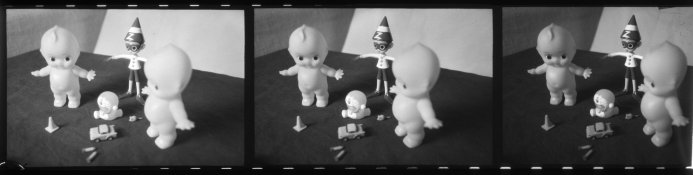
The difference was dramatic and the proof is in the pudding. I think this digital photo of the strip taken from the lightbox has crunched the blacks a bit as, seen with the eye, there is still enough detail in there but the overall contrast and bite is a dramatic improvement. In my case the extra vigour of the paper dev has worked.

I think I could try a drop of sodium thiosulphite in the developer next to see if the hilights can be expanded a little more, too.

Very happy with the new test. Tomorrow I will scan the strips to get a better look and a sense of what a Super 8 sized crop will look like in terms of grain and detail.

Ilford PQ. 1:5, 10 minutes 1st and 5 minutes 2nd.

IlfordPQ.jpg

I think this single frame macro close up digital photo shows how lovely this slide looks:

IlfordPQlupeSmall.jpg
 
Last edited by a moderator:

nworth

Member
Allowing Ads
Joined
Aug 27, 2005
Messages
2,228
Location
Los Alamos,
Format
Multi Format
Tri-X has a reputation for not reversal processing very well, and the few times I have tried, that has also been my experience. The results are generally grayish, with poor contrast and gradation. The film base can also be annoying. Tuning the process will probably help, but I can't be encouraging. Kodak recommends TMax 100 for slides.
 

Athiril

Subscriber
Allowing Ads
Joined
Feb 6, 2009
Messages
3,062
Location
Tokyo
Format
Medium Format
I've gotten great results from HC-110 and @ EI 3200, at high temp processing with some thiocyanate added to the mix.
 
OP
OP

mr.datsun

Member
Allowing Ads
Joined
Oct 27, 2008
Messages
379
Location
The End of t
Format
Sub 35mm
Tri-X has a reputation for not reversal processing very well, and the few times I have tried, that has also been my experience. The results are generally grayish, with poor contrast and gradation. The film base can also be annoying. Tuning the process will probably help, but I can't be encouraging. Kodak recommends TMax 100 for slides.

n-west, thank-you for your comments and I note your reservations about this but I have to place what i am doing in context. These tests are a precursor to moving over to Tri-X Reversal Super 8. Without there being a dedicated off-the-shelf kit I wanted to run trials. That meant finding the right developer, dilution and timings to get a decent image before wasting precious Super-8 at nearly £20 a pop. So these 35mm slide tests are a dry run and I'm very encouraged by the last result. I actually like it!

With regards the poor contrast and gradation - that's exactly what happened in Rodinal - poor contrast and flat areas with sudden changes from one grey tone to another - almost with a halo between them. I think the Ilford PQ has addressed those problems pretty well. There's some lovely tones in the new one and the gradations have arrived. It may not be perfect but it certainly has a look. I will post a proper scan later.

Also, as you mention the film-base – I'm guessing that the 35mm film base is contributing to the look of the results which is why I'm not too worried about proceeding to Super 8.
 
Last edited by a moderator:
OP
OP

mr.datsun

Member
Allowing Ads
Joined
Oct 27, 2008
Messages
379
Location
The End of t
Format
Sub 35mm
I've gotten great results from HC-110 and @ EI 3200, at high temp processing with some thiocyanate added to the mix.

3200ASA in HC-110? Now that's something I'd like to see! Have you got any to show, please?
 
OP
OP

mr.datsun

Member
Allowing Ads
Joined
Oct 27, 2008
Messages
379
Location
The End of t
Format
Sub 35mm
flatbed scan of tri-x slide. black level set using the black of the film edge. this is the Ilford PQ Universal version. Any comments, ideas for improvement, please?

tri-x reversal single frame PQ small.jpg
 

Tofek

Member
Allowing Ads
Joined
Nov 8, 2010
Messages
61
Location
Paris
Format
Multi Format
Looks better! How come, I tried PQ once, with Ilford FP4+, the Ilford method actually, and the slides were muddy and grey...You diluted 1:5 or 1+5 ? Ilford says 1+5 if I remember well.
So the best frame was shot at what ASA, 200?
 
OP
OP

mr.datsun

Member
Allowing Ads
Joined
Oct 27, 2008
Messages
379
Location
The End of t
Format
Sub 35mm
Looks better! How come, I tried PQ once, with Ilford FP4+, the Ilford method actually, and the slides were muddy and grey...You diluted 1:5 or 1+5 ? Ilford says 1+5 if I remember well.
So the best frame was shot at what ASA, 200?

Tofek, yes I meant 1+5. Strange FP4+ was grey, you'd think it might have more punch than pulled TriX. What ASA did you use?

As far as my results, they all look useable but I think 200ASA seems to have best overall balance. Of course this is still 35mm and the true test will be on Super 8.

I think I should verify this test once more to see if I'm getting consistent results.

I do remember getting more contrast and very crisp grain on Super 8 Tri-X when i tried this years ago with a Tetenal kit. The grain on these seems quite gentle.

Tofek – are you going to try Adox Pan-X Reverso?

tri-x reversal strip001small.jpg
 
Last edited by a moderator:

Tofek

Member
Allowing Ads
Joined
Nov 8, 2010
Messages
61
Location
Paris
Format
Multi Format
That's weird, I always thought the contrary : TriX as a contrasty film and FP4+ as a soft film, nevermind. I shot it as 100ASA, but I don't have the time I used with me now...I also use dichromate bleach so maybe this is why our results are different ?
In super 8 I'm using reloadable cartridges "kaccema" so I only buy film in bulk. It's much cheaper than commercial cartridges, here in Europe. So Adox maybe some day...Up to now I was using Orwo UN54, and think about trying the Fomapan. But I didn't really succeed at getting good contrast (that Rodinal must be the reason!) so I might be buying another roll of the Orwo to fix it up, don't know yet
Oh and btw, the TriX super 8 stock changed some years ago (5 maybe?) so perhaps that's why your results are different
 
OP
OP

mr.datsun

Member
Allowing Ads
Joined
Oct 27, 2008
Messages
379
Location
The End of t
Format
Sub 35mm
That's weird, I always thought the contrary : TriX as a contrasty film and FP4+ as a soft film, nevermind. I shot it as 100ASA, but I don't have the time I used with me now...I also use dichromate bleach so maybe this is why our results are different ?
In super 8 I'm using reloadable cartridges "kaccema" so I only buy film in bulk. It's much cheaper than commercial cartridges, here in Europe. So Adox maybe some day...Up to now I was using Orwo UN54, and think about trying the Fomapan. But I didn't really succeed at getting good contrast (that Rodinal must be the reason!) so I might be buying another roll of the Orwo to fix it up, don't know yet
Oh and btw, the TriX super 8 stock changed some years ago (5 maybe?) so perhaps that's why your results are different

Tofek, I'm a bit confused on the contrast issue as I always thought fast films to be high contrast. But I spoke to someone at Silverprint who recommended paper developer as with faster films I'm going to lose contrast. At least this was in the context of our discussion on reversal. But I checked Tri-X and found it to be described as a medium contrast film. That along with losing contrast through lowering it's IE made me guess I needed the aggressiveness of the PQ. Hope to get my understanding of the issues cleared up one day.

Another thing, though is that I always used Rodinal with HP5 35mm because I liked the flat grainy grey look it gave me.

Yes, your experiences reversal processing have been quite different to mine so I don't know what that is down to. I don't know about the effect of the kind of bleach but one thing is niggling me about the bleach in my process. I forgot to lower the potassium permanganate percentage on the second test. I don't know if that affected the image quality.

Reloadable carts. Sounds good. I wondered how you were doing test strips before you dev'd the whole film.

Tri-X. Yes. I wish they'd go back to the old one. The new one is too forgiving, too smooth. i did everything I could to get it to go grainy with Rodinal and then with PQ – and failed.
 
Last edited by a moderator:

Tofek

Member
Allowing Ads
Joined
Nov 8, 2010
Messages
61
Location
Paris
Format
Multi Format
Yes I see your point now about pulling the TriX, thank you for the explanation.
I guess I will have to give up on Rodinal, at least with the Orwo film...A shame since it's my only film developer and lasts for decades. But seeing your results makes me want to retry the PQ !
 
OP
OP

mr.datsun

Member
Allowing Ads
Joined
Oct 27, 2008
Messages
379
Location
The End of t
Format
Sub 35mm
That along with losing contrast through lowering it's IE made me guess I needed the aggressiveness of the PQ. Hope to get my understanding of the issues cleared up one day.

Of course I meant lowering its exposure - as it's being set at 200 ASA.
 
OP
OP

mr.datsun

Member
Allowing Ads
Joined
Oct 27, 2008
Messages
379
Location
The End of t
Format
Sub 35mm
In super 8 I'm using reloadable cartridges "kaccema" so I only buy film in bulk. It's much cheaper than commercial cartridges, here in Europe.

Tofek,
which film(s) are you getting in bulk? Are the kaccema hard to get hold of?

Sodium Thiosulphate. I found this note on page about reversal processing:

http://members.iinet.net.au/~forbes/reversal.html

Basically the developers used in reversal processing are print developers with the addition of hypo (sodium thiosulphate), the amount of which should be varied to suit the film. I've read two accounts of what is accomplished by adding and varying the thiosulphate. One school of thought is that it increases the contrast of the developer, the other is that it reduces the density of the resultant image. It may be that both are true and that the density loss occurs more extensively in the highlights

I'm confused about the idea that it might reduce density, as that would make a darker positive. But I wonder whether it be used to get a touch of contrast increase by clearing the hilights?
 
Last edited by a moderator:

Tofek

Member
Allowing Ads
Joined
Nov 8, 2010
Messages
61
Location
Paris
Format
Multi Format
By reducing density of the negative, the solvent will reduce the density of the positive, since it affects non reduced Ag+ : if I understood well, with potassium thiocyanate, SCN- reacts with the silver halides complex Ag(X) and forms Ag(SCN) + X-, thus making less silver prone to reduction available, which means less density, whether it's on the negative or positive. And since the amount added to the developer is around 2-5g, it's easy to put too much of it and spoil the density. That's what happened to me...but I guess if you add just the right amount it should clear highlights without spoiling the darks, increasing contrast. There's also the sodium thiosulphate which reacts the same, but one is stronger than the other, and I don't remember whether it's KSCN or Na2S2O3.
Another variant I read about is using the solvent as a separate bath after bleach and clearing, what would this change? Maybe more control, since you can work in daylight at this stage?
As for the film in bulk, I buy it from Wittner Cinetec, Germany. They have Orwo UN54, Fomapan and Agfa Scala 200X.
 
OP
OP

mr.datsun

Member
Allowing Ads
Joined
Oct 27, 2008
Messages
379
Location
The End of t
Format
Sub 35mm
Thanks for the explanation. I don't understand the chemistry too well but get the principle. I'll give this a go once I can get some sodium thiosulphate.

I didn't know about the Scala 200X. That's a quite exciting prospect as it has a good reputation amongst still photographers as a reversal film. I see Wittner recommend rating it at 100ASA and using D94a.

If working in Super 8 pays off for me then I'll consider investing in a bulk system.

Tofek, where is the best forum for discussing Super8?
 

Tofek

Member
Allowing Ads
Joined
Nov 8, 2010
Messages
61
Location
Paris
Format
Multi Format
The forums I know of are filmshooting.com , cinematography.com and super8.es (the most complete about reversal processing, though in spanish ), filmvorfuehrer.de (even worse, in german).
 
OP
OP

mr.datsun

Member
Allowing Ads
Joined
Oct 27, 2008
Messages
379
Location
The End of t
Format
Sub 35mm
thanks tofek. I tried joining filmshooting.com a little while ago. I'm waiting for a response. I'll check out cinematography.com, too.
 

Mike Wilde

Member
Allowing Ads
Joined
Aug 10, 2006
Messages
2,903
Location
Misissauaga
Format
Multi Format
When I am calbrating an unknow film (and I do this semi often - on found films in bulk loaders I buy, etc). I expose them to a reflective step wedge test target in a copy camera, to determine the minimum effective exposure to overcome base and get image content off of the toe of the H-D curve.


Then a transmission step wedge is useful.

I use the step wedge in a slide copier where the light source is daylight to fine tune developer times.

For reversal, thiocyanate into the first developer has always worked best for me to get rid of the overall grey haze.
 
OP
OP

mr.datsun

Member
Allowing Ads
Joined
Oct 27, 2008
Messages
379
Location
The End of t
Format
Sub 35mm
When I am calbrating an unknow film (and I do this semi often - on found films in bulk loaders I buy, etc). I expose them to a reflective step wedge test target in a copy camera, to determine the minimum effective exposure to overcome base and get image content off of the toe of the H-D curve.


Then a transmission step wedge is useful.

I use the step wedge in a slide copier where the light source is daylight to fine tune developer times.

For reversal, thiocyanate into the first developer has always worked best for me to get rid of the overall grey haze.

Mike. Good advice. I'd never heard the term step wedge but, yes, I had been thinking of printing a zone system strip in the darkroom to use in order to a get a better calibration, especially as I also use a Weston meter. I guess this is the same as a reflective step wedge. But I wonder, can such a reflective 9 step wedge be bought cheaply in the UK? I now see that there is a nice looking thing called a Stouffer 9 step wedge but they do not seem to be available here.
 
Photrio.com contains affiliate links to products. We may receive a commission for purchases made through these links.
To read our full affiliate disclosure statement please click Here.

PHOTRIO PARTNERS EQUALLY FUNDING OUR COMMUNITY:


Ilford ADOX Freestyle Photographic Stearman Press Weldon Color Lab Blue Moon Camera & Machine
Top Bottom