
• Welcome to Photrio!
    Registration is fast and free. Join today to unlock search, see fewer ads, and access all forum features.
    Click here to sign up

Hello - Seeking Yaschiamat Guidance

1000002053.jpg

A
1000002053.jpg

  • 2
  • 0
  • 47
A certainty....

A
A certainty....

  • 1
  • 1
  • 52

Recent Classifieds

Forum statistics

Threads
202,696
Messages
2,844,359
Members
101,475
Latest member
Melascha
Recent bookmarks
0

spankurmonkey

Member
Allowing Ads
Joined
Apr 23, 2014
Messages
11
Location
Minnesota, U
Format
Sub 35mm
Hello,

I was referred here from folks at dpchallenge.com as I acquired a Yashicamat camera.
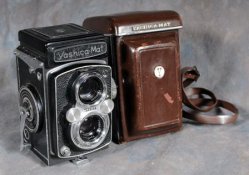
$_57.JPG

I am hoping I can get some guidance on this site as to how to take pictures with it. Also, the best place to get the film and processing. I checked my local area and they do not carry the 120 film and do not develop it.

Thanks,

Kris
 
You can order 120 film from Freestyle or B&H. There is a place on the westcoast called The Darkroom can develop your film and put it on CD. BTW welcome to APUG.

Jeff
 
You made it -- welcome! You can order 120 film cheaply from B&H or Adorama or Freestyle. As I mentioned "over there," Kodak Tri-X 400 is a good all purpose black and white film to start out with. Search on YouTube for Yashicamat for tips on loading and shooting. It's something best seen in action versus trying to explain.
 
Thanks for the info and I need to read the manual but who can give me cliff notes on how to adjust the camera with respect to the timing/fstop ,etc? I think it is the two dials on the front.

Also, does it also shoot color?

what size photos does it produce?

I've not thought about development myself but I really want to try this out. My father had one a longtime ago and I know before he passed he bought this one on Ebay. However, I don't think he ever got the opportunity to shoot any film through it. So I want to take some myself to keep his passion going.

Thanks!!
 
Amazon also sells 120 film. I've had good luck from them, B&H, Badger Graphics, and Midwest. Badger and Midwest were for LF film, though.
 
It shoots a 6x6cm negative(21/4 square). The exposure is set with the wheels, the shutter speed and aperture(f-stop) settings are read in the window on the top of the lens assembly. You take a light reading and transfer the settings to the camera via the wheels, then focus and compose through the top view finder, pop the magnifier up for critical focus back down for comp. Always be sure the x-synch is in the X position before using the self timer. Most people jamb the selector switch in the x position permanently as it is for electronic strobe flash(m setting for flash bulb). The Yashica Mat automatically cocks the shutter on film advance, so just hold the camera cradled in your left hand with index finger resting on the shutter release, all other functions are performed with right hand.
 
Do you own a light meter or have a smart phone with an app for it. You can always use the sunny 16 rule (or sunny 11 depending on your location). I recommend you purchase a book on basic photography, such as "Photography" by London and London (or London and Upton depending on reprint).
 
I have a smartphone but no light meter. If I wanted to take just some basic indoor photos and outdoor is there a general guide of what speed of film, etc.?
I think I may have a photography book but I think it is more digital in nature, perhaps the settings are the same.
 
Thanks for the info and I need to read the manual but who can give me cliff notes on how to adjust the camera with respect to the timing/fstop ,etc? I think it is the two dials on the front.

Also, does it also shoot color?

what size photos does it produce?

I've not thought about development myself but I really want to try this out. My father had one a longtime ago and I know before he passed he bought this one on Ebay. However, I don't think he ever got the opportunity to shoot any film through it. So I want to take some myself to keep his passion going.

Thanks!!

http://www.butkus.org/chinon/yashica/yashicamat_m/yashicamat_m.htm

for manual if that is the model you have there are several

We need to know which part of the planet you are on...

If you buy a changing bag and development tank you can process your own monochrome or colour negative easily.

http://www.ilfordphoto.com/aboutus/page.asp?n=31

oh and welcome
 
I am from the US. Live in Minnesota.

I really appreciate the responses. This may be a really dumb question but developing the film is only one step right? How do you get the actual prints? Any YT videos out there that can show me the process?
 
fotoguide_002.jpg

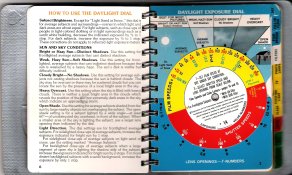
The sunny 16 rule is for a subject in bright open sun, set the shutter at 1 over the film speed and aperture at f/16. Example: shooting 100 speed film, you set shutter at 1/100 at f-16. For weak hazy sun, open up one stop(f-11) for cloudy bright, one more stop (f-8), or slow the shutter by one step(1/50 @ f-11)this would be the same setting needed for a subject in open shade (no sun falling on subject but bright sun elsewhere). My suggestion, buy a cheap light meter (incident) and learn to use it. IMO, there is no better way to learn proper exposure than with the camera you have plus a decent incident meter.
 
Here's a guide to developing the (black and white) film: Dead Link Removed
-- and here: http://www.ilfordphoto.com/Webfiles/200629163442455.pdf

Chemicals are cheap and available mail order from Freestyle and others, tanks are available in the classifieds or on ebay for around $20-30. Nikor is my preferred brand, but make sure you get the 120 size!
Scan the negative or print it with an enlarger (maybe your local art museum or community college has a darkroom)

Here's a post that explains exposure and how to estimate how to set the camera for different situations:
http://www.fredparker.com/ultexp1.htm
You don't *really* need a light meter, you can do pretty well without.
 
Last edited by a moderator:
If you have a smartphone, there are a number of exposure meter apps (some free) out there you can get, and they work really well, I find. I am only aware of light meter apps that are "reflective" (i.e. they measure the light reflecting off the subject and coming to the film), which is the way exposure meters built into cameras work. An "incident" meter, which actually measures the light hitting the subject, is more accurate (since it's not fooled by excessively bright or dark subjects), but more complicated to use.

Someone has already directed you to the butkus camera instruction manuals site, so hopefully you can find the right one for your particular camera there. But the Yashica Mats all work more or less the same way; some have light meters, or the capacity to accept 220 film (takes 24 exposures; very hard to find these days). Basically, you load the unexposed film in the compartment at the bottom of the camera, making sure the printed side of the film backing paper is facing outward (i.e. against the back of the camera. Insert the tip of the film paper into the slot in the empty spool that's sitting in the top compartment (I hope the camera came with an empty spool; can't do anything without one!). Then, wind the crank clockwise so the film is being wound onto the top spool, until the large arrow on the back of the film paper (looks like <-------->) lines up with the two small red dots you see on either side of the film, just below the square opening where the film is exposed. Once you've line up the arrow with those dots (what are often called the "start marks"), close and lock the back, and then continue to wind the crank until it stops -- the frame counter on the camera should now be at frame #1. To cock the shutter, turn the crank counterclockwise until it stops. Set the shutter speed and aperture, and push the shutter release! You can then wind on to the next frame.

Here is a link to a very comprehensive site on the Yashica TLR models, like your Yashica Mat: http://www.yashicatlr.com/index.html
 
Last edited by a moderator:
it shoots color if you put in color film
 
I am from the US. Live in Minnesota.

I really appreciate the responses. This may be a really dumb question but developing the film is only one step right? How do you get the actual prints? Any YT videos out there that can show me the process?

Developing exposed film is a multi-step process, that must be completed in total darkness. There are daylight processing tanks, but they must be loaded in total darkness. Once loaded and closed, the rest can be done in open light. Once the film is developed and dry, it can then be printed or scanned(please pardon that word).

Send me your mailing address and I will send you a roll of black and white film. Once you have finished shooting it, return it to me for processing and printing--free to you.
 
Hi Rick

Yea normally you use a negative film develope it and either scan it for a positive image or contact print it for square 6x6 cm positive print or enlarge it for a bigger positive print.

You can use a transparency film and develop it for projection like a power point slide in a projector rather than a computer.

You need to go to library and borrow books and read threads and ask questions...

Lots to learn.

Noel
 
it shoots color if you put in color film

And if you bring it to England, you can shoot colour with it!


Steve.
 
Yes Steve, but since formats are reversed in the UK, does it shoot 6x6 or 21/4 x 21/4?
 
2 1/4" x 2 1/4" but in the reverse order.

We don't like metric here.


Steve.
 
Filmphotographyproject.com has great prices on 120 film as well. Podcasts are fun too.

sent from phone. excuse my typing.
 
Welcome to APUG
 
Send me your mailing address and I will send you a roll of black and white film. Once you have finished shooting it, return it to me for processing and printing--free to you.

Rick, that was a very very nice way of welcoming a newbie. Now that you have given me the idea, I will do it for someone else too :smile:

Thanks for making my day.
 
Photrio.com contains affiliate links to products. We may receive a commission for purchases made through these links.
To read our full affiliate disclosure statement please click Here.

PHOTRIO PARTNERS EQUALLY FUNDING OUR COMMUNITY:


Ilford ADOX Freestyle Photographic Stearman Press Weldon Color Lab Blue Moon Camera & Machine
Top Bottom