• Welcome to Photrio!
    Registration is fast and free. Join today to unlock search, see fewer ads, and access all forum features.
    Click here to sign up

Hand coloring B&W prints

PenStocks

A
PenStocks

  • 6
  • 1
  • 80
Landed Here

H
Landed Here

  • 4
  • 6
  • 75

Recent Classifieds

Forum statistics

Threads
201,838
Messages
2,830,946
Members
100,977
Latest member
Midmod
Recent bookmarks
0

John_A

Member
Allowing Ads
Joined
May 25, 2014
Messages
65
Format
35mm
Anyone still doing this on a regular basis? I remember trying it in the photo classes at art school, but thats 20years ago or so..
Found this video from Afghanistan(!) of all places, where there still is a studio offering this service, or atleast was in 2012.
https://youtu.be/JDyqmUKjNdg

Skickat från min D6503 via Tapatalk
 

pentaxuser

Member
Joined
May 9, 2005
Messages
20,340
Location
Daventry, No
Format
35mm
Thanks for the link. Now that really is basic hand colouring in all senses but the end result is more effective that I had expected when he started the colouring

pentaxuser
 

Kirks518

Member
Allowing Ads
Joined
Oct 5, 2013
Messages
1,494
Location
Flori-DUH
Format
Multi Format
He makes his own q-tips (cotton swabs), and he's also security!
 

winger

Subscriber
Allowing Ads
Joined
Jan 13, 2005
Messages
3,980
Location
southwest PA
Format
Multi Format
I've mostly stuck with coloring flowers, not people. He did a great job - obviously very experienced.
The first "kit" I got of Marshall's oils included loose cotton and little sticks to make my own swabs. I've done that a few times, but mostly use some make-up applicators that have tiny tips. They're double-ended and the other end is broad and flat and that works well to blend eye liner.
 

removed account4

Subscriber
Allowing Ads
Joined
Jun 21, 2003
Messages
29,832
Format
Hybrid
hi johnA

im hand coloring bleached cyanotypes, beend doing it for about 4 years now. i use ink, crayon and watercolors.
i also color (with a mouses click, an extension of my hand ) black and white photographs made with glass, paper and metal negatives.

good luc with your project !
 

gone

Member
Allowing Ads
Joined
Jun 14, 2009
Messages
5,504
Location
gone
Format
Medium Format
I do this, but not regularly. It's fun to use watercolours just for a change, and use them on glossy paper instead of matte. It takes a completely different technique, much like painting on porcelain green ware. You get one shot at putting down a quick wipe of colour, then things go down hill quickly if that isn't done right. Unlike painting on the porcelain, you can't scratch it out, it's part of the print once it's in the emulsion. But that's what gives it such a different look. Best practiced on small prints first :[

The oils you can move around and blot out if there's a problem.
 

Jesper

Subscriber
Allowing Ads
Joined
Mar 29, 2009
Messages
881
Location
Sweden
Format
Multi Format
During one period I did it quite a lot using airbrush. This of course required extensive masking and a lot of work (took about a week to produce one 40x60cm picture) and it often failed. Only a few negatives worked since too much grey made the final result look dirty. I got the best results with Kodak Technichal pan and HC110 (it was a long time ago).
 

eddie

Member
Allowing Ads
Joined
Jul 24, 2005
Messages
3,259
Location
Northern Vir
Format
Multi Format
I do it often. It can add depth to a photograph, and I enjoy the hand-crafted aspect of it.
This one was half completed to show how it changes the black and white:
inprogress.jpg
 

doughowk

Member
Allowing Ads
Joined
Feb 11, 2003
Messages
1,809
Location
Kalamazoo, MI
Format
Large Format
I've started to do photo oils over Palladium prints on Bergger COT320. For the color you want, either mix it precisely or start light and build up. Once the oil color is on the paper, can't lighten with mineral spirits.
 

ColColt

Member
Allowing Ads
Joined
May 26, 2015
Messages
1,824
Location
TN
Format
Multi Format
Back in the 80's I had a crash course from a gal whose Mom use to make a living at hand coloring photos. I ordered the Marshall's Oil Paints and I think it came with Marlene or something like that, if you wanted to remove colors or a mistake you made. I had the best luck printing on Kodak's Ektalure R FB paper. It's a challenge getting the colors right-especially skin tones.
 
OP
OP
John_A

John_A

Member
Allowing Ads
Joined
May 25, 2014
Messages
65
Format
35mm
Thank for all the replies! Great to hear that hand-colouring not is a lost art.. Seeing some of the pictures has made me thinking and suddenly Ive got lots of ideas
Any advices on what papers and paint to use to achieve good results?

Skickat från min D6503 via Tapatalk
 

ColColt

Member
Allowing Ads
Joined
May 26, 2015
Messages
1,824
Location
TN
Format
Multi Format
I don't know what's available today but Ektalure R or X was the paper to use for hand coloring back in the day. You need some fiber base paper that has a texture and be sure to fix and rise well. Best I recall you had to use a toner prior to coloring but memory fails me as to which I used...it for sure wasn't selenium or gold toner. I want to think sepia but not sure on that.
 

Sirius Glass

Subscriber
Joined
Jan 18, 2007
Messages
50,814
Location
Southern California
Format
Multi Format
It would be nice if the people who have the knowledge and experience would write an article for APUG to post with the collective knowledge in one place. I have never done this so I am reading this thread as others are doing.
 

eddie

Member
Allowing Ads
Joined
Jul 24, 2005
Messages
3,259
Location
Northern Vir
Format
Multi Format
Any advices on what papers and paint to use to achieve good results?

Skickat från min D6503 via Tapatalk

My favorite (currently available) papers are Ilford MGIV matte, and the Ilford Warmtone semi-matte. Both have enough tooth to hold the oils, but not too much to cause the oils to bunch up. If you plan on doing skin tones, the Warmtone gives a nicer base for the paint. Art 300 has a nice texture which will make it look more like it's done on canvas. Liquid emulsions, on your choice of paper furthers your options. Really, any matte/semi matte fiber paper should work well.

Any oil paint works. Start with a cheap kit with a dozen, or so, colors. As your skills improve, you can use costlier paints with better pigments.

I use Q-Tips and cotton balls to apply the paint, and the cotton balls to even the paint out. I don't mask borders, as I find the paints build up at the taped area. Instead, I use a straightedge, and eraserstik style erasers to erase paint from unwanted areas, once the print is dry.

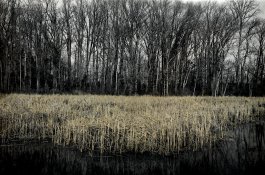
I usually recommend starting with pencil (any colored pencil works). The results are softer, but it's quicker. I rough the lead up with sandpaper before applying to large areas. Then, I use the pink eraserstiks to smooth the color tone. For sharper, deeper tones, I use a sharpened pencil point.
This one was done with one colored pencil, roughed up to apply, then smoothed with the eraser:
reedstrees.jpg

It's a lot of fun, but takes some time to master. It does add to how creative you can be. Good luck, and keep us posted on your progress.

 
Photrio.com contains affiliate links to products. We may receive a commission for purchases made through these links.
To read our full affiliate disclosure statement please click Here.

PHOTRIO PARTNERS EQUALLY FUNDING OUR COMMUNITY:


Ilford ADOX Freestyle Photographic Stearman Press Weldon Color Lab Blue Moon Camera & Machine
Top Bottom