• Welcome to Photrio!
    Registration is fast and free. Join today to unlock search, see fewer ads, and access all forum features.
    Click here to sign up

Graded Paper

Forum statistics

Threads
203,265
Messages
2,852,079
Members
101,752
Latest member
Frederic CHICHE
Recent bookmarks
0

nickandre

Member
Allowing Ads
Joined
Oct 22, 2007
Messages
1,918
Location
Seattle WA
Format
Medium Format
So I use Multigrade paper when I print. Would using graded paper give me better tonality? Is there some other advantage?
 
I think years ago an argument could have been made that "graded" papers had better tonality if your negative matched the paper. Now-days I don't think that is such an issue, with multi-grade papers having beautiful tones, however a graded paper may offer a different "look" that you prefer. You just have to try them out and see. Be glad that you still have some choices. Many of the classic photopapers that photographers remember with great fondness were "graded" papers. Papers such as Brovira, Portriga, Ektalure, Cykora, etc. It is this fondness for the tones of long discontinued papers that may have people thinking that single-grade papers may be "better".
 
I think years ago an argument could have been made that "graded" papers had better tonality if your negative matched the paper. Now-days I don't think that is such an issue, with multi-grade papers having beautiful tones, however a graded paper may offer a different "look" that you prefer. You just have to try them out and see. Be glad that you still have some choices. Many of the classic photopapers that photographers remember with great fondness were "graded" papers. Papers such as Brovira, Portriga, Ektalure, Cykora, etc. It is this fondness for the tones of long discontinued papers that may have people thinking that single-grade papers may be "better".

I fully agree, and having the flexibility of changing the contrast within one sheet of paper is an advantage that have removed graded papers from my darkroom.
 
graded

if you are willing to take the time to experiment then a graded paper may give you an expanded palette....the older papers had a lot of flexibilty...I used to play with different developers to change the tones or create my OWN look for a particular paper...ilford gallerie will work....the emaks might work too..never tried it....you have to put the time in to find out for yourself....that's the fun part
Best, Peter
 
Every paper has its own unique character, and it could be that you'll find something worth using in a specific graded paper but not in a VC paper. For instance, Slavich Bromoportrait 80 has a "silk" embossed surface that is, AFAIK, not available in any other current paper. A similar surface was common in the 1970s, so using that paper can give prints a somewhat "retro" look.
 
So I use Multigrade paper when I print. Would using
graded paper give me better tonality? Is there some
other advantage?
Better tonality? Possible. Writing of VC papers Phil Davis
made this observation: "... within this filter range, the only
real difference in image contrast and gradation occurs in the
dark tones, ..." He goes on to say, "This a characteristic that's
visible to some extent in most, if not all, variable contrast paper
curve families ... "

So within a range of mid to light grays changes within a range
of filter grades have no effect on contrast. Examples provided
show same grade results with one paper using filter grades
-1 through 2. Another paper, -1 through 3, same results.

Some Manufacturer's data sheets make graphic and support
Phil's findings. Not uncommon are APUG members having
problems gaining contrast in the less dense portions of
a print.

The above described shortcoming of VC papers is not
shared by Graded papers. See a few data sheets.
Nice curves. Dan
 
But say I start my print with a 2 grade paper and the contrast is high. Do I have to do another test strip with the 1 grade paper? Are they identical in relative speed assuming I placed the midtones correctly?
Do they make grades below 1? I had to use a 1/2 grade filter on one of my negatives recently.
 
I think below grade 1 you're going to have to use a soft-working developer like Selectol Soft in order to achieve something like grade 1/2.
 
Normally, it is easier to make a separate test strip when you change paper grades. Bite the bullet and get used to it, it is actually faster and more economical.

FWIW, you should be making your test strips based on the least dense part of the print, i.e., the whites and adjusting the contrast/paper grade to get the blacks you need. With film, we "expose for the shadows (the least dense part of the neg), develop for the highlights (the most dense parts)," In printing the "negative" of the axiom is, "expose for the highlights (the least dense part of the print), adjust contrast for the shadows (the most dense parts)."

As for getting less contrast from graded (and VC) papers. Using a soft-working metol-based developer like Selectol Soft or Ansco 120 will result in about a half-zone less contrast. Using this diluted in conjunction with a water bath (15-30 seconds in the developer with agitation, 2 minutes water bathe with no agitation, repeat the cycle as needed) will reduce contrast even more. If you are using a condenser enlarger, printing with a diffused light source will reduce contrast some as well.

Best,

Doremus Scudder
www.DoremusScudder.com
 
But say I start my print with a 2 grade paper and the contrast is high. Do I have to do another test strip with the 1 grade paper? Are they identical in relative speed assuming I placed the midtones correctly?
Do they make grades below 1? I had to use a 1/2 grade filter on one of my negatives recently.
******
I always run a min-exposure/max black through clear film test when I change grades; but after a while, it gets to be pretty intuitive, if one sticks to the same papers. And I use graded and VC.
 
But say I start my print with a 2 grade paper and the contrast is high. Do I have to do another test strip with the 1 grade paper? Are they identical in relative speed assuming I placed the midtones correctly?...

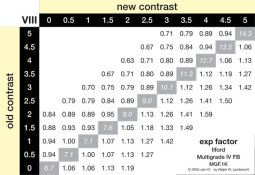
Changing the paper grade will always change your exposure requirement! Paper or filter manufacturer claims to the contrary are based on the speed point, defined in the ISO standard. Unfortunately, the ISO speed point has a density of 0.6, and only if your exposure is based on that density can the exposure be held constant. Most printers pick a highlight point to determine the paper exposure; some pick a shadow point. The rest f the tonal adjustment is then done by selecting the best paper contrast (grade). Both methods do not use the ISO speed point. Hence, an exposure adjustment is required.

You can accomplish that by making a new test strip, or you make a test sequence for your favorite paper once. I do it for my favorite highlight densities for Zone VII, and VIII, which are 0.19 and 0.09, respectively. An example is attached. This way I know how to change the exposure when switching from one grade to another without another test strip.

You find an Excel template to record your own tests on my website in the library section!
 

Attachments

  • PaperContrastComp1.jpg
    PaperContrastComp1.jpg
    49.4 KB · Views: 132
Turn the Lights UP

You'll have an easy time seeing about a not so
dark darkroom if using Graded paper. I wouldn't
trade that high level of safe lighting for the low
level I once did not enjoy when working with
VC papers. Dan
 
Photrio.com contains affiliate links to products. We may receive a commission for purchases made through these links.
To read our full affiliate disclosure statement please click Here.

PHOTRIO PARTNERS EQUALLY FUNDING OUR COMMUNITY:



Ilford ADOX Freestyle Photographic Stearman Press Weldon Color Lab Blue Moon Camera & Machine
Top Bottom