• Welcome to Photrio!
    Registration is fast and free. Join today to unlock search, see fewer ads, and access all forum features.
    Click here to sign up

Giving a darkroom talk to digital people

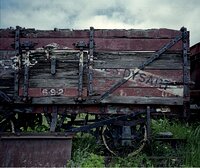
A coal wagon

A
A coal wagon

  • 5
  • 3
  • 42
Morning Birdie

D
Morning Birdie

  • 1
  • 2
  • 41

Forum statistics

Threads
203,143
Messages
2,850,486
Members
101,693
Latest member
Liftahorse
Recent bookmarks
0
Yes- you could always do a cyanotype, as a proof-of-concept with regards to not needing a darkroom, and no real chemistry. Plus they'd get the magic of seeing the latent image form and develop in water. And that can be done quickly and in room light (provided the room is not lit with fluorescents, which will fog the paper).
 
Make sure that you name and list some producers of the materials - many people think that Kodachrome was the last film made in the world, after the fanfare of it's ending.

Absolutely. People are amazed that I can reference Kodak, Fuji, Ilford, Foma, Adox, and chinese film as being commercially available. Paper is available from multiple manufacturers as well. Alt process items from multiple manufacturers. Chemicals from multiple manufacturers or DIY. It's an Internet marketplace now, not a retail/brick&mortar market like many older people grew up with.
 
I'd not spend too much time on it. Chances are they don't even know how a DSLR works or how prints are made from digital files.
 
Do you have a digital projector? If so, bring it to illustrate the principle of the enlarger...

  • The enlarger has a light source, like the projector.
  • The image sensor in the projector is like the negative in the enlarger.
  • The lens of the projector creates an image on the wall; the enlarger creates on image on the baseboard easel.
  • If you move the projector farther from the wall, the image gets bigger; if you move the enlarger farther from the baseboard, the image gets bigger...this is how we control the magnification/size of the image being printed.
  • We use the cropping tool of Photoshop to make an image of a small section of the entire frame; we put a small easel under the large image projected on the baseboard, to make a print of a small crop of the entire frame.
  • We select glossy or matte paper to print an image in a digital printer; we select different paper surfaces for the darkroom print, too.
  • We control contrast via digital postprocessing; we control print contrast mostly using different contrast grades of B&W print paper
  • We control brightness via digital postprocessing; we control print brightness via the enlarger lens aperture and via the length of time that we expose the paper to the projected image
 
I think you've been given some good ideas. After your presentation, gauge the interest you've generated. Invite one (or 2) of the most interested to your darkroom in the near future. Have them leave with prints they've made, so at the next meeting they can say, "I made this myself".
 
I would stress the hand made aspect of traditional processes and how working in a darkroom is a nice break from sitting in front of a computer all day long. To me, working in the darkroom is play, while doing photography on a computer is work. Use the words: "A darkroom is the ultimate man cave." Any married, male members will be searching the internet for enlargers as soon as your talk is over.
 
You need to taylor your presentation to your audience.

Help! I have to give a talk about darkroom to my photography club.

I assume this means they already have some understanding of photography; I also assume this means they are older (since that seems to be the way with photo clubs I've seen). Perhaps you could suggest a future club photo competition that was for film images only.
 
For me, the physical b&w print in my hand is what really the darkroom thing is about. I was teaching photography for few years at the university (including darkroom classes) and what was always amazing for the students, was the feeling of having great picture perfectly printed in their hands. I would start with it.

Good luck! :smile:
 
Perfect printed b&w print are rare and sometimes unattainable for some people, I think the process/experience is more important to some people than perfect results. A perfect print does speak very well for the medium though!
 
That's a great idea!!


you could also just take a piece of photo paper and empty your pockets on it, and
leave it out in the light while you give your chat ... and when you are done, you'll have
a lumesque print ... there really isn't enough UV to make a cyanotype inside with room light
but if you do your talk when there is daylight, you could also do the empty your pockets thing
on a sheet of sun print paper ... and if the talk-ees have trouble with deep rich prussian blue
you can make a weak bath of baking soda and water ( or washing soda and water ) and remove some
of the blue and make greens or yellows or ?

think of your darkroom talk as if you are doing show and tell to a bunch of 2nd graders ... adults are as curious as kids

have fun!
john
 
Bring a tank with film in it and a second with none so you demo how to load. Then develop the roll.

A small enlarger so you can project a previously made neg is step 2.

Then you invite all to your home for a magic show if they are still interested. 90% will not be.
 
Think like a journalist (in general, not photo-journalist). "Localize" your speech - relate it to what they know, then work backwards.

Many digital shooters will take their files to a store to have them printed RA-4. You could explain it works just as it had before digital (as far as automated 1-hour photo services). Of course now the negatives are scanned, and exposed to the paper differently. Start with how it's done now, and then explain how it was done "optically" by a minilab. Not a huge difference. Describe the darkroom as simply a manual version that is far more versatile. As we get more "modern" we get more automated, and arguably more convenient. Leave quality out. I like to debate quality, but that would be a subject for _after_ an informative speech.

Then use the Photoshop analogies people have mentioned above to show 1) where the computer tools got their names and 2) how the same things were done before computers as we know them. Perhaps a tiny sidebar about how the amount of light (duration of exposure, aperture, etc.) affects the print, and how computer tools basically just emulate this.
Explain how this is similar for film, paper, and even a digital sensor. Not every digicam has the same sensor; some sensors react differently, just as papers can be different.
Same concepts, different methods/materials.

Personally, I don't like digital, but it has it's place. Different tools for different needs, and there is nothing wrong with that.
It is also very convenient.
Give digital credit for making things convenient for people who would otherwise not be able to do employ photographic processes. Not only does this relate to darkroom versus digital, but expensive versus cheap digital. One can get a cheaper digital camera and The Gimp, Free Open Source Software (FOSS) that is a powerful Photoshop equivalent for free: gimp.org
Before digital, it was not as easy for just anyone to do more than take snapshots and settle for what a minilab gave them.
People can now also get a cheap point-and-shoot, have the film scanned when developed, and then do "darkroom" work without a darkroom. There are disadvantages too, but you are trying to inform people about the concept, not which side of the bread should be buttered.

Also keep in mind there are other, more general, analogues that may relate to some of your audience. For example, most people take their cars to a garage for repair - they don't need to know how to fix anything. However, some people like to do some of there own work. Fixing my own car is cheaper, but more importantly, I really enjoy it. The same can be said with landscaping yards, baking cakes and pies, etc.
I can buy a lousy pie from one store, a good one from another, and I can make my own. Each has it's advantage.

As for most things in life, focusing on differences can pull people apart. Differences are important, but focusing first on similarities helps draw us together.

 
this could be a good thing for film to get more people interested in film photography. Back in the old days, the percentage of people who do their own darkroom work is rather small. Most would have to rely on the labs and thus relinguish a lot of controls over to the labs. With digital most people now taking controls of the process from beginning to end and they got used to that. Now if you introduce to those people that with film you can have the same control although it takes even more time and more rewarding.
 
How did the talk go?
 
save your breath.
 
Photrio.com contains affiliate links to products. We may receive a commission for purchases made through these links.
To read our full affiliate disclosure statement please click Here.

PHOTRIO PARTNERS EQUALLY FUNDING OUR COMMUNITY:


Ilford ADOX Freestyle Photographic Stearman Press Weldon Color Lab Blue Moon Camera & Machine
Top Bottom