
• Welcome to Photrio!
    Registration is fast and free. Join today to unlock search, see fewer ads, and access all forum features.
    Click here to sign up

Getting even development with dip'n'dunk?

Forum statistics

Threads
203,265
Messages
2,852,107
Members
101,753
Latest member
Janek201
Recent bookmarks
0

Usagi

Member
Allowing Ads
Joined
Apr 17, 2007
Messages
362
Location
Turku, Finla
Format
Multi Format
Hi,

I have been practicing dip'n'dunk development for a some time now, but I am having a big problems with streak marks and all kind of uneven development.

Yesterday I did comparison with different developing methods and results were shocking. The worst was dip'n'dunk, then came Jobo and best was Paterson orbital (and I am always been bit worried about unevenes that it has!).


On this test, I used Adox CHS 25 Art 4x5 (Efke PL 25 M) and Rodinal 1+50. The temperature was 24°C / 75F.

First test was done by agitating slowly (raise the hangar, tilt to the left, dip, raise, tilt to the right) for first minute, then agitate once at each minute.
The result was really uneven. Also the holes of the hanger frame caused streak marks.
(I have got those streak marks from draining holes with Hp5+ and XTOL also).

Next test was done with agitating once at every 30. second. No initial agitation. Result was quite similar.

What causes this? I am agitating too fast (one cycle takes about 15 seconds) or too slowly?

In the attachment is also result from Jobo and Paterson orbital.
I don't know why Jobo gave also bit uneven. Have to recheck...

chs25art_rodinal_1_50_tests.jpg
 
Interesting... My guess is that your developer solution is too warm and thus overly active. Also, with the rotary processing try a pre-wash of water.
 
Hi,
First test was done by agitating slowly (raise the hangar, tilt to the left, dip, raise, tilt to the right) for first minute, then agitate once at each minute.
The result was really uneven. Also the holes of the hanger frame caused streak marks.
(I have got those streak marks from draining holes with Hp5+ and XTOL also).

Next test was done with agitating once at every 30. second. No initial agitation. Result was quite similar.

For me, the key bit of knowledge to understanding all uneven development problems I've had was when it was explained to me that it takes place in the first 30sec of the development process. So, try this:

First, presoak for a min or two w/ agitation every 15 sec. Some will debate on if this is necessary, but it's never hurt me, especially w/ 120 and up.

Second, and this is what the trick was for me. Lower the racks into the tanks slowly, and then for the initial 30 seconds shake them vigorously. I mean really jostle them, and also lift them up and down about a half inch and slap them back down. Be rough. After 30 seconds, stop. Then continue agitation at 1 min as usual.

I bet this will help.
 
Are these from a developer with a pretty short developing time? No initial 30 sec continuous agitation?
 
Last edited by a moderator:
In first test I used one minute initial continuos agitaition, in the second I did not.


GraemeMitchell, that makes sense. I'll try if your method helps.
The 24 degree celsius is a bit warm, developing times tend to be short. But it's hard to keep everything at 20 degree.

In my aparthment, the normal temperature is between 25 and 26 degree celsius during winter. During summer it's hotter...
 
Dear Jukka,

Jobo suggestions: Run at 78rpm. Be sure to use the plastic baffle things with sheet film reels. Four and one half minutes is short enough that it might be contributing to the inconsistency, but I have no experience processing sheet film for that length of time. All of my sheet film in Jobo systems involves Kodak/Ilford film in Xtol 1+1 or greater so the times are much longer.

Neal Wydra
 
Uneven development problems like this with tanks and hangers are usually caused by insufficient agitation. In the first case, agitating every minute, the problem is not enough agitation with this combination of film, developer, and temperature. In the second case, the problem would seem to be lack of an initial agitation period.
 
Your agitation is WAY too slow. I agitate first 30" continuously and then once a minute 2 cycles.
Each cycle consists of: raising, tilting to left, lowering, raising, tilting to right, lowering.
I do two such cycles in 4-5 seconds!!! (= raising, tilting (left or right), lowering in 1 second)
Prewash is not necessary.
I don't like dev times under 7 minutes b/o possibly insufficient consistency from run to run.
Whenever I have seen development problems like yours, it was due to too slow agitation.
 
I will test a much faster agitation :smile:

As the temperature is a bit high and Rodinal 1+50 is a fast developer - it leads to another question, can the activity of rodinal reduced somehow by adding something to the developer?

Ofcourse there's 1+100 and 1+200...
 
This initial post is a great sample for those who have problems with edges.

grey background, three different process methods.

In all cases I believe your initial agitation is lacking.
To get the best results with rotary I would suggest to manually twist the tank for the first 15-30 seconds of development, be quick .
I suggest the twisting method ,, Imagine your hands at 6 and 12 oclock on a steering wheel of a car. Now turn the wheel 180 , you will see the twisting and inversion that happens. Put your hands at the top of the tank and bottom and practice this first.

In all the samples I see the minus density in the film which definately can be solved by better agitation at the beginning of process.

If you do it right you should be able to read the density across all areas of the film and they will be equal or very , very close.
 
I did another test run.
The initial impression is that with hanger I got now much better result. The faster agitation seems to work. The draining marks from the holes of the hanger's frame are gone. But the whole sheet isn't yet even, so I guess that I have to change my agitation pattern somehow.

Now I agitated continuosly first 30 seconds, then raise-tilt left - immerse - raise - tilt right - immerse pattern every 30th second.
One cycle took 5 seconds.


Jobo was different story. I didn't get any better result althought I used faster rotation and did initial 15s agitation by hand. Perhaps it's the short developing time or strong developer (rodinal 1+50).

It's a bit mystery as jobo has raised so high above other developing methods. So I expected that it will give a very good results without any problems.
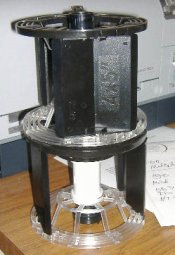
I have 2523 tank with 2509 or 2509n reels (not sure which one - but I don't have any plastic flaps I have read about).

Still seems like I get best results with paterson orbital but it causes some extra density to the edges especially with XTOL 1+1.
 
One thought - how big is your deep tank? I've never had a problem using the old Kodak deep tanks (5 gallon from memory?? the ones that could take 8x10 film hangers).

I could process 20 sheets of 5x4 at a time (that was as many holders as I could grab in 1 hand) - agitate continuously for the first minute - in, out, in out drain to the left, in, out and drain to the right, then do the same thing for 15 seconds each minute (about 3 or 4 agitations a minute) for the whole dev time.

I used to use ID11/D76 (with replenishment) and never had uneven development.

I use a Jobo and get excellent results.... I use a CPE 2 processor and a tank which holds a reel that holds 6 sheets.

The trick with processing film in a Jobo is to use a pre-wash first - I do a 5 minute pre-wash before putting the dev in, and have never had any un-even development (I learn't this trick from the guy who was the local Jobo sales rep for the distributors back in the day-he said not pre-washing was the most common cause of uneven development for color slides). And I use the slower of the 2 rotation speeds.....
 
forgot to mention one thing - if you're using deep tanks you don't need to be too gentle - if you go really slowly you don't seem to "flush" the film surface with fresh chemistry

in/out of the chem should take a couple of seconds...
 
Thanks!

My tank is about 1400cc (0.37 gallon). I will do another test with increased agitation, one minute continuos and one or two agitation cycles per 30 seconds.
I think that I am still too gentle with dip'n'dunk :smile:
 
In dip n dunk processing don't forget to maintain good agitation in the fix as well or you may get bromide streaking, from the film clips. I probably wouldn't choose Rodinal as first choice for sheet film either, use a more robust, replenishable deep tank developer like HC110, D76 or xtol.
 
have you tried turning the film around in the film rack? with some racks if the film is emulsion back rather than emulsion front this happens due to currents in the developer during agitation. At least I recall something about that from my study days when people were dip and dunk processing in small tanks with kodak hangers?
 
In and out 10 times the first minute with tip and drains. The initial 30 sec are critical so keep it moving as fast as you can. The drains will not be complete.

You will find a hangar rack is of great value. Arkay made mine for and obscene amount of money. Worth every penny.
 
Jobo Reel 2509N

Hi Jukka,

These are the sheet film reels I use. The kit comes with baffles for different sizes of sheet film.

Neal Wydra
 

Attachments

  • Jobo Reel 2509N.jpg
    Jobo Reel 2509N.jpg
    37.4 KB · Views: 137
Moving the hangar in the developer is insufficient. You MUST lift, tip, drain, reimmerse. 8 times the first minute, then twice every 60 sec, once left, once right.

This is not dip and dunk. D&D is nitrogen burst agitation. It is perfect always every time.
 
Photrio.com contains affiliate links to products. We may receive a commission for purchases made through these links.
To read our full affiliate disclosure statement please click Here.

PHOTRIO PARTNERS EQUALLY FUNDING OUR COMMUNITY:


Ilford ADOX Freestyle Photographic Stearman Press Weldon Color Lab Blue Moon Camera & Machine
Top Bottom