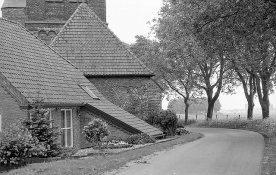
Rodinal is a non-solvent developer, which means it doesn't reduce grain. If you start with fine, slow film, you end up with a very fine result. If you start with a coarser faster film, you get larger grain than you would have with a solvent ("fine grain") developer like D-76 or Xtol.
So people will see huge grain on Tri-X with Rodinal, assume Rodinal is bad for grain. Whatever.
Put some fine grain film (Acros, TMX, Pan-F, Efke/Adox 25) through Rodinal at 1+50 and you will not see a "grainless" result, but it will be very fine grain with huge resolution, good acutance and lots of detail. If you use D76 or Xtol instead, it will look smoother but that's because the solvent in those other developers softens the grain and dissolves away some detail to gain smoothness.
You need to be careful to distinguish between the size of the grain and the magnitude (brightness ratio) of the grain; they are quite separate concepts yet people think of "graininess" as just a single scalar value. Think of it as the difference between wavelength and amplitude.
If you under-expose and push or increase contrast in post (scanning or higher paper grades), the contrast increase will increase the grain magnitude, so don't do that.
If you agitate Rodinal more or run it at higher temperature, you get (to overgeneralise a bit) more grain. Less agitation (3 inversions at the top of every minute, perhaps once every couple minutes) and developing at 20C will minimise grain.
Example, Efke-25 (same as Adox CHS-25) in Rodinal 1+50:
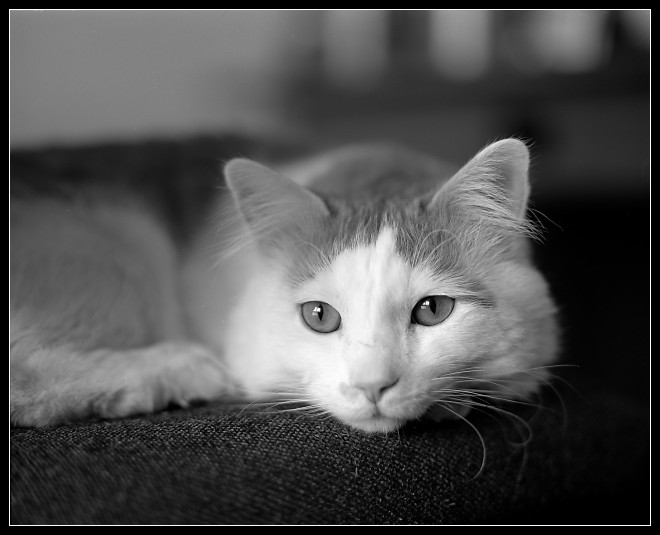
Perhaps you really want "smooth" not fine-grain though, in which case try using D-76 instead of Rodinal. The more-concentrated the D76 or Xtol you use, the more solvent action, therefore these developers at stock concentration will give smoother results than at 1+1 dilution, at the cost of very fine detail. And try some TMX too, that's much easier to shoot than Efke-25 and about the same resolution.




 ..and I think that's because you underexposed the film and tried to squeeze the results through a scanner, which gets goofy when you try to obtain information on scanned regions that are blank or plain black resulting in some digital noise added to the scanned areas.

 . Now I understand what people mean with developing color is easier than b/w...