

• Welcome to Photrio!
    Registration is fast and free. Join today to unlock search, see fewer ads, and access all forum features.
    Click here to sign up

Gator skin - what's up?

Recent Classifieds

Forum statistics

Threads
201,768
Messages
2,829,817
Members
100,935
Latest member
Fablesilence
Recent bookmarks
0

Erik L

Member
Allowing Ads
Joined
May 9, 2007
Messages
838
Location
Grand Junction CO
Format
8x10 Format
Hi Folks,
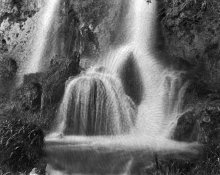
I was giving my first try with 8x10 efke pl100 and have this "gator skin" look to the highlights. The exposure was a 5 mississippi count. Since I didn't do any testing to get a proper developing time I decided to use a stand technique. My procedure was Pyro HD 2+2+450 and I agitated for the first minute vigorously in an 11x14 tray and let it sit after that for 45 minutes. This is a technique I use frequently with foma 100 in 11x14 size and have never seen the gator skin before. Is this bromide drag? I haven't experienced it before so I don't know what to look for. Any clue what's up folks? thanks for any help
regards
erik
 

Attachments

  • gator skin.jpg
    gator skin.jpg
    101.4 KB · Views: 313

E76

Member
Allowing Ads
Joined
Mar 20, 2008
Messages
401
Location
Baltimore, MD
Format
Medium Format
I had the same exact problem with Efke 25, but never figured out the cause. I assumed at the time that it had something to do with the developer being too warm (IIRC, it was around 80°F), thereby reticulating the emulsion, but I cannot be sure.
 
OP
OP

Erik L

Member
Allowing Ads
Joined
May 9, 2007
Messages
838
Location
Grand Junction CO
Format
8x10 Format
I think my developer was at room temp? It only appears in the highlights - but I'm open to any conclusions. BTW, it happened in 4 negs and only in some of the highlights.
regards
erik
 

Poohblah

Member
Allowing Ads
Joined
Aug 30, 2008
Messages
436
Format
Multi Format
Reticulation doesn't look like that. I doubt that reticulation would be visible on a contact print anyway.

That's really strange though! None of the books I've read warned about this problem. But if the source of the problem is pinpointed, that seems like a really cool technique to use for some alternative sort of prints.
 

Mark Antony

Member
Allowing Ads
Joined
Mar 27, 2007
Messages
789
Location
East Anglia,
Format
Multi Format
Really tricky to diagnose, it doesn't look like a classic case of reticulation, but I'll bet it is mild type. Do you use a warmer pre-wet or is it possible that you went from a very cold running tap wash to a room temp stablilser?
It looks like some kind of gelatin expansion/shrinkage to me. These older thin emulsion films have softer gelatin compared to say T-Max (which Kodak tell me can be washed in hot water) which has hardened gelatin. So if you are using your T-Max developing modus, you may come up with a few problems with old style emulsions.
It will be more noticeable in mid/hi-light region.
Just my guess.
 

2F/2F

Member
Allowing Ads
Joined
Apr 29, 2008
Messages
8,031
Location
Los Angeles,
Format
Multi Format
That's awesome. Don't change a thing!
 
OP
OP

Erik L

Member
Allowing Ads
Joined
May 9, 2007
Messages
838
Location
Grand Junction CO
Format
8x10 Format
Really tricky to diagnose, it doesn't look like a classic case of reticulation, but I'll bet it is mild type. Do you use a warmer pre-wet or is it possible that you went from a very cold running tap wash to a room temp stablilser?
It looks like some kind of gelatin expansion/shrinkage to me. These older thin emulsion films have softer gelatin compared to say T-Max (which Kodak tell me can be washed in hot water) which has hardened gelatin. So if you are using your T-Max developing modus, you may come up with a few problems with old style emulsions.
It will be more noticeable in mid/hi-light region.
Just my guess.

Perhaps Mark - that might have happened with water temp? I guess I'll pay greater attention next time to my pre wet temp. It came out of the fixer looking that way so it can't be the wash water temp. Just kind of baffling to me.
regards
Erik
 

Nicholas Lindan

Advertiser
Advertiser
Joined
Sep 2, 2006
Messages
4,313
Location
Cleveland, Ohio
Format
Multi Format
Looks like random convection patterns in stagnant water in combination with developer exhaustion, the developer exhausts first over the highlights. Expected results in my book.

Agitation and a less homeopathic developer should cure it.
 
OP
OP

Erik L

Member
Allowing Ads
Joined
May 9, 2007
Messages
838
Location
Grand Junction CO
Format
8x10 Format
Looks like random convection patterns in stagnant water in combination with developer exhaustion, the developer exhausts first over the highlights. Expected results in my book.

Agitation and a less homeopathic developer should cure it.

Nicholas, now that sound plausible to me. I'm not sure where the flow patterns come from unless it was the initial agitation for a minute because it was standing still for 45 minutes. Maybe it happened when I removed it from the tray and put in the stop which would be the only other time the developer would have moved over the film. Guess I won't be stand developing this combo anymore.
regards
erik
 

Nicholas Lindan

Advertiser
Advertiser
Joined
Sep 2, 2006
Messages
4,313
Location
Cleveland, Ohio
Format
Multi Format
The flow patterns are due to very small thermal gradients - fractions of a degree, the sort of thing you can't get rid off - that set up small convection cells. The surface of the developer will be cooler due to evaporation, as the water cools it becomes denser and falls to the bottom of the tray where it displaces warmer developer that rises to the top. There will be additional gradients due to the developing process as the developing agent is oxidized and halides are given off resulting in small changes in developer density.

You will only see these patterns when the developer is standing quite still with no agitation.
 
OP
OP

Erik L

Member
Allowing Ads
Joined
May 9, 2007
Messages
838
Location
Grand Junction CO
Format
8x10 Format
The flow patterns are due to very small thermal gradients - fractions of a degree, the sort of thing you can't get rid off - that set up small convection cells. The surface of the developer will be cooler due to evaporation, as the water cools it becomes denser and falls to the bottom of the tray where it displaces warmer developer that rises to the top. There will be additional gradients due to the developing process as the developing agent is oxidized and halides are given off resulting in small changes in developer density.

You will only see these patterns when the developer is standing quite still with no agitation.

Thanks Nicholas, I would have never thought of that explanation. I'll chalk it up to a learning experience but am confused why my foma 100 doesn't do a similar thing with stand development?
regards
Erik
 

Nicholas Lindan

Advertiser
Advertiser
Joined
Sep 2, 2006
Messages
4,313
Location
Cleveland, Ohio
Format
Multi Format
confused why my foma 100 doesn't do a similar thing with stand development?

That's the real question - some possibilities:

  • More developer per unit of film area
  • Greater developer depth
  • Less temperature difference developer to air
  • Less temperature difference bench/sink/tray to developer
  • Less bromide in Foma emulsion
  • 8x10 Vs 11x14 film size
It may be that the conditions that exhibited the problem were unique with just the right temperature gradients and a second film developed with the same stand regime would not exhibit the same problem.

It is a bit like being hit by lightning while playing golf in a thunderstorm: it is to be expected; but playing golf in a thunderstorm is no guarantee of getting hit. The 'gator skin' effect is to be expected, but there is no guarantee of it happening.

And of course, there is no guarantee of the convection cell theory being correct - the problem could be due to something completely different such as a film manufacturing defect.
 
OP
OP

Erik L

Member
Allowing Ads
Joined
May 9, 2007
Messages
838
Location
Grand Junction CO
Format
8x10 Format
Nicholas, thanks for thinking this through. I liked your original theory whether it's true or not:smile:
regards
erik
 
Photrio.com contains affiliate links to products. We may receive a commission for purchases made through these links.
To read our full affiliate disclosure statement please click Here.

PHOTRIO PARTNERS EQUALLY FUNDING OUR COMMUNITY:


Ilford ADOX Freestyle Photographic Stearman Press Weldon Color Lab Blue Moon Camera & Machine
Top Bottom
