
• Welcome to Photrio!
    Registration is fast and free. Join today to unlock search, see fewer ads, and access all forum features.
    Click here to sign up

FX-1 TEA semi-stand developer

Forum statistics

Threads
203,120
Messages
2,850,084
Members
101,679
Latest member
thatguysitanio
Recent bookmarks
1

Alan Johnson

Subscriber
Allowing Ads
Joined
Nov 16, 2004
Messages
3,426
FX-1 is the highest acutance developer of all but with a pH about 11 it is a bit grainy.I replaced the carbonate B solution by dilute TEA giving a pH about 9.5.
A-Metol 5g, Sodium sulfite 50g, Water to 1L
B-TEA 200ml, water to 1L
For use take 1 part A, 1 part B, 8 parts water
Develop 4-5 times as long as D76 1+0 time, agitate 1 min then 30s every 8 min for 35mm, every 4 min for 120.
IMO high acutance developers show the effect best if printed slightly contrasty.
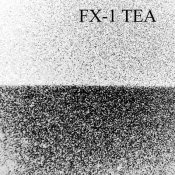
Attachments show positives from approx 1mm squares of APX-100 negative,photos of a black card on a gray card ,developed in FX-1 and FX-1 TEA.Adjacency effects can be seen.On prints from actual scenes, the grain is somewhat reduced with the TEA version.
Metol exhaustion may give highest acutance but the experiment shows patience is needed to go down this route.
 

Attachments

  • fx-1 copy.jpg
    fx-1 copy.jpg
    199.7 KB · Views: 198
  • fx-1 tea copy.jpg
    fx-1 tea copy.jpg
    196.9 KB · Views: 204
Good stuff, Alan!

Thanks!
 
Alan, are your examples from 35mm or 120? have you found that 35mm is conducive to the generating of adjacency effects than 120, all things being equal? thanks for sharing your efforts!
 
The absolute width of adjacency effects tends to be dependent on absolute image size. Any developer that produces these efects will tend to make them more obvious the smaller the image of the same scene.
 
Incidentally, TEA also makes a good substitute for Kodalk solution in PMK. I think it was the one organic base that Hutching did not investigate. Now, since 1:1:50 using TEA:tongue:MK:water is a good combo, I figured I could pervert the PMK by mixing it in TEA. The buggers are sulfite and Metol. I substituted 4 grams of ascorbic acid and 2.5 grams of p-aminophenol base along with the 50 grams of pyro to make 500 ml stock and I think I've got it: a single solution PMK. Thanks to Gordon Hutchings for the seminal ideas and apologies to him for the perversion.

 
That's right the dimensions of the adjacency effects do not depend on the size of the negative.To demonstrate the adjacency effect,not for routine printing, make a dark high contrast print.I have only used AP100 with this developer.From other work it seems likely T-max 100 will give very little edge effect.Most effect is probable from Adox/Efke 25,100, Plus-X,but at the expense of resolution.If 120 is not enlarged as much as 35mm the lines will of course appear thinner.
From the Film Developing Cookbook p55 "Some experts on high definition developers,particularly Crawley, believe that borax and Kodalk impair definition, giving a "fuzzy" appearance to the grain."
Therefore TEA not metaborate is the stuff to use with the A solution of FX-1.
 
Therefore TEA not metaborate is the stuff to use with
the A solution of FX-1.

Blends of bicarbonate and carbonate will yield a range of ph.
A ph of approximately 8 to 11 may be achieved. Photo grade
sulfites, the carbonates, the borates, and likely TEA, have
an acceptable range of ph. I wouldn't be surprised to find
sodium sulfite with a ph equal to or exceeding that of
metaborate.

For the darkroom employed determining the ph to some
degree of accuracy, say 0.1 ph, is the problem. Carefully
conducted exact activity tests may be a good indirect
measure of ph. Those though not so easy. Dan
 
...so whether the lens has a higher resolving power ( i'm assuming the standard lens in 35mm will have a higher resolving capacity than the 80mm lens in the 120 format ) has little bearing?
 
That's a strange question. The lens is not resolving the Mackie line, I'm sure we know. One might think that the line that was sharpest to begin with might have the most well-defined area of chemical activity that creates the Maclie line. In that case, the lenses that need accuity enhancement the least would get the most. One thing we know is that too much accuity "enhancement" can play havoc with lens resolution tests.
 
Blends of bicarbonate and carbonate will yield a range of ph.
A ph of approximately 8 to 11 may be achieved. Photo grade
sulfites, the carbonates, the borates, and likely TEA, have
an acceptable range of ph. I wouldn't be surprised to find
sodium sulfite with a ph equal to or exceeding that of
metaborate.

For the darkroom employed determining the ph to some
degree of accuracy, say 0.1 ph, is the problem. Carefully
conducted exact activity tests may be a good indirect
measure of ph. Those though not so easy. Dan

If you depend on pH as an indicator of activity suitable for sorting developers into categories, I don't think you'll get very far. There will be a lot of scatter in your curve. For a given developer, it's pretty well accepted that if it's activity doesn't suit the purpose, you can usually add some acid or base to change it, but you might find that the change of pH that satisies the need is not more than the probable error of measurement of even a pretty good pH meter. There are time when you need the mindset of a chef, who goes by dashes, drops and smidgeons. A friend of mine and his friend were working on designing a piece of electrical apparatus for some psychological test or other and thay couldn't get it to work as planned. They tried everything they could think of and were about to give up when it started working. Close examination showed a couple of wires that were not supposed to be connected got crossed. They simply soldered them together and poured on the potting compound. What do you think is the possibility that this has been the beginning of some of our most useful machines and processes? Goodyear, Edison, Eastman and others followed the Princes of Serendip into fame. Edison, IIRC, it was who said "Genius is 1% inspiration and 99% perspiration.
 
a sharper line encourages migration of developer over from low density to high density ie the ole knife edge test. if the edge was 'blurry' ie not as sharp ( like when i compare edges rendered between 35mm and 5x4 - 5x4 giving lower lppm performance) then the edge effect is not as pronounced. the few examples i have found on the web funnily enough happen to use 35mm. was curious if anyone had successfully done it with medium format. so, yes i'm sure we're alll reading off the same page regarding mackie lines being chemical and not optical, but, it seems, the sharper the line, irrespective of enlargment, the easier it seems to draw out adjacency lines... unless mr johnson did use a big camera...
 
It gets a little stickier, or maybe simpler, when we talk about angular resolution instead of lines/mm. Then, the resolution of a large format lens is not much different from a 35 mm lens, given the same angle of coverage. My head is spinning now, so it would be a good time for someone else who has both 35 mm and 4x5 or larger to solve the problem experimentally. A further factor is that 35 mm is generally enlarged, which brings another lens into the picture that may not be involved in, say, 8x10, or 10x8 if you are British. At any rate, a Mackie line of a certain width will be affected by the enlarging lens, but not by the camera lens, and we're still left with an experiment to do IMHO.
 
Dan was right about the bicarbonate buffer.

Buffered FX-1 semi-stand developer:
A- Metol 5g, Sodium Sulfite 50g, water to 1L
B- Sodium Carbonate anhydrous 10g, Sodium Bicarbonate 14g, water to 1L
For use take 1 part A, 1 part B, 8 parts water.
Develop 5 times as long as the time for D-76 1+0.Agitate 1 min then 30s every 8 min for 35mm, every 4 min for 120.
I have tested this,all my posts refer to 35 mm here, the working solution pH is about 9.5 and once again find the grain is somewhat reduced compared to normal FX-1.
Speed increase from FX-1 plus from semi stand gives EI 160 sun/shade with APX-100.
I dont see any obvious differences to the TEA version.
 
Photrio.com contains affiliate links to products. We may receive a commission for purchases made through these links.
To read our full affiliate disclosure statement please click Here.

PHOTRIO PARTNERS EQUALLY FUNDING OUR COMMUNITY:


Ilford ADOX Freestyle Photographic Stearman Press Weldon Color Lab Blue Moon Camera & Machine
Top Bottom