• Welcome to Photrio!
    Registration is fast and free. Join today to unlock search, see fewer ads, and access all forum features.
    Click here to sign up

Fujinon EP 75mm versus El-Nikkor 80mm

Rainy Day Trees

A
Rainy Day Trees

  • 4
  • 0
  • 59
One Way

A
One Way

  • 1
  • 1
  • 57

Forum statistics

Threads
203,153
Messages
2,850,625
Members
101,700
Latest member
Cpeason301
Recent bookmarks
0

BetterSense

Member
Allowing Ads
Joined
Aug 16, 2008
Messages
3,151
Location
North Caroli
Format
35mm
If you had one of each of these lenses and had to choose which one to keep, which would it be?
 
sharper

The lens that gives me the sharpest prints with my darkroom setup. What works for anyone else in other darkrooms does not mean anything.
 
They both have clean elements. I guess I will keep the nikkor because it's faster. I don't have time to perform a good comparison test.
 
The 75mm Fujinon is a 3 or 4 element lens, the 80mm Nikkor is a top of the line 6 element lens. Howard Tanger
PS: BTW, there will be replys to this post stating that the person gets excellent results from their 3 & 4 element lenses. If so, what is the reason for 6 element lenses? Do not tell me $$$.
 
From what I have read the Fuji is a 6 element. The nikon has illuminated click stops and that is worth something.
 
The top range of Fujinon enlarging lenses was Fujinon EX wasn't it? I have a 90mm f5,6 EX (with illumination, rotatable housing, adjustable clicks etc.) and it produces the most attractive results of any lens which I have - and that includes Componon-S and Rodagon. Most likely the EP was either fewer elements or different coating or both? Were there also several 'grades' of 80mm Nikkors? I know I have a 50mm f4 Nikkor which is a four element design, and not stunning at all.
 
Fujinon EP are 6 element, 4 group lenses source here. ES are 4 element, 3 group. (and yes, ES<EP<EX)

"EL-Nikkor" could mean anything, they didn't change the name when they upgraded the formulae, you'd have to post a photo so we can identify which it is. (although if you've got the original box, they were stamped with 'N', but afaik the lenses weren't. My lens isn't marked 'N' but my box is, but no guarantee it's the right box for the right lens).
I think that the f/2.8 Nikkors were the new 6/4 versions and f/4 are older 4/3, but there are probably exceptions even if this is roughly true.
Edit: Wikipedia has f/2.8 N as 6/4 Double Gauss, and f/4 N as 4/3 tessars, the non-N f/5.6 in longer lengths are 6/4 Orthometar and nothing said about shoter non-Ns. And as is the problem with them thar wikis, there's no source listed.
 
Last edited by a moderator:
Evaluate your individual lenses to decide.

To correct earlier mis-information, Fujinon EP lenses are 6 element top of the line professional lenses with excellent build quality. Fuji EX lenses are the same with the addition of EBC (Electron Beam Coating) on the glass and illuminated aperture windows.
 
They both have clean elements. I guess I will keep the nikkor because it's faster. I don't have time to perform a good comparison test.

I doubt you'll find much difference in optical performance between the two.Just don't sell them.You'l nnever get what they are worth:wink:
 
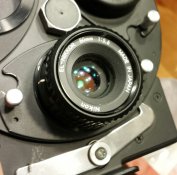
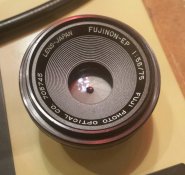
Here are some quick snaps of the lenses.

Ordinarily I would test the lenses. My Darkroom is boxed up for a move and I am trying to simplify my junk before moving it. These lenses are redundant so I should keep only one of them but I can't test right now.
 

Attachments

  • 2014-07-20 22.16.42.jpg
    2014-07-20 22.16.42.jpg
    615.8 KB · Views: 405
  • 2014-07-20 19.31.15.jpg
    2014-07-20 19.31.15.jpg
    865.8 KB · Views: 422
A couple of thoughts ....

Enlarging lenses from different manufacturers tend to have different characteristics. The differences will most likely be subtle, but real. You may find, for instance, that one is appreciably better for really large enlargements. Or that the colour response of one is more consistent with your other lenses for other formats when you print colour sensitive materials.

And you may find that one (probably the 80mm) will actually work well with 6x7 or even 6x8 negatives, whereas the other will max out with 6x6 negatives.

I definitely wouldn't sell one until I've tried them both. You might like one better than the other.

I have a lot of different lenses, of a variety of different focal lengths. Most of them are on two turrets. You might find it convenient to have a 75mm lens on one turret (say with lenses used more frequently with smaller formats) and an 80mm lens on another turret (say with lenses used more frequently with larger formats).

By the way, they both appear to be the same "speed" - f/5.6 maximum aperture.
 
Note that the listed coverage of the Fujinon 75/5.6 EP in the link in post #9 is 56mm x 56mm: 6 x 6cm format.

If the intended use is 6 x 7cm enlarging, the 80/5.6N EL Nikkor shown in the photo of post #12 is suitable. The 75/5.6 Fujinon EP is not.
 
The relatively fast El Nikkor 75/4 is a poor performer with med format negs, but is quite acceptable when you use only the center of the field,
for 35mm negs. The 80/5.6 is much better corrected, but is still really meant for 6x6 or 645 usage. I'd want something longer for 6x7 or 6x9.
I really like the 105 Apo Rodagon N; but 90 apo lenses are also available. A distinct level of snap that you don't get with ordinary enlarging lenses. Of course, Nikon once made a 105 Apo El Nikkor; but most people can't afford that, even if they can find one.
 
When Fuji still made enlarging lenses their top-of-the-line line was the EX series. The EP occupied a lower price point, presumably because of simpler construction. They weren't the only manufacturer to do this, Schneider and Rodenstock also offered several different lines, trading price for performance. I have to believe, given the size and weight of enlarging lenses in this focal length range, that you can find space to move both of these so you can do your own testing after you've set up a darkroom in your new location.

BTW, Nikon's literature claims that the 80mm f/5.6 is usable for 6x7, though undoubtedly a longer lens would be even better as Drew points out. I've used my 80mm El-Nikkor for this format when I needed a lot of enlargement, though I normally use a 105 to gain a little more room between lens and paper.
 
Last edited by a moderator:
The Fuji EP series were 6/4 design as were the shorter EX series but the longer EX were 6/6. The EP were single coated vs. the EX having EBC coating. Their EX series was their ultimate line and many say the EX line is better than Componon-S and regular Rodagon and nearly as good as (or as good as) Apo Rodagon and Apo Componon HM within their proper magnification range. Don't forget the Computar DL series and their re-badged varieties such as Beseler Color Pro and Hoya Super EL.
 
Photrio.com contains affiliate links to products. We may receive a commission for purchases made through these links.
To read our full affiliate disclosure statement please click Here.

PHOTRIO PARTNERS EQUALLY FUNDING OUR COMMUNITY:



Ilford ADOX Freestyle Photographic Stearman Press Weldon Color Lab Blue Moon Camera & Machine
Top Bottom