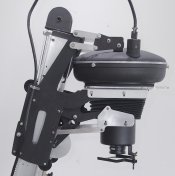
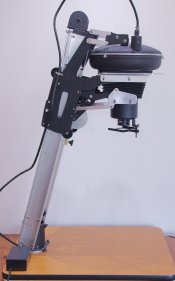
As my Automega E-5 5x7 enlarger project winds down, I thought I'd give a synopsis of the project, and thank some of the folks who helped keep it going. I'll also indicate some of the materials and sources I used, in the event someone might find it useful. A couple of photos of the enlarger now:
In earlier posts to this thread I've mentioned my initial troubles removing the old paint from the lamphouse interior. The upper half of the lamphouse is made of steel, the lower half of aluminum. I didn't fully appreciate the consequences of this difference before charging ahead with the old paint removal. I resorted to sandblasting, which removed the paint but caused the flat bottom of the (aluminum) lamphouse bottom section to warp.
I tried to clamp the distortions out, using bar clamps and several flat wooden disks matched to the flat bottom, inside and out. I kept the clamps on for about a week, tightening the clamps daily. Kino suggested something similar, and that did reduce the warpage. I then tried (gently) pounding the remaining irregularities out using wooden disks as support inside the unit, and a 1" thick, 12" long straight steel bar across the outside of the deformed bottom (less barbaric than it sounds). That seemed to settle the issue.
3M Black Super Weatherstrip and Gasket Adhesive - a contact cement - worked well to attach a 5/16" thick gum rubber mat from McMaster-Carr (Wear-Resistant Natural Gum Foam Sheet 5/16" Thk, 36" Wd, Ultra Soft, 1 ft. Length, #8601K44) to the flat bottom surface of the lamphouse. I didn't get the mat on perfectly though, so I made a circle-cutting jig that fit snugly inside the 5x7 hole in the bottom of the lamphouse half. The result was a tidy circular mat that centered well on the circular lamphouse bottom. The mat had just the right amount of squishiness for the omegalite head.
Although the remedy for the deformation of the bottom half of the lamphouse seemed pretty good at the time, 7 weeks down the road some of the deformation had returned - enough so that the new gum rubber mat no longer made a light-tight seal with the top of the negative carrier. I decided to trim the rubber mat, rather than tearing it off the lamphouse and trying some other fix on the distortion of the lamphouse floor.
To that end, I built a "router sledge" that allowed me to maneuver a router bit along the width and length of the mat, at a constant height. Of course I cobbled together a test piece before tackling the lamphouse: first attempt = shredded mat scrap. By-and-by I figured it out and ultimately flattened the mat using the router sledge. I carefully sharpened the router bit beforehand, and as a result got a good finish on the mat. Fingers crossed that the stresses in the lamphouse have equilibrated.
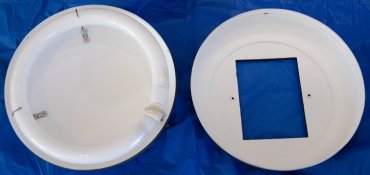
The interior of the lamphouse is now a bright flat white. The attached photo doesn't quite do the whiteness justice. Finding an flat white aerosol in a quality paint took a bit of doing. After investigating the spray primers and paints available at the local big box stores,I wasn't convinced that they would deliver what I wanted: flat finish; high reflectivity; very good adhesion; resistence to crackling/peeling from temperature variations; mated with a high-build primer. Ultimately, my choices were an SEM high-build aerosol primer (16 Ounce Gray Primer/Surfacer #42013) and a compatible flat white paint: Dupli-Color DA1672 12 oz. Flat White Aerosol Premium Enamel.
The rest of the enlarger restoration was pretty simple by comparison. I stripped it down completely, removed rust and oxidation on parts I didn't plan to replace, and sanded most aluminum parts with 600 grit sandpaper to restore their sheen. Most of the screws, washers and nuts needed cleaning or replacement, and as they were mostly standard #8x32 or #8x24, replacement was easy. The wire wheel on my dremel made short work of most rust on those parts that I didn't replace. There was a fair amount of congealed/hardened lubricant in a few spots (along the rail guides mostly), easily removed. I elected not to replace that lubricant, as the rails move freely through the guides. I used a hard wax on the rotating pins.
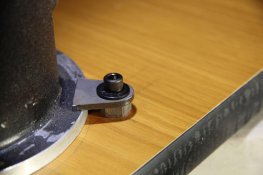
The enlarger had no base board or base clamp initially. The local Habitat for Humanity ReStore contributed a $5 formica-covered board, size and condition nearly perfect. The entirely adequate base clamp system came together using 1/4-20 bolts, weld tabs, and some washers and nuts, for under $20. Photo attached. The OEM part was available, but at an exorbitant price. Most of the remaining missing parts would be more expensive, or take a lot more effort to jimmy.
There were five or six tiny pinholes in the bellows (which were probably without effect), easily patched with Permatex Ultra Black Gasket Maker. The bellows detaches from the upper aluminum frame (which acts as the receptacle for the negative carrier as well) easily via 8 tiny screws, almost no fuss at all. Otherwise the bellows is in good shape.