• Welcome to Photrio!
    Registration is fast and free. Join today to unlock search, see fewer ads, and access all forum features.
    Click here to sign up

fogged film -a very basic question

Recent Classifieds

Forum statistics

Threads
203,218
Messages
2,851,585
Members
101,728
Latest member
Luis Angel Baca
Recent bookmarks
0

thebanana

Member
Allowing Ads
Joined
Nov 4, 2004
Messages
2,666
Location
Manitoba, Ca
Format
Medium Format
How does one know when film is fogged? What does it look like when developed?
 
Good Evening,

Until film is developed, there's normally no visible evidence of fogging. Fogging can take on a wide variety of appearances. A small camera light leak might show up on the normally-clear film edge as a darker area, the degree depending on the amount of stray light accidentally hitting the film. A more more serious light leak may have similar areas of extra density within the images themselves. Sometimes the effect is very subtle; other times, there can be enough fogging to ruin an image, either partially or completely. One almost sure way to get fogging is to open accidentally a camera back at the wrong time. Another is to pull a dark slide while the shutter is open for focusing. I, along with many others, have done both of the preceding. Loading film into a tank in an area which isn't completely dark can also fog film, often with overall reduced contrast or completely ruined images when the film is processed. Film can gradually become fogged as it ages, although this takes a loooong time with many B & W films. Such film, when developed usually has low contrast and produces rather dull-looking prints . All the above is just for openers; no doubt others will be able to add lots more possibilities and variations.

Konical
 
How does one know when film is fogged? What does it look like when developed?

Look in this APUG thread for an example: (there was a url link here which no longer exists)

The edges of the upper negative image show low transmission density - which I interpret as low level of film base density plus low fog density (aka Base plus Fog density).

The edges of the lower negative show much higher transmission density which I interpret as combination of the film's base density plus any fog density.
 
Static electricity discharges can leave 'lightning bolt' or 'smoke swirl' marks on film or paper. Usually associated with low humidity environs and rapidly rewinding roll film, or separating sheets of lf film or paper.
 
Fog, it can be overcome, to some degree

I have some old film still stashed.

New film when measured with a densitometer, or compared to a step wedge, usually has a desnity where it has not been exposed to light of about 0.07 to 0.1 - the almost clear part of a step wedge.

As film fogs, the not exposed to light part starts to gain density - to say 0.15 - one or so steps down on a 21 step step wedge.

To compensate for this, you need to develop longer - to get more density from areas that were exposed to light. It also helps to use the film in lighting situations with low contrast. Otherwise the highlights of the scene are going to fall on the area of the characteristic h/d S curve where the densest areas of the film have thier tones compressed.

In a physical analogy - you are trying to lift your skirt up a bit so the hem does not drag in the dirt. You just don't want to get up on tippty toes if you are in a room with a low ceiling.

Fogged film also tends to have also lost speed if it has fogged due to age. Do a personal film speed test on any large batch of fogged film that comes your way.

The other old skill that can hold you in good stead with fogged batches in early testing is the art of developing by inspection after about 80% or the recommended development time has passed. A lot of fogged films need more time in the developer to get a reasonable contrast from a long scale negative that is developed to sit above the fog floor.
 
How does one know when film is fogged? What does it look like when developed?

Fog appears on negative film as an decrease in the thick densities that does not follow expected image contrast.

There are different kinds of fogging.

Age fog is an increase in base fog and thus lowering of contrast. In early stages usually undetectable without a densitometer, or long time experience with a stock, in later stages visible as muddy highlights or general lack of contrast.

Flash fog (exposure fog) arises from inadvertent exposure to light, and includes a range of streaks, edge density, shapes, etc. directly related to the leak.

Xray fog is when your film gets fried in an xray machine. The fog from Xrays usually gets served up in a band or sine wave type pattern. On roll film the stripe can be fogged through the edge of the roll, resulting in increasing and decreasing levels of fog as one advances through the roll.

Base fog is the natural fog inherent in whatever film and process you choose. An unexposed frame is processed to find base+fog for a particular film/developer.This can be measured with a densitometer, or through some printing exercises.

There are other kinds of fogging, chemical fogging from bad processing etc.

Morning fog is what I have on Sunday morning. It is indicated by an empty tequila bottle, a headache, and a vague recollection of something or other.

 
Last edited by a moderator:
[...] There are different kinds of fogging [...]

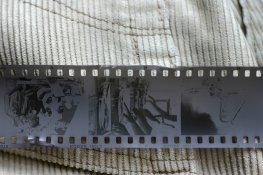
i've just stand developed a three frames test strip (35mm rollei retro 100) for 8 and a half hours, using 1ml of rodinal with ~300ml of water and NO agitation at all.
the neg came out nicely done but with some sort of fogging to it, similar (but less apparent) to what happens if the fixer is dying/dead, just that it didn't go away after refixing (even in undiluted fixer). the scanner is not happy at all to do it's thing - low contrast, blown exposure...
there's also a very small zone of clear base on the film edge, that i suspect to be due to a slightly tilted tank (i put it on some old clothes), confirming even further that it's not fixer-related.

it looks smth like this (visible images when the film is held against any background). any suggestions? (i've tried this method after seeing an impressive scan on flickr - 1:333 dilution for 8h, 25 mins)
 

Attachments

  • IMG_8662.jpg
    IMG_8662.jpg
    178.7 KB · Views: 1,041
Photrio.com contains affiliate links to products. We may receive a commission for purchases made through these links.
To read our full affiliate disclosure statement please click Here.

PHOTRIO PARTNERS EQUALLY FUNDING OUR COMMUNITY:


Ilford ADOX Freestyle Photographic Stearman Press Weldon Color Lab Blue Moon Camera & Machine
Top Bottom