You get similar results if your single coated lens has just the right amount of flare and the highlights in your image have just the right intensity. Note that Athiril's work requires very well dialed in preflash. Add too much, and you kill all detail in the shadow regions, add to little and you end up with no improvement.
BTW we should make a distinction whether someone preflashes film or paper. Preflashing film, if done right, provides some extra shadow detail, whereas as far as I have understood this, preflashing of photographic paper somewhat reduces image contrast and reduces required exposure time for big enlargements. Could some of the expert printers fill me in on that?
Rudi,
You're right, there seems to be some confusion on this thread about what material we are flashing. The OP really wanted to know about film, although Bob and Ian mistook this and gave info about flashing paper.
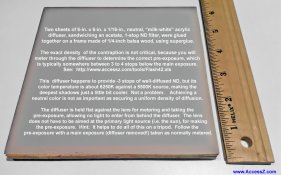
Just for the sake of clarity: flashing affects the low-density area of whatever material you are flashing. With negative film, this is the shadow densities. With paper (not-reversal), flashing affects the highlight densities. With reversal film (slides, transparencies, b&w reversal), flashing affects the highlights.
Furthermore, the effect of flashing is very similar to that of overall flare in an optical system, just more precisely controllable.
In any case, the flashing adds a layer of overall exposure to that of the image exposure. This allows details in the low-density areas to be rendered that would otherwise have fallen below the exposure threshold; again, for film the shadows, for prints and reversal materials, the highlights.
Also, in any case, and as David Allen so nicely explained, the overall flash exposure adds a certain unit of exposure to all other exposures, affecting low-density areas more than high-density areas. This reduces separation/contrast in the low-density areas (shadows for negative film, highlights for prints and reversal materials).
Now comes the question as to usefulness. For me, it is a question of how our eye works. It tends to lose the ability to distinguish differences in tones in low light and in dark areas (e.g., print shadows). On the other hand, the eye is quite able to pick out small differences in density/tonality at higher levels of illumination and in brighter areas of a print. That makes flashing a print to tame the highlights vastly superior to flashing a negative to get more shadow density, but with less contrast, when we are simply trying to squeeze too much contrast into the material's range.
However, as David Allen explains, flashing negative materials will allow you to use a bit faster shutter speed/smaller aperture. That might be useful for black-and-white negatives in certain situations. Plus, there are times when getting a bit of shadow density is more important than tonal separation. That said, being able to give a bit more exposure will always result in more shadow detail and better shadow separation and, if that is what is desired, then flashing will work against it. The decision has to be made based on the subject and in full knowledge of the affects of flashing.
For color negatives, where processing options are more limited, flashing is a more useful tool, as Athiril's work demonstrates.
And, as I mentioned earlier, flashing transparency film to tame the highlights is a time-honored and very useful technique.
As for flashing black-and-white printing paper: for those negatives that have a really great density range, but still have information in the densest areas, flashing the paper will allow the image to be printed on a higher-contrast-grade paper, thus optimizing separation in the shadows and mid-tones while still getting detail in the lightest areas (which the eye is better at separating). Of course, if the highlight areas are easily burned, then burningh is often a better approach. But many times the highlights are too small or too complicated to burn effectively and without halos. In these cases, flashing the paper is really helpful. One can also use a bit of both, combining flashing and burning, to tame highlights and still keep the rest of the print from going too muddy. This is what I think flashing paper is best used for. Yes, it "reduces print contrast," but very selectively, in the highlights, and really allows one to keep more contrast in the mid and low tones since a higher-contrast grade con be used. It may reduce exposure time somewhat as well, but I would never use flashing just to reduce exposure time.
Best,
Doremus