• Welcome to Photrio!
    Registration is fast and free. Join today to unlock search, see fewer ads, and access all forum features.
    Click here to sign up

flashing and chemical hypersensitization

Emi on Fomapan 400

A
Emi on Fomapan 400

  • 3
  • 2
  • 38
Venice

A
Venice

  • 1
  • 0
  • 59

Recent Classifieds

Forum statistics

Threads
201,795
Messages
2,830,299
Members
100,953
Latest member
kevin1995
Recent bookmarks
0

BetterSense

Member
Allowing Ads
Joined
Aug 16, 2008
Messages
3,151
Location
North Caroli
Format
35mm
I have heard that preflashing to an amount just below that needed to create density will increase shadow speed. I use the technique myself in printing, but I'm not sure it's actually making the paper faster. How long does this effect last? Can I preflash a minute ahead of time, or an hour or day ahead of time? Does post flashing do the same thing?

What other treatments are there to increase the real shadow speed? I have heard that hydrogen does something; also, baking film?
 

Bob Carnie

Subscriber
Allowing Ads
Joined
Apr 18, 2004
Messages
7,735
Location
toronto
Format
Med. Format RF
I have pre flashed and post flashed and they seem to be the same

I do step wedges of time (strip tests) I then pick the flash time of the unit of light just before the one I see tone with.

pretty simple.. keep the head high on the second enlarger and out of focus, making sure that you have tons of coverage.

If I was doing a lot of large contact printing, I would make a digital negative to size for the highlight ++++ regions and flash only into them.

for enlarger printing I just preflash the whole sheet of paper.
 
Joined
Sep 10, 2002
Messages
3,675
Location
Eugene, Oregon
Format
4x5 Format
I have heard that preflashing to an amount just below that needed to create density will increase shadow speed. I use the technique myself in printing, but I'm not sure it's actually making the paper faster. How long does this effect last? Can I preflash a minute ahead of time, or an hour or day ahead of time? Does post flashing do the same thing?

What other treatments are there to increase the real shadow speed? I have heard that hydrogen does something; also, baking film?

Like Bob says, post- and pre-flashing are essentially the same. The technique works for both film and paper. For paper, the highlights will be affected, for film, the shadows, but both are the low-density areas. In either case, you are not changing film or paper speed at all, but giving an overall exposure that is below the minimum exposure to make a density change in the material.

What happens is that the film/paper you flash gets enough exposure to reach just below the threshold where the next few photons will make a visible difference in the image.

For paper, this means that highlights that would otherwise print white now have a little "substance" to them. Keep in mind, however, that the flash exposure will be added to all densities. This makes little difference in mid- to dark tones, but will reduce highlight contrast a bit (to quite a bit, depending on your flash exposure) and may not be the best solution to your particular problem.

For film, the corresponding thing happens to the shadows. Shadows that would be below the threshold without flashing now have some density on the negative, but the contrast in the shadow area is reduced and shadow separation is not as great. Again, the subject you are dealing with should determine if this is a good solution. I prefer to expose more to get shadow detail instead of flashing with B&W negative materials just because of the loss of separation. For reversal films, flashing is a useful tool to tame highlights. This latter, for me, is the only real reason to flash film.

I've flashed paper up to days ahead of time and had good results. Usually, though, I flash a test strip for the print I'm working on, and after arriving at the right flash exposure, will flash several sheets of paper and keep them in a paper safe. These I use through the last stages of refining and printing up a run of prints. Flashing minutes or even an hour ahead of time will be just fine. I've always flashed film just prior to exposure with a grey card or the like, but one could, theoretically, flash film in advance.

If you are searching for more "shadow speed," then you really need faster film... There are some techniques for super-sensitizing film, but they are usually limited to astronomy/scientific photography and are not really practical for the field. Sure, some developers give you more effective speed than others, but this is usually less than a stop. The real speed of an emulsion is in the design.

Best,

Doremus
 

Old-N-Feeble

Member
Allowing Ads
Joined
Feb 22, 2012
Messages
6,805
Location
South Texas
Format
Multi Format
It seems to me using lenses with a little more internal flair would produce similar (not quite identical) results.
 

doughowk

Member
Allowing Ads
Joined
Feb 11, 2003
Messages
1,809
Location
Kalamazoo, MI
Format
Large Format
I wonder if pre-flashing film would help in high contrast situations such as church interiors where the overall scene is dark but the windows become too dense? "Way Beyond Monochrome" has a chapter on pre-exposure (ie, pre-flashing) in which they recommend use of white-balance filter.
 
OP
OP
BetterSense

BetterSense

Member
Allowing Ads
Joined
Aug 16, 2008
Messages
3,151
Location
North Caroli
Format
35mm
I know I mentioned paper, but in this thread I wanted to talk about film. I'm thinking about making a device to facilitate preflashing for night exposures. But I don't know if it will work if I preflash before I go out or if I have to flash during the exposure.
 

MattKing

Moderator
Moderator
Allowing Ads
Joined
Apr 24, 2005
Messages
55,165
Location
Delta, BC Canada
Format
Medium Format
I know I mentioned paper, but in this thread I wanted to talk about film. I'm thinking about making a device to facilitate preflashing for night exposures. But I don't know if it will work if I preflash before I go out or if I have to flash during the exposure.

Pre-flash or post-flash, it shouldn't matter when you do it.
 

Mr Bill

Member
Allowing Ads
Joined
Aug 22, 2006
Messages
1,526
Format
Multi Format
I know I mentioned paper, but in this thread I wanted to talk about film. I'm thinking about making a device to facilitate preflashing for night exposures. But I don't know if it will work if I preflash before I go out or if I have to flash during the exposure.

Hi, I don't know how long the flashed-film effect will hold, but something I've done on occasion is to use a double exposure for the "flash". Just about any constant tone object will work - just put it far enough out of focus. Something like 4 or 5 stops below a metered exposure ought to be in the general range you want. If you have a scene where the shadows just barely go too dark, this works pretty good, but you might have to try a couple variations on the "flash."

I think, like Old-N-Feeble suggests, that the effect could be made nearly identical to lens flare when the flash exposure is just so. But with a separate "flash" exposure, you can add any amount of effective flare that you want.
 

Rudeofus

Member
Joined
Aug 13, 2009
Messages
5,119
Location
EU
Format
Medium Format
Athiril (who mostly post in the color section here) has done some incredible work with preflashing, and claims to have gotten quite a bit of extra shadow detail.
 

Xmas

Member
Allowing Ads
Joined
Sep 4, 2006
Messages
6,398
Location
UK
Format
35mm RF
Athiril (who mostly post in the color section here) has done some incredible work with preflashing, and claims to have gotten quite a bit of extra shadow detail.
Athiril's c41 postings are impressive.
But you get sort of similar results by using a single coated lens which is fuss free.
I'm not selling any of mine so no vesting interest.
 

Ian Grant

Subscriber
Allowing Ads
Joined
Aug 2, 2004
Messages
23,409
Location
West Midland
Format
Multi Format
It seems to me using lenses with a little more internal flair would produce similar (not quite identical) results.

It's not a simple as that internal flare causes loss of shadow detail and drops overall micro-contrasts, images look less sharp.

I do the same as Bob when printing using a second enlarger for the flashing exposure, I usually pre-flash. On occassions I might mask part of the image with my hand or a piece of card.

Since I've been using Pyrocat HD I've found I need to use flashing less,

Ian
 

Xmas

Member
Allowing Ads
Joined
Sep 4, 2006
Messages
6,398
Location
UK
Format
35mm RF
It's not a simple as that internal flare causes loss of shadow detail and drops overall micro-contrasts, images look less sharp.

[snip ... snip]

Ian

Hi Ian

True but I still prefer the signature.
Lots of other people bought the single coated variants of the modern Cosina 4 and 3.5 cm /1.4 M lenses, so it is not just me.

Noel
 

Rudeofus

Member
Joined
Aug 13, 2009
Messages
5,119
Location
EU
Format
Medium Format
But you get sort of similar results by using a single coated lens which is fuss free.
I'm not selling any of mine so no vesting interest.

You get similar results if your single coated lens has just the right amount of flare and the highlights in your image have just the right intensity. Note that Athiril's work requires very well dialed in preflash. Add too much, and you kill all detail in the shadow regions, add to little and you end up with no improvement.

BTW we should make a distinction whether someone preflashes film or paper. Preflashing film, if done right, provides some extra shadow detail, whereas as far as I have understood this, preflashing of photographic paper somewhat reduces image contrast and reduces required exposure time for big enlargements. Could some of the expert printers fill me in on that?
 

Ian Grant

Subscriber
Allowing Ads
Joined
Aug 2, 2004
Messages
23,409
Location
West Midland
Format
Multi Format
I used a 1950s Summicron for quite a long time and never felt that it flared, I loved it's tonality and plan to use it again this year (I haven't shot any serious 35mm work for over a decade).

There's excellent early coated lenses, I use a 1940 12" f6.8 Dagor that the first owner had coated after WWII as well as a 1953ish CZJ T coated 150mm f4.5 Tessar. The term single coated is a bit of a misnomer as many lenses had more than one coating before Pentax introduced their Multi-coated lenses in collaboration with Zeiss.

Essentially I find the differences between my coated lenses and my MC lenses so slight you couldn't tell the difference in prints B&W or Colour, however compared to a pre WWII un-coated lens you can detect differences and they are more prone to flare. I've used my 50's coated Tessar as well as a late production 150mm f5.6 Xenar on a quite a few occasions shooting into the sun with no flare where as my multi-coated SLR lenses (zooms) were flaring badly.

Pre flashing lowers contrast because it lowers the threshold for the highlight exposures so the highlight are strengthened (have a higher density) it has very little effects on the shadows the reduction in overall exposure needed is quite minimal. As Bob said at the start pre-flashing should add no additional base fog.

Flare on the other hand is a stronger additional exposure often uneven sometimes to the extent of being obtrusive.

Ian
 

David Allen

Member
Allowing Ads
Joined
Nov 6, 2008
Messages
991
Location
Berlin
Format
Med. Format RF
Pre-flashing works predominately on the shadows not the highlights.

If Zone II has 2 units of light and Zone VII has 64 units of light, a uniform pre-flash of exposure of 2 units will add +2 units right across the scale. The difference is that Zone II with 2 units of light moves up to Zone III because it has received +2 units of light (100% extra light) but Zone VII hardly shifts at all as an extra 2 units of light only represents an increase of 3.125%.

Using pre-flash was very useful to me when I did landscape photography and could not afford to use a lower shutter speed or wider aperture (if this was an option then I could just have given more exposure and used a two-bath developer or -1 development).

My technique was that I have a thin piece of opaque plastic mounted into a filter ring. I would meter through this and then set the exposure for Zone II. I then placed the filter on the lens and gave the first exposure with the determined Zone II exposure. The filter was then removed and a second exposure was made placing what would be normally a Zone IV area on Zone III. Thereby, I achieved a shorter exposure time / higher aperture for the scene.

I used to use a similar technique with slide film when shooting train interiors with people for British Rail. It took some testing at first but, once the variables were pinned down, it worked a treat.

Normally, if the film was uprated (and processed as such) they would be very contrasty with little to no shadow detail (not good with the mixture of skin colours amongst our regular models!). Using the pre-flash filter technique, the ‘uprated’ film (usually +2 stops) was processed for a +1.5 uprating time and delivered outstanding results with a full range of tones.

Bests,

David.
www.dsallen.de
 
OP
OP
BetterSense

BetterSense

Member
Allowing Ads
Joined
Aug 16, 2008
Messages
3,151
Location
North Caroli
Format
35mm
Pre-flashing works predominately on the shadows not the highlights.

If Zone II has 2 units of light and Zone VII has 64 units of light, a uniform pre-flash of exposure of 2 units will add +2 units right across the scale. The difference is that Zone II with 2 units of light moves up to Zone III because it has received +2 units of light (100% extra light) but Zone VII hardly shifts at all as an extra 2 units of light only represents an increase of 3.125%.

Using pre-flash was very useful to me when I did landscape photography and could not afford to use a lower shutter speed or wider aperture (if this was an option then I could just have given more exposure and used a two-bath developer or -1 development).

My technique was that I have a thin piece of opaque plastic mounted into a filter ring. I would meter through this and then set the exposure for Zone II. I then placed the filter on the lens and gave the first exposure with the determined Zone II exposure. The filter was then removed and a second exposure was made placing what would be normally a Zone IV area on Zone III. Thereby, I achieved a shorter exposure time / higher aperture for the scene.

I used to use a similar technique with slide film when shooting train interiors with people for British Rail. It took some testing at first but, once the variables were pinned down, it worked a treat.

Normally, if the film was uprated (and processed as such) they would be very contrasty with little to no shadow detail (not good with the mixture of skin colours amongst our regular models!). Using the pre-flash filter technique, the ‘uprated’ film (usually +2 stops) was processed for a +1.5 uprating time and delivered outstanding results with a full range of tones.

Bests,

David.
www.dsallen.de

This is brilliant info. Thanks!

Did you ever preflash the film hour or days ahead of time, or always within seconds of the main exposure?

Am I correct that your preflashed negatives, if they were developed without any additional exposure, would have exhibited some amount of density from the preflash exposure? Some sources I have read suggest that the preflash exposure can be so small as to be below the threshold of the film and still give results.
 

Gerald C Koch

Member
Allowing Ads
Joined
Jul 12, 2010
Messages
8,131
Location
Southern USA
Format
Multi Format
There are two types of hyper-sensitization; physical and chemical. In the first instance, the film is exposed to a very low intensity green light for roughly 20 minutes. The key here is low intensity for a long period of time so flashing is not the correct word in this case.

For chemical hyper-sensitization there are several methods. Only one is practical for the home user. In this method the film is exposed to the vapor from hydrogen peroxide solution. A two reel tank can be used with the film on the upper reel and the peroxide solution in the space below. The film must not contact the liquid. About 1/4 inch of peroxide is sufficient.

In each case the film should be used as soon as possible as the effect does not last. Both techniques produce variable results and so testing is important. The only group that routinely uses HS are astronomers who have to get the maximum sensitivity from their film. Really not worth the bother for the average user.
 
Last edited by a moderator:
Joined
Sep 10, 2002
Messages
3,675
Location
Eugene, Oregon
Format
4x5 Format
You get similar results if your single coated lens has just the right amount of flare and the highlights in your image have just the right intensity. Note that Athiril's work requires very well dialed in preflash. Add too much, and you kill all detail in the shadow regions, add to little and you end up with no improvement.

BTW we should make a distinction whether someone preflashes film or paper. Preflashing film, if done right, provides some extra shadow detail, whereas as far as I have understood this, preflashing of photographic paper somewhat reduces image contrast and reduces required exposure time for big enlargements. Could some of the expert printers fill me in on that?

Rudi,

You're right, there seems to be some confusion on this thread about what material we are flashing. The OP really wanted to know about film, although Bob and Ian mistook this and gave info about flashing paper.

Just for the sake of clarity: flashing affects the low-density area of whatever material you are flashing. With negative film, this is the shadow densities. With paper (not-reversal), flashing affects the highlight densities. With reversal film (slides, transparencies, b&w reversal), flashing affects the highlights.
Furthermore, the effect of flashing is very similar to that of overall flare in an optical system, just more precisely controllable.

In any case, the flashing adds a layer of overall exposure to that of the image exposure. This allows details in the low-density areas to be rendered that would otherwise have fallen below the exposure threshold; again, for film the shadows, for prints and reversal materials, the highlights.

Also, in any case, and as David Allen so nicely explained, the overall flash exposure adds a certain unit of exposure to all other exposures, affecting low-density areas more than high-density areas. This reduces separation/contrast in the low-density areas (shadows for negative film, highlights for prints and reversal materials).

Now comes the question as to usefulness. For me, it is a question of how our eye works. It tends to lose the ability to distinguish differences in tones in low light and in dark areas (e.g., print shadows). On the other hand, the eye is quite able to pick out small differences in density/tonality at higher levels of illumination and in brighter areas of a print. That makes flashing a print to tame the highlights vastly superior to flashing a negative to get more shadow density, but with less contrast, when we are simply trying to squeeze too much contrast into the material's range.

However, as David Allen explains, flashing negative materials will allow you to use a bit faster shutter speed/smaller aperture. That might be useful for black-and-white negatives in certain situations. Plus, there are times when getting a bit of shadow density is more important than tonal separation. That said, being able to give a bit more exposure will always result in more shadow detail and better shadow separation and, if that is what is desired, then flashing will work against it. The decision has to be made based on the subject and in full knowledge of the affects of flashing.

For color negatives, where processing options are more limited, flashing is a more useful tool, as Athiril's work demonstrates.

And, as I mentioned earlier, flashing transparency film to tame the highlights is a time-honored and very useful technique.

As for flashing black-and-white printing paper: for those negatives that have a really great density range, but still have information in the densest areas, flashing the paper will allow the image to be printed on a higher-contrast-grade paper, thus optimizing separation in the shadows and mid-tones while still getting detail in the lightest areas (which the eye is better at separating). Of course, if the highlight areas are easily burned, then burningh is often a better approach. But many times the highlights are too small or too complicated to burn effectively and without halos. In these cases, flashing the paper is really helpful. One can also use a bit of both, combining flashing and burning, to tame highlights and still keep the rest of the print from going too muddy. This is what I think flashing paper is best used for. Yes, it "reduces print contrast," but very selectively, in the highlights, and really allows one to keep more contrast in the mid and low tones since a higher-contrast grade con be used. It may reduce exposure time somewhat as well, but I would never use flashing just to reduce exposure time.

Best,

Doremus

 
Last edited by a moderator:

Rudeofus

Member
Joined
Aug 13, 2009
Messages
5,119
Location
EU
Format
Medium Format
Thanks for all these replies, didn't mean to hijack the thread, but hope my questions were also in the interest of the thread starter. I will have to try Doremus's suggestion of preflashing plus higher paper grades once. I love to have the sun in my frames but really struggle getting all the tones in place in the print. Slide film for some reason does this automatically for me ...

Speaking of slide film: are you sure, Doremus, that mostly the highlights are affected when one preflashes slide film? For some reason I can't wrap my head about this ...
 

David Allen

Member
Allowing Ads
Joined
Nov 6, 2008
Messages
991
Location
Berlin
Format
Med. Format RF
This is brilliant info. Thanks!

Did you ever preflash the film hour or days ahead of time, or always within seconds of the main exposure?

Am I correct that your preflashed negatives, if they were developed without any additional exposure, would have exhibited some amount of density from the preflash exposure? Some sources I have read suggest that the preflash exposure can be so small as to be below the threshold of the film and still give results.

As explained in my post, I used pre-flash immediately before the exposure. The whole point of doing tests in advance is to determine how much pre-flash suits your needs. The pre-flash can't be below the threshold of the film but it can be very near.

Of course, this is all relating to film. In pre-flashing prints, it is the other way around in that the pre-flash affects the highlights. Generally, with VC paper this is not really needed if your setup allows you easily to switch grades during printing. However, it still remains useful with fixed grade papers and with selective pre-flashing of one area on VC paper. Pre-flashing an area of the print that is oddly shaped can be far more successful that burning in same area using a mask.

Bests,

David.
www.dsallen.de
 

Hansha

Member
Allowing Ads
Joined
Jan 2, 2016
Messages
10
Format
35mm
Hello,

I am aware my question is about a slightly different aspect of pre or post exposing, yet essential.

Is there a way to pre/post expose 35 mm film with exact frame registration? Are there any cameras which can let's say rewind to frame Nr. 1?

Pre/post exposing out of the camera seems to be quite complicated for tuning the exposure amount.

Thank you for your answers and thoughts.

Best
 

Gerald C Koch

Member
Allowing Ads
Joined
Jul 12, 2010
Messages
8,131
Location
Southern USA
Format
Multi Format
Technically flashing does not increase a film's speed. What it does do is add a small amount of exposure and moves the toe of the H&D curve. To the user it does appear to increase the EI for the film

Chemical hypersensitization is rather complicated and too involved to answer here. For 35mm and 120 formats the setup is simple but for others more complicated. There are several useful sites on the web. The only method practical for the amateur involves use of hydrogen peroxide. Hypersensitized film must be used as soon as possible as the effect is only temporary. This means either immediately or within an hour or so.
 
Last edited:

darkroommike

Subscriber
Allowing Ads
Joined
Mar 22, 2007
Messages
1,738
Location
Iowa
Format
Multi Format
There are any number of techniques that work to a limited degree but the effect is not additive, the real boost seems to max out at about 1 f-stop at normal camera speeds no matter how many "tricks" you employ. If you use techniques a,b,c,d on a piece of film a+b+c+d still only equals 2x ISO. Astrophotographers have it easier in the land down under (reciprocity departure not Australia) in that they can get better boosts but most have left film for other types of imagers.
 

zilch0md

Member
Allowing Ads
Joined
Jul 1, 2012
Messages
33
Format
Med. Format RF
Resurrecting this thread...

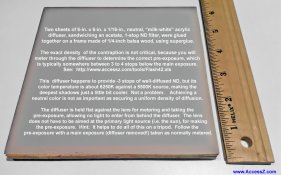
Readers might be interested in looking at this Excel spreadsheet I use to determine how much pre-exposure I want to apply when shooting reversal films:

Dead Link Removed

Here's a screenshot of a portion of the spreadsheet. Note the curves showing the impact of a given amount of pre-exposure on each zone:

Dead Link Removed

Dead Link Removed

Mike
 

Attachments

  • Pre-Exposure_Diffuser.jpg
    Pre-Exposure_Diffuser.jpg
    301.7 KB · Views: 78
Last edited:
Photrio.com contains affiliate links to products. We may receive a commission for purchases made through these links.
To read our full affiliate disclosure statement please click Here.

PHOTRIO PARTNERS EQUALLY FUNDING OUR COMMUNITY:


Ilford ADOX Freestyle Photographic Stearman Press Weldon Color Lab Blue Moon Camera & Machine
Top Bottom