• Welcome to Photrio!
    Registration is fast and free. Join today to unlock search, see fewer ads, and access all forum features.
    Click here to sign up

Film Test Helper

Recent Classifieds

Forum statistics

Threads
201,724
Messages
2,829,143
Members
100,916
Latest member
mikenickmann99
Recent bookmarks
0

Doc W

Member
Allowing Ads
Joined
Nov 7, 2009
Messages
955
Location
Ottawa, Cana
Format
Large Format
I have a vague memory in the back of mind of someone else trying this.

I just finished testing some 4x5 film for EI and development time. We all know that this can be tedious and also expensive if you are testing sheet film, especially when you are looking for Zone I exposure. I have several more films I want to test including HP5 and a few odds and ends like some ancient Plus-X and Super XX, all in 4x5, and Technical Pan in 8x10.

For the test for Zone I exposure., I think I can save money and time by sacrificing one film holder and one dark slide. I plan to drill four holes about 1/2" in diameter, one in each quadrant of the slide. All I need is a quarter inch for the densitometer, so I am giving myself a little bit of room. I could use each hole to expose for a different ISO, covering the others with opaque tape. For the 8x10 Tech Pan, I will just sacrifice one sheet, cutting it into 4x5 pieces.

It sounds reasonable to me. Rather than 5 or 6 sheets, I would use a maximum of two and could maybe only one. Do you think I could get away with more than the four holes? I decided on four just to make sure the light is really confined for each test. Has anyone tried this?
 

eddie

Member
Allowing Ads
Joined
Jul 24, 2005
Messages
3,259
Location
Northern Vir
Format
Multi Format
I once had something similar (misplaced a long time ago). I sacrificed 5 dark slides for it. It allowed 8 exposures on one sheet of film. Each slide had one hole drilled in it. 1/2" also. By flipping the top 3, you can get 3 exposures on the bottom.

DSdrill.jpg
 

paul ron

Member
Allowing Ads
Joined
Jan 22, 2004
Messages
2,709
Location
NYC
Format
Medium Format
instead of ruining dark slides, why not just mark the back of one slide with 5 or 6 even increments? so all you have to do is push it in for a given amount after each exlosure. it will be like doing a test strip on your enlarger.
 
Joined
Sep 10, 2002
Messages
3,671
Location
Eugene, Oregon
Format
4x5 Format
No need to sacrifice a film holder. Just push it in in increments to make stripes. Do the math to figure out what exposures you need to get whatever exposures you want. Keep in mind that there will be intermittent exposure. I made a small cardboard ruler with marks that show me how far to pull the darkslide to get five stripes on one sheet of film.

Here's my regime for making five stripes on a sheet of film in 1/3-stop increments:

1. Determine starting exposure. Use the highest probable E.I. (usually the rated film speed or a little faster), meter the test target and set shutter and aperture combination. Use a rather slow shutter speed, they are more accurate. Make sure you have a rather small aperture setting, since all the following steps involve opening.

2. Pull the dark slide completely, then re-insert it 1/5 of the way (covering 1/5 of the sheet) and make the initial Zone I exposure. Use your ruler to know how far to insert the darkslide

3. For +1/3-stop increments; descending film speed:
3.1: Close down 2 stops, insert the dark slide another 1/5 and make the second exposure. It's necessary to close down this much to get the desired exposure of just 1/3-stop more.

3.2: Open 1/3-stop, insert the dark slide part way and make the third exposure. Repeat this procedure for additional exposures on the same sheet of film.

So, you end up with one unexposed stripe (fb+fog) and four others at E.I.s in 1/3 stop increments. If, for example, you chose an E.I. of 400 for your initial exposure, you would end up with: stripe 1 (top of holder) unexposed; stripe 2, E.I. 400, stripe 3, E.I. 320; stripe 4, E.I. 250, stripe 5, E.I. 200.

Now that I've written all that, I'm going to recommend that you forget the film speed test entirely unless you are using a developer that is known to cause a marked loss in film speed. Instead, start doing development tests using an E.I. that's 2/3 stop slower than box speed. You can nail down your developing times and keep an eye on shadow detail in relation to fb+fog easily as long as you have a large enough unexposed area on your negative (border or intentionally unexposed area by not pulling the darkslide all the way out). Make proper proofs of your negs and see if you can rate your film higher and still keep the desired amount of shadow detail. FWIW, I've tested film for years and it always comes out the same for me: 1/3 stop slower than box speed. I stopped film-speed testing some time ago and just do the development time tests. I fine tune shadow detail and tweak developing times as needed on the basis of field notes.

Best,

Doremus
 

silveror0

Member
Allowing Ads
Joined
Dec 3, 2007
Messages
364
Location
Seattle area, WA
Format
Large Format
Here’s yet another method. Since you already have a densitometer, just get a Stouffer 21-step wedge (T2115, ½x5” @ $7.50)? It can be calibrated by recording its ACTUAL densities with your densitometer. Tape it diagonally across the film in the holder and expose in camera – focused on infinity to avoid bellows extension - then develop normally. That way, with only one sheet, you’d not only determine the EI but the HD curve as well. I’d stick a small opaque tape on the film during exposure to get a fb+f reading, since the rebate may not be large enough for an accurate reading with your densitometer. For a target I’d use an evenly lit white mount board; meter it and place the reading on Zone X and develop normally. Measure the resulting density adjacent to the wedge near mid-format to get the Zone X density. Then, since the wedge steps are in ½-stop increments, count down 18 steps to find the Zone I result. I plot the results in MS Excel, Net Density vs. Zone (Net D = density reading minus fb+f), and if the Zone I Net D doesn’t fall on 0.1 I slide the curve along the Zone scale until it does. The amount of Zone correction needed defines your EI. This correction does not change the shape of the curve. Obviously, your agitation regimen must be consistent. Since I agitate by shuffling 6 sheets in a tray, I first expose 6 sheets, as described, one for each dev time trial, then dev them together. After plotting these curves, it’s easy to estimate the dev times required for N, N+, N-, as well as how much additional exposure is needed if an N- shows a loss of film speed.

BTW, step #1 on the wedge is just the density of the wedge with no exposure; step #2 is 1/2-stop of exposure above the wedge base.

http://www.stouffer.net/Productlist.htm

Since there’s a minimum order of $20, I’d suggest also getting an additional step wedge that’s very useful for testing printing paper (as well as film), either by projection or contact, e.g. TP4x5-21.

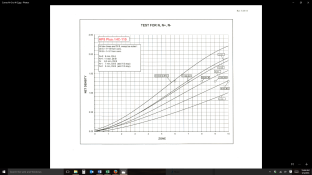
Here's what the results look like:
Curves N+2 to N-2.png
 
Last edited:
OP
OP
Doc W

Doc W

Member
Allowing Ads
Joined
Nov 7, 2009
Messages
955
Location
Ottawa, Cana
Format
Large Format
A few of you have suggested that exposure is cumulative, e.g., exposing it for, say, 1/15 " + 1/15" is the same as exposing it for 1/30". I have read that this is not true and that the cumulative exposure will not be equal to the sum of all the other exposures.
 

paul ron

Member
Allowing Ads
Joined
Jan 22, 2004
Messages
2,709
Location
NYC
Format
Medium Format
i guess there is some truth in that. leaf shutters do have slightly out of spec speeds for each setting and cumulatively it can add up to be more than the single speed selected which may be a smaller fraction off spec.

when i did my tests, all i wanted was a ball park figure and those small differences really didnt matter much.
 
Joined
Sep 10, 2002
Messages
3,671
Location
Eugene, Oregon
Format
4x5 Format
A few of you have suggested that exposure is cumulative, e.g., exposing it for, say, 1/15 " + 1/15" is the same as exposing it for 1/30". I have read that this is not true and that the cumulative exposure will not be equal to the sum of all the other exposures.

You're referring to the "intermittency effect." Indeed, cumulative exposures are actually less than the sum of the total exposure. However, in the method I described above, I've never found it to make enough difference to really skew the results. And, film speed tests are really only starting points anyway. They need to be refined based on actual results in the field. If you're worried about the intermittency effect influencing your results, just rate your film 1/3 stop slower than the test results. That will give you plenty of leeway.

FWIW, I use additive exposures often for subjects that require really long exposures and have movement problems. I'll close the shutter and wait for the wind to settle down or the traffic or pedestrians to pass and then open it up again, often several times per exposure. I've never had the intermittency effect result in an underexposure; I just err on the side of a more generous exposure.

Best,

Doremus
 

paul ron

Member
Allowing Ads
Joined
Jan 22, 2004
Messages
2,709
Location
NYC
Format
Medium Format
then what you need is a set of these.... just flip the window from left to right and bottom to top.
Problem solved!

4x5 E IMG_20170704_175016.jpg
 

RalphLambrecht

Subscriber
Allowing Ads
Joined
Sep 19, 2003
Messages
14,916
Location
K,Germany
Format
Medium Format
I have a vague memory in the back of mind of someone else trying this.

I just finished testing some 4x5 film for EI and development time. We all know that this can be tedious and also expensive if you are testing sheet film, especially when you are looking for Zone I exposure. I have several more films I want to test including HP5 and a few odds and ends like some ancient Plus-X and Super XX, all in 4x5, and Technical Pan in 8x10.

For the test for Zone I exposure., I think I can save money and time by sacrificing one film holder and one dark slide. I plan to drill four holes about 1/2" in diameter, one in each quadrant of the slide. All I need is a quarter inch for the densitometer, so I am giving myself a little bit of room. I could use each hole to expose for a different ISO, covering the others with opaque tape. For the 8x10 Tech Pan, I will just sacrifice one sheet, cutting it into 4x5 pieces.

It sounds reasonable to me. Rather than 5 or 6 sheets, I would use a maximum of two and could maybe only one. Do you think I could get away with more than the four holes? I decided on four just to make sure the light is really confined for each test. Has anyone tried this?
why not get a 4x5 Stouffer step tablet and expose with that? This way, you get30 exposures, 1/10 stop apart onto a single sheet!
 

silveror0

Member
Allowing Ads
Joined
Dec 3, 2007
Messages
364
Location
Seattle area, WA
Format
Large Format
why not get a 4x5 Stouffer step tablet and expose with that? This way, you get30 exposures, 1/10 stop apart onto a single sheet!
Ralph - I know you meant a step interval of .10 density (1/3-stop), using the 31-step wedge. I, too, prefer the 31-step wedge, only because it gives more data points for the curve plots.
 
Last edited:
OP
OP
Doc W

Doc W

Member
Allowing Ads
Joined
Nov 7, 2009
Messages
955
Location
Ottawa, Cana
Format
Large Format
Ralph, can you explain how that would work? In the past, I would take a spot meter reading of my light table (daylight spectrum) and expose a sheet for Zone I, i.e., take the reading (at box speed) and open up 4 more stops. Then I would open up 1/3 stop and expose another sheet, repeating this until I had covered a range of ISO. All sheets were developed at the normal time established by the spreadsheet.

That works fine but I wind up using a lot of sheets in the process.

How would I do this with a test tablet? Sorry if that sounds like a dumb question but I have only a slender grasp of how all this works in the first place! :sad:
 

silveror0

Member
Allowing Ads
Joined
Dec 3, 2007
Messages
364
Location
Seattle area, WA
Format
Large Format
Ralph, can you explain how that would work? In the past, I would take a spot meter reading of my light table (daylight spectrum) and expose a sheet for Zone I, i.e., take the reading (at box speed) and open up 4 more stops. Then I would open up 1/3 stop and expose another sheet, repeating this until I had covered a range of ISO. All sheets were developed at the normal time established by the spreadsheet.

That works fine but I wind up using a lot of sheets in the process.

How would I do this with a test tablet? Sorry if that sounds like a dumb question but I have only a slender grasp of how all this works in the first place! :sad:

Doc - Ralph may not plug his book (Way Beyond Monochrome, Ed.2), so I'll do it for him. It's a very wise investment (via Amazon) that explains use of the step wedge plus a WHOLE LOT MORE.
 
OP
OP
Doc W

Doc W

Member
Allowing Ads
Joined
Nov 7, 2009
Messages
955
Location
Ottawa, Cana
Format
Large Format
Doc - Ralph may not plug his book (Way Beyond Monochrome, Ed.2), so I'll do it for him. It's a very wise investment (via Amazon) that explains use of the step wedge plus a WHOLE LOT MORE.
I have the book and Ralph says to expose just as I described, except he explains it for roll film. Sheet film is more expensive so I was looking for a way to save a few bucks.
 
Photrio.com contains affiliate links to products. We may receive a commission for purchases made through these links.
To read our full affiliate disclosure statement please click Here.

PHOTRIO PARTNERS EQUALLY FUNDING OUR COMMUNITY:


Ilford ADOX Freestyle Photographic Stearman Press Weldon Color Lab Blue Moon Camera & Machine
Top Bottom