
• Welcome to Photrio!
    Registration is fast and free. Join today to unlock search, see fewer ads, and access all forum features.
    Click here to sign up

Film stock dating

Lost

H
Lost

  • 0
  • 0
  • 37
Joints

H
Joints

  • 0
  • 0
  • 25

Forum statistics

Threads
203,531
Messages
2,856,093
Members
101,888
Latest member
Hans Hansen
Recent bookmarks
0

elbinster

Member
Joined
Apr 27, 2026
Messages
2
Location
Virginia, US
Format
Medium Format
Hello fellow filmers,

I would like to try and date some bulk 35mm film I stumbled across. Even a rough estimate.

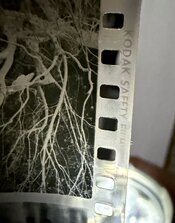
The edge markings say “KODAK SAFETY FILM” then “KODAK PLUS X PAN FILM” then “B F K C”. The frame count goes up to 44 as well, which seems strange.

I recently got this film from an antique store in a Lloyd’s daylight loader (with black cover and red handle). I got about 9 full rolls with some moldy ones up front used for testing. To my utter surprise, it developed pretty easily.

Rodinal stand developing brought out some fog but XTOL developed pretty clear (though a bit thin).

I doubt this is 1954 Plus X but is there any way of knowing if it’s 70s, 80s, 2011?
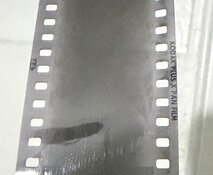
 

Attachments

  • IMG_1108.jpeg
    IMG_1108.jpeg
    261.9 KB · Views: 20
  • IMG_1109.jpeg
    IMG_1109.jpeg
    293.5 KB · Views: 18
  • IMG_1110.jpeg
    IMG_1110.jpeg
    325.5 KB · Views: 19
Plus-X Pan film was discontinued in 2002 in favor of KODAK PROFESSIONAL PLUS-X 125.
A quick search for the datasheet for Plus-X Pan film revealed a datasheet with a 1997 date - found here: https://125px.com/docs/film/kodak/f8-Plus-X_Pan-199709.pdf
I'm not sure how far back that version of the Plus-X name went.
 
Plus X film was introduced by Kodak in 1938 approx. for 35mm and as a Cine film in 1941. It became a popular film in the 1940s and onward. The ISO has been anywhere from 40 to 125 over the years. It morphed from 35mm to 120 roll film, film packs and sheet film over the years. Some people think that older outdated film is best processed at lower temperatures around 60 degrees in an anti-fog developer like HC110 dilution B.
 
Plus X film was introduced by Kodak in 1938 approx. for 35mm and as a Cine film in 1941. It became a popular film in the 1940s and onward. The ISO has been anywhere from 40 to 125 over the years. It morphed from 35mm to 120 roll film, film packs and sheet film over the years. Some people think that older outdated film is best processed at lower temperatures around 60 degrees in an anti-fog developer like HC110 dilution B.

This is all true.
The wrinkle to consider is that Kodak made very slight changes over the years to the exact name used in the edge printing and on the boxes and datasheets. Those changes usually, but not always, coincided with reformulations and improvements to the film. When those changes occurred, sometimes the recommended development times changed.
So with respect to the OP's sample of film, the trick is to determine during what period of time the film boxes and datasheets and its edge printing showed as "Plus X Pan".
 
Photrio.com contains affiliate links to products. We may receive a commission for purchases made through these links.
To read our full affiliate disclosure statement please click Here.

PHOTRIO PARTNERS EQUALLY FUNDING OUR COMMUNITY:


Ilford ADOX Freestyle Photographic Stearman Press Weldon Color Lab Blue Moon Camera & Machine
Top Bottom