


Hi all,
Yesterday I developed my latest roll of film and today I decided that I at least wanted to have closer look at a contact sheet of it. Now I had run out of my regular Ilford Multigrade paper developer... So what to do? Well, I still had some stock solution D-76 film developer, and never afraid of some experimentation I thought: "Heck, I'll give it a go!"
So I made up 2 liter of developer by mixing D-76 stock 1:1 with water and put it in the developer tray.
After reading a bit on the internet, which suggested film developers were less concentrated and would need considerably longer development time, I also decided to add a teaspoon of soda (sodium carbonate), as I at least know that it helps as an accelerator in redevelopement with thiourea sepia toning, but I don't know if it is of any real use in a normal developer (except that normal development also needs OH- anion of alkali conditions for continued development).
So I than tried the following: Ilford Multigrade RC Warmtone paper, 3.5 minutes. And... it looked great! Yes, the development was a bit slow compared to normal developer, but tonality and max black looked OK.
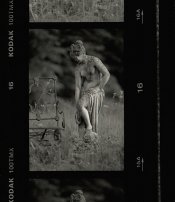
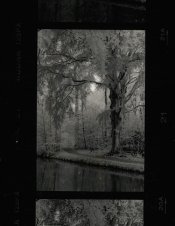
It turns out that, compared to my regular Ilford Multigrade paper developer, the D-76 works more like a warmtone developer. The tones were distinctly warmer than with the normal Ilford Multigrade paper developer, even though the comparison contact sheet is also on RC Warmtone. The attachements show the results, I don't know if the difference in warmth shows up in the scans...
Attachment 1: Statue: D76, Stock to water 1:1, 3.5 minutes
Attachment 2: Tree: Ilford Multigrade developer at regular 1:9 concentration, 2 minutes
So I also decided to try out some regular Ilford MGIV FB paper and enlarge a negative. I was a bit in hurry, as I also wanted to do some other things this day, so after an initial max black test for 4 minutes development, which turned up a medium to dark grey color, I just figured 8 minutes would do to get maximum black.
Since the negative I wanted to print was shot on an overcast day, and hence with many mid tone greys anyway, being slightly beneath max. black would probably also not hurt. Actually, I choose the "statue" negative, and the final print results were close to what you see here in the scan of the contact sheet. I also split sepia/selenium toned the prints, and the color is a lovely sepia. Great.
So what is my conclusion and what did I learn?:
Don't hesitate if you are in a similar situation. I was completely satisfied with the final prints. Tonality is great, maybe a bit less max. black but more than OK.
Fair enough, printing times are a bit long, and I don't know if there is much capacity in such a bath, but as a "backup" option, even for final prints, it proved fine. I know the prints are keepers, I may post a scan of the enlargement tomorrow if I have time.
Yesterday I developed my latest roll of film and today I decided that I at least wanted to have closer look at a contact sheet of it. Now I had run out of my regular Ilford Multigrade paper developer... So what to do? Well, I still had some stock solution D-76 film developer, and never afraid of some experimentation I thought: "Heck, I'll give it a go!"
So I made up 2 liter of developer by mixing D-76 stock 1:1 with water and put it in the developer tray.
After reading a bit on the internet, which suggested film developers were less concentrated and would need considerably longer development time, I also decided to add a teaspoon of soda (sodium carbonate), as I at least know that it helps as an accelerator in redevelopement with thiourea sepia toning, but I don't know if it is of any real use in a normal developer (except that normal development also needs OH- anion of alkali conditions for continued development).
So I than tried the following: Ilford Multigrade RC Warmtone paper, 3.5 minutes. And... it looked great! Yes, the development was a bit slow compared to normal developer, but tonality and max black looked OK.
It turns out that, compared to my regular Ilford Multigrade paper developer, the D-76 works more like a warmtone developer. The tones were distinctly warmer than with the normal Ilford Multigrade paper developer, even though the comparison contact sheet is also on RC Warmtone. The attachements show the results, I don't know if the difference in warmth shows up in the scans...
Attachment 1: Statue: D76, Stock to water 1:1, 3.5 minutes
Attachment 2: Tree: Ilford Multigrade developer at regular 1:9 concentration, 2 minutes
So I also decided to try out some regular Ilford MGIV FB paper and enlarge a negative. I was a bit in hurry, as I also wanted to do some other things this day, so after an initial max black test for 4 minutes development, which turned up a medium to dark grey color, I just figured 8 minutes would do to get maximum black.
Since the negative I wanted to print was shot on an overcast day, and hence with many mid tone greys anyway, being slightly beneath max. black would probably also not hurt. Actually, I choose the "statue" negative, and the final print results were close to what you see here in the scan of the contact sheet. I also split sepia/selenium toned the prints, and the color is a lovely sepia. Great.
So what is my conclusion and what did I learn?:
Don't hesitate if you are in a similar situation. I was completely satisfied with the final prints. Tonality is great, maybe a bit less max. black but more than OK.
Fair enough, printing times are a bit long, and I don't know if there is much capacity in such a bath, but as a "backup" option, even for final prints, it proved fine. I know the prints are keepers, I may post a scan of the enlargement tomorrow if I have time.
Attachments
Last edited by a moderator:


 .
. 
