• Welcome to Photrio!
    Registration is fast and free. Join today to unlock search, see fewer ads, and access all forum features.
    Click here to sign up

Film choice for low light interiors

Forum statistics

Threads
203,265
Messages
2,852,115
Members
101,753
Latest member
Janek201
Recent bookmarks
0

gedra

Member
Allowing Ads
Joined
Nov 23, 2008
Messages
41
Format
Multi Format
I'm planning to shoot some low incandescent light interiors (about 1/60 @ f4), and would like a bit more latitude without resorting to flash. Would I get better images with a 1600 ISO film, or will pushing Tri-X or HP5 be superior? I normally use Plus X and TMY and realize that neither of these are good choices. Thanks a million!
 
If you know that you need 1/60 at f4 then adjust your speed dial on the camera until you get this. Whatever that speed is then that is your film speed.

The fastest film is probably Ilford D3200 which has a "natural" speed of 1250 and maybe 1600 in a speed enhancing developer like DDX or Microphen but can be rated much faster if you are prepared to sacrifice shadow detail.

A slightly slower film but with finer grain is Neopan 1600.

pentaxuser
 
Depends on if you want less grain and less shadow detail, or more grain and more shadow detail. I don't have a problem with a little bit of grain, especially when printed in the darkroom (this is APUG, right?), so I just use TMZ at 1600 or 3200. Delta 3200 would work just as well. Even though they are only ISO 800-1200 films naturally, they still have plenty more shadow detail at 1600 than Tri-X or HP5+ pushed. Pushing doesn't add speed, it just boosts contrast.

A middle ground would be Neopan 1600. It's slower than the other (not really 1600) but does have finer grain. To be honest, looking at the curves in their respective pdfs, TMAX 400 looks faster than Neopan 1600, but maybe that's just me. I never really cared for the look of Neopan 1600. It usually looks real pushed and contrasty to me. However, a lot of people seem to like it.
 
I'd say try either Kodak's TMZ or Ilford's Delta 3200. Neither of these films is actually a 3200 speed film. The natural speed point falls at around 800 to 1000, and I think that Delta 3200 might be a wee bit faster than the Kodak. Whatever... The advantages these films offer over pushing something slower are about a stop extra speed and very low contrast. Having an extra stop of natural speed is good for obvious reasons. Having an inherently low contrast is good because when you do overdevelop the film, contrast remains manageable, and you get a little bit extra (not a lot so don't expect that) in the shadows. What seems to have worked best for me with TMZ is to develop to the next stop above that which you exposed the film; in other words, if you exposed for an EI of 1600, use the EI 3200 development times. For films exposed at EI 3200, use the development times for 6400.
 
I would either underexpose TMY by 1 stop or use Neopan 1600. If shooting medium format, the answer is Delta 3200.

(Added: I have a tiny four-section tripod that weighs nothing and can fit anywhere. I'd bring it along in a shoulder bag. You could then use today's best ISO 400 B&W film, TMY, and get the most of either MF or 35mm.)
 
Last edited by a moderator:
Fuji Acros is by far your best answer. At these light level it is by far the fastest film available.
 
Well, Jim's got a point there. Acros has some incredibly good reciprocity departure characteristics. If I recall correctly, exposures up to 2 minutes require no compensation and that can make a medium speed film faster than a fast film under very low lighting conditions. Take the case of Tri-X which isn't really the best for long exposures. According to Kodak's data sheet a ten second exposure needs two stops extra exposure to compensate for reciprocity failure. So now you either need to open the lens an extra two stops or extend the original 10 sec exposure to 50 seconds. Development should be pulled back by 20% to compensate for the highlights which fall outside the reciprocity failure range. With Acros, because it is already two stops slower, the initial exposure would be 40 seconds at the original f stop, and there's no need to pull back development to tame blown highlights. So indeed, Acros is faster in that sort of situation. But I think the Acros solution isn't going to work for the OP. He's talking about shooting at 1/60 sec @ f/4, clearly something than can be done hand held with a normal or wide angle lens.
 
35mm or 120? TMAX 3200 is great but if 120 I would go with Tri-X
 
Ilford's delta 3200 is available in 120 roll film. It's really nice in medium format too. Sure it's grainy as hell, just like TMZ is grainy. But you need a lot less magnification to reach a given print size, so the grain doesn't look so bad at all.
 
Assuming we're talking about EI 1600 or 3200 here, I did some experimentation and concluded that I like pushed Tri-X better than Delta 3200 at those speeds. Anything is going to be contrasty and grainy, of course, and the choice just comes down to personal taste. If you can, I'd suggest shooting a few test rolls with different films and/or different developers, and see what works for your eye.

I settled on Tri-X or HP5+ at EI 3200 in Super Soup, personally, but your mileage may vary.

-NT
 
Thanks for the responses. I'll be shooting 35mm hand held as this is a tour of a deactivated ICBM silo. Running through a few rolls of different films sounds like a great idea.
 
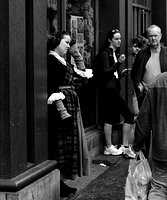
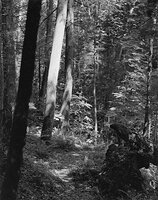
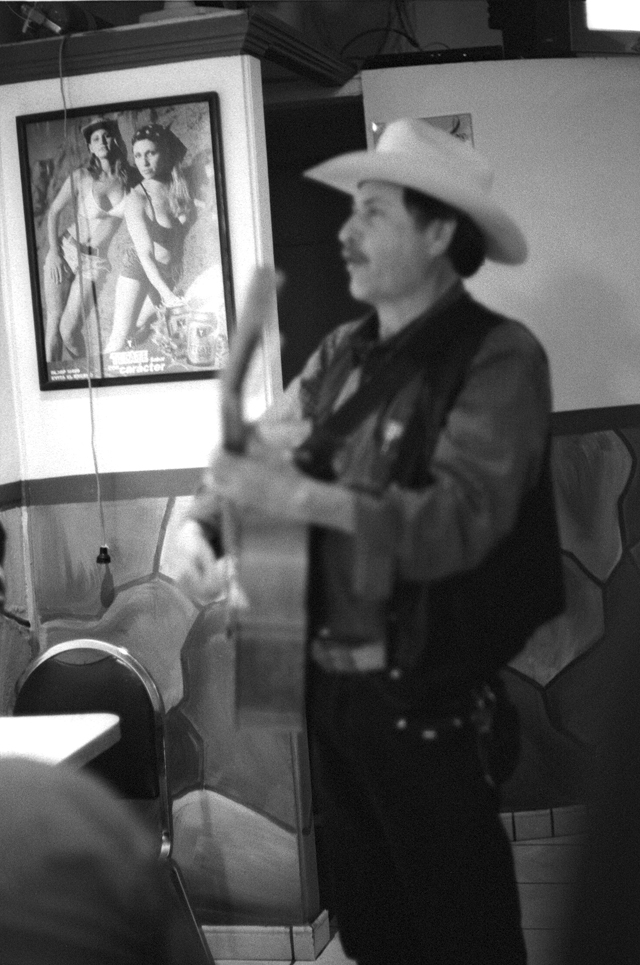
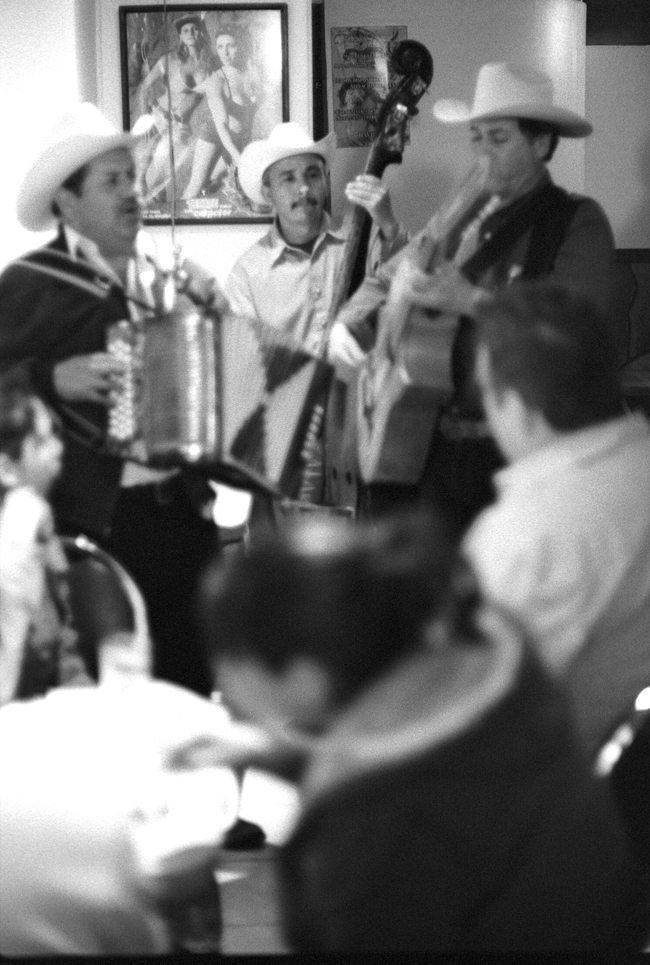
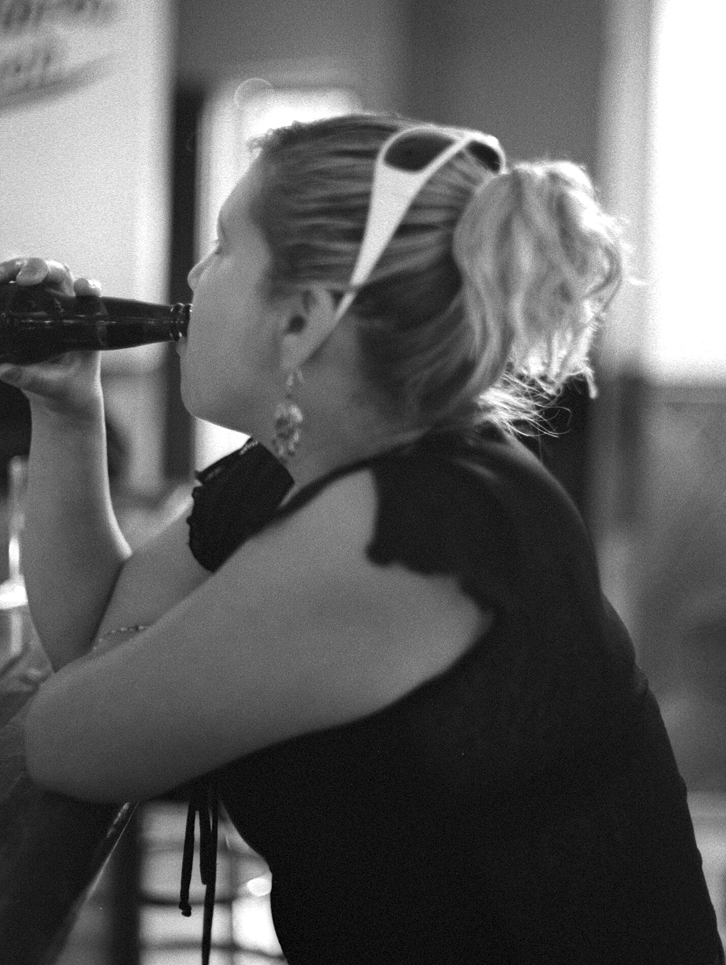
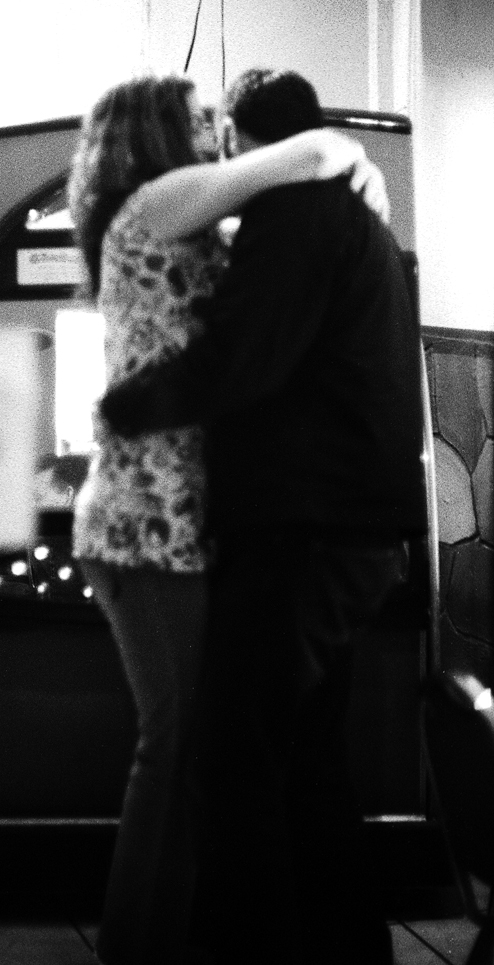
I found that Tri-X pushed to 1600 or even 3200 is better than Delta 3200. I had really good results in a dimly lit bar in Tecate, Mexico. They were grainy, but that only added to the shots. Taken with Topcon RE Super, 58mm/1.4 Tri-X@1600. Probably developed in HC-110 Dil B.

2298565099_42492101e1_o.jpg


2298563421_5be28f4373_o.jpg


2298563615_7aea3739fd_o.jpg


2299358136_c3d43a8f1a_o.jpg
 
Why would Fuji Acros be by far the best answer at '60 and f/4.0? It would be the best answer at speeds slower than 1/2 second or so, but it being a 100 film, it would be one of the worst options available for shooting low light interiors hand held.

I would try some Delta 3200. It is a 1000 speed film that, due to its low contrast, does not dump shadow detail all that badly upon underexposure, and that, for the same reason, pushes relatively far without blasting the highlights into oblivion.

It is very grainy, however. If that its a problem, I would simply suggest to save up for a faster lens and keep working with T-Max.
 
I'll be a contrarian.

My experience with interiors is that the lighting ratio is all wrong and as a result there is much too much contrast. It is a good idea to turn on every light in the room just to try and even out the illumination.

To help tame the contrast I use a no-shoulder film, pull it a stop, develop in a shadow-preserving developer (D-76, Xtol, TMax) and then burn the highlights. Lens is either an f2 or f1.4, stopped down as needed, with 1/30th or 1/60th shutter speed.

I have had good results with interiors lit by a combination of window and room light shooting Tech Pan at ASA 25. You don't really need a fast film.
 
Fuji Acros is by far your best answer. At these light level it is by far the fastest film available.

Not the case. Run the numbers.

(there was a url link here which no longer exists)

Lee
 
My experience with interiors is that the lighting ratio is all wrong and as a result there is much too much contrast. It is a good idea to turn on every light in the room just to try and even out the illumination.

It sounds like the OP doesn't have control of the lighting, though. I see where using a slower film with more light is preferable---though if you can shoot interiors handheld at ASA 25, your interiors have a lot more lights in them than mine do---but it doesn't seem like it's a viable solution for this particular case.

-NT
 
I see where using a slower film..

Adding a foolish inconsistency to the proceedings:

It isn't using a slower film, but pulling the film to be able to capture the contrast range of the scene. The pictures posted above show the problem - empty dead black shadows and clothes where, in real life, there is stuff.

As to using ASA 25 film indoors, no it wasn't a particularly bright scene: large room, 2 sash windows, cloudy day, one table lamp. Most of the light was from the windows, the lamp was in the scene and provided a bit of shadow fill. Shooting from the position of the windows minimized shadows. In interior work it is always best if you have a light source over your shoulder. I mentioned it as an illustration that one can often get away with slow film if one has a fast lens and can hand-hold at a 1/15th.

And, of course, a tripod can really help in such situations. At 1/2 second a little bit of motion blur seems natural, as long as it isn't the subject's head.

But I agree, all this is not very helpful to the OP.

My advice in a missile silo would be to have a light source behind you, if possible. It might be quite well lit: after all nobody wants to be fumbling in the dark when doing maintenance on a nuke.

 
Last edited by a moderator:
Photrio.com contains affiliate links to products. We may receive a commission for purchases made through these links.
To read our full affiliate disclosure statement please click Here.

PHOTRIO PARTNERS EQUALLY FUNDING OUR COMMUNITY:


Ilford ADOX Freestyle Photographic Stearman Press Weldon Color Lab Blue Moon Camera & Machine
Top Bottom