Compensating developers will capture more range in the neg... but can also give you a flatter neg so then you'll probably need to boost your contrast grade in printing- no big deal. An extreme example of a compensating developer is POTA, with which you can get ~20 stops of range in a normal film, I posted an example recently from a night scene that I guessed had at least 12 stops of range in it and was extremely difficult to meter- basically it was a wild guess and all I had loaded was efke 25, not the world's most forgiving film, so I used POTA and voila, easily printable neg...
(there was a url link here which no longer exists)
You probably can't tell from this grade 3 quickie contact print ^^^ but there is literally no part of the neg without full detail... except the little hot lights themselves, but even they aren't badly blown. But again, POTA is an *extreme* example, a 'supercompensating' developer. Probably holds the world's record in compensation, I'd not be surprised if 22-24 stops is possible with some films using POTA.
With my IR stuff I sometimes use wd2d+, a pyro developer. The reason being, IR photographs tend to have a lot of detail in the whites that people simply neglect. IMHO too many IR shots go white as snow in the highlights... detail-less white... when in fact there is a lot of interesting texture there. A pyro developer helps you keep the highlights and has one other big advantage too: it scans very well. This is important in some cases because IR films on the market (and actually, also HIE) aren't/weren't exactly the most reliable b&w film products... they don't store well. I see all kinds of scratches and dust and whatnot, more than usual. More prone to static too, perhaps? I don't know. In my experience, the Rollei stuff is the least problematic, but nevertheless the film base is very thin and prone to scratches etc. Now, wd2d+ is helpful with thin / very flexible / slightly fragile negs. Something to keep in mind, if you are open to scanning as a way to correct scratches and specks etc. I think you will find that all the IR films are a bit more prone to damage than ordinary b&w films.
Finally, I'd just like to say a few words in favour of superpan. I recently began working with this film and... suffice it to say I just bought my second big box. Love it.





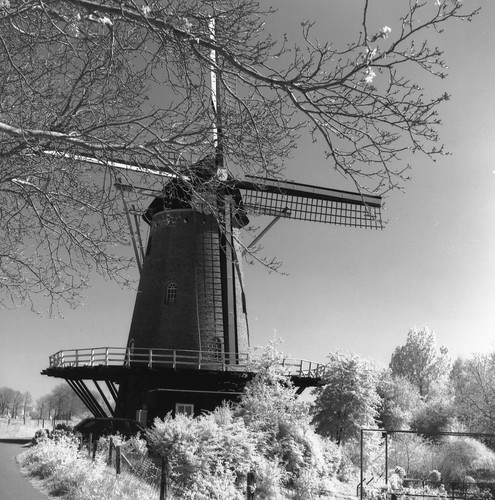
 ) I have tested the Super Pan 200 in with Beutler last night.