• Welcome to Photrio!
    Registration is fast and free. Join today to unlock search, see fewer ads, and access all forum features.
    Click here to sign up

Exposing Cyanotypes

Moment of Spin

A
Moment of Spin

  • 2
  • 0
  • 76
Bad patch

H
Bad patch

  • 2
  • 1
  • 48

Recent Classifieds

Forum statistics

Threads
203,104
Messages
2,849,878
Members
101,669
Latest member
JeremiahPeterson
Recent bookmarks
1

MamiyaJen

Member
Allowing Ads
Joined
Aug 7, 2011
Messages
56
Location
Doncaster, U
Format
Medium Format
I've finally got some time on my hand to start experimenting with cyanotypes but my main worry is exposing them. I don't have a UV light source (this is how i always exposed them while at uni) and I don't really have any money to buy one.

Now bearing in mind I'm in England and it's summer, do i need bright sunshine to expose them that way, or will 'average' daylight be sufficient? I don't particularly want to sit around waiting for the day the sun finally decides to show its face, or is that what I'm stuck doing?
 
Hi,

Here in the UK exposing cyanotypes during the 'daytime' works fine (note I carefully avoided mentioning the sun); it can just take a fair bit longer! With really dull days, it could even take a few hours. You may notice that the contrast varies with different exposure times; but primarily just expose by inspection. Luckily cyanotype is cheap enough to just try it out and see what happens. I have found that using an ordinary light meter against a the same wall every day will give a good indication of how much UV light is available; i.e. if the meter read LV13 on a sunny day and exposure took 1 minute, and it is LV9 today, there are 4 stops less light (in the visible band) . Therefore a good guess would be 4 stops longer exposure (x16). I would therefore have a look after about 11 minutes and it should be about a half stop under exposed. I would then check every minute, expecting the 16 minute mark to be quite close.

Best regards,

Evan
 
Sunlight seems to be richer in UV in the morning, than in the afternoon.
 
I don't have a UV light source (this is how i always exposed them while at uni) and I don't really have any money to buy one.

It doesn't have to be expensive, you can buy 2 fluorescent tubes and an armature for less than 40£. Those tubes last a long time. Don't bother with black light tubes though, they are too shielded to be of any good use, you need the ones they also use in aquariums and the like, maybe check a shop that sells stuff like that. I had excellent results with a setup like that and still use it. Alternatively you could pick up one of those facial tanning beds, those aren't terribly expensive if you look around (maybe even second hand will do).
 
I've never had any trouble doing them outside in daylight, regardless of the cloud cover. I find that direct, blasting sun works the best, but they go even if its overcast.

I use a split-back contact frame so I can open up and check the progress as it goes
 
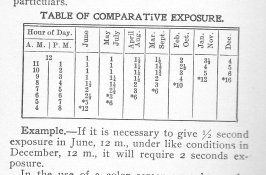
Here's some information that I've found useful, from back in the days when sunlight exposure for print production was in vogue.

Source: Stith, Townsend. Photographic Instruction Book. 1903.
 

Attachments

  • Comparative Exposure.jpg
    Comparative Exposure.jpg
    461 KB · Views: 236
Last edited by a moderator:
I've found that full sun (this one is obvious) gives the fastest exposures, around 6 minutes where I am. Open shade, however, tends to give me the best highlight detail. I think it's because sometimes here there can be fogging from, I think, heat in full sun.
 
Photrio.com contains affiliate links to products. We may receive a commission for purchases made through these links.
To read our full affiliate disclosure statement please click Here.

PHOTRIO PARTNERS EQUALLY FUNDING OUR COMMUNITY:


Ilford ADOX Freestyle Photographic Stearman Press Weldon Color Lab Blue Moon Camera & Machine
Top Bottom