

• Welcome to Photrio!
    Registration is fast and free. Join today to unlock search, see fewer ads, and access all forum features.
    Click here to sign up

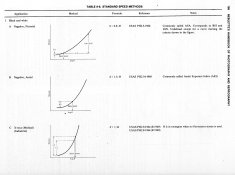
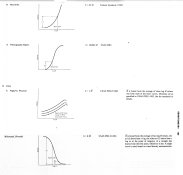
Examples of Different Speed Methods

Recent Classifieds

Forum statistics

Threads
202,083
Messages
2,834,856
Members
101,104
Latest member
tcruicks
Recent bookmarks
1
Joined
Jan 7, 2005
Messages
2,743
Location
Los Angeles
Format
4x5 Format
I ran across these examples of speed methods for various film types (and one paper). This is the only time I've seen diagrams of non-pictorial films included. It's a bit dated, but I think it illustrates how the method of determining the speed is dictated by it's intended use.
Standard Speed Methods 1.jpg

Standard Speed Methods 2.jpg
 
Last edited by a moderator:

removed account4

Subscriber
Allowing Ads
Joined
Jun 21, 2003
Messages
29,832
Format
Hybrid
hi stephen

is the graph showing photographic paper typical for all photo papers ?
i have tested 20+ types/brands/grades of photopaper and they vary
greatly in speed ... from asa 25 or 50 to less than 1
( asa relative to film speed, not the index numbers the companies give )

thanks !
john
 
OP
OP
Stephen Benskin
Joined
Jan 7, 2005
Messages
2,743
Location
Los Angeles
Format
4x5 Format
Michael, I didn't know they did. I would think that since latent image regression occurs most in areas of low exposure, using something like the 0.10 speed point would make sense.
 

Bill Burk

Subscriber
Allowing Ads
Joined
Feb 9, 2010
Messages
9,479
Format
4x5 Format
I'm guessing that choosing Zone III for reciprocity failure tests avoids the situation where the loss of speed leaves you too little information at the normal 0.1 speed point.
 

ic-racer

Member
Joined
Feb 25, 2007
Messages
16,751
Location
USA
Format
Multi Format
Others out there also. I can't find it right now but came across a definition based on minimum acceptable resolution on the Y-axis, with speed on the X-axis.
 
OP
OP
Stephen Benskin
Joined
Jan 7, 2005
Messages
2,743
Location
Los Angeles
Format
4x5 Format
I'd have to read those articles. Reciprocity only effect areas of low exposure (except for high intensity reciprocity, but that works differently). The principle is the same as latent image keeping as explained in the Gurney-Mott hypothesis. I don't remember much about chemistry, but here's an excerpt from Photographic Materials and Processes on reciprocity:

"When exposures are made at low light levels, the efficiency with which the sub-latent images are formed on the crystal is low because of the tendency of the silver atoms to give up an electron and return to the ionic state. Further exposure allows a greater number of silver atoms to accumulate around those few sub-images that survive, but these sub-images are relatively stable."

It seems to me that since reciprocity has a greater influence with lower exposure levels, and since the purpose is to define the film speed at lower exposure levels over a longer period of time, then the speed point would be a logical point of measurement.

Again, I'd have to read the other people's reasoning in order to comment on them. But I frequently seem to be at odds with popular wisdom.
 
OP
OP
Stephen Benskin
Joined
Jan 7, 2005
Messages
2,743
Location
Los Angeles
Format
4x5 Format
Michael, thanks for posting the link to the Bond article. IÂ’ve been able to skim through it a couple of times and IÂ’m sure the results he got are fine. And while I havenÂ’t done a thorough read, there are a number of observations IÂ’d like to make about the testing.

Bond never explains why Zone III is the aim exposure for the testing. He doesnÂ’t address it in anyway. ThereÂ’s no theory to support the choice. I donÂ’t know about anyone else, but my first reaction is to ask why that point and why not another exposure or density point? He doesnÂ’t even make an assumption why Zone III should be used. What would his results be if he tested a stop lower, or two stops lower? Are we to simply accept his choice of Zone III without an explanation? While IÂ’m sure his numbers will yield acceptable results, there is no evidence that they are remotely representational of the filmÂ’s reciprocity.

There are two other things that stood out. First is the testing exposure of 5 ½ stops above the metered reading (Zone X ½). I guess technically the exposure was keyed to Zone IX ½ and given another stop for close up compensation. His results are pretty much what I’ve written about (most recently in the Large Format Forum). It’s easy to calculate the film plane exposure when you are using a camera as a sensitometer. Basically five stops over the metered exposure point will produce about a stop less exposure than most of the these type of methods assume. I haven’t worked out the specifics of Bond’s testing, but on the surface, this appears to be the case.

The other thing was the paragraph about camera flare. I had to go back and re-read how he was using the step tablet because I couldnÂ’t believe that anyone would have a paragraph on flare (and creating a device to boot) if the test was contacted. And I discovered I hadnÂ’t misread the testing procedures. The step tablet is indeed contacted. Not only contacted, but the target was a single toned white subject. This is about as flare free a test as one can get.

How valid is the test? ItÂ’s questionable at best in my book, but IÂ’m sure the results are good enough for photography work.
 
Last edited by a moderator:
OP
OP
Stephen Benskin
Joined
Jan 7, 2005
Messages
2,743
Location
Los Angeles
Format
4x5 Format
Low level reciprocity only affects the lower luminance values. The reason why development needs to be reduced when compensating for reciprocity is because the higher values aren't affected by the latent image regression and build additional density with the additional exposure required to create adequate shadow density. The further the exposure is from the shadow, the less of an affect reciprocity has on it.

What Bond needed to do was to first prove that the use of Zone III was the best point to test for reciprocity. He would then have a strong foundation from which to present his conclusions.

I believe it's important to do a little critical analysis with any written material or claim and not just take the author at their word. There's too much argument from authority used in and around the photographic community and too many statements and claims made without any proof or supporting argument. I'm consistently tempted to simply reply "prove it" to many posts here on APUG. Ansel said it was so just isn't enough.

I'm currently doing a little critical analysis of a few charts and graphs in the thread Hiding in Plain Sight. I think it would be a good idea to make it a common practice here to do more critical analysis of articles, graphs, information from websites, or photographic theories or concepts. Such discussions would be a welcome change from the ubiquitous what developer to use with what film threads.

The Bond article is a good start. Too many of these types of articles tend to be heavily into the how to and light on the reason why. Shouldn't we be also talking about the why?
 

Chuck_P

Member
Allowing Ads
Joined
Feb 2, 2004
Messages
2,369
Location
Kentucky
Format
4x5 Format
Shouldn't we be also talking about the why?

Why should you force feed a "why" analysis on someone else's results........if for yourself, that's fine.

I have a camera and a step wedge-----and I have a text that I use that has taught me "how to" effectively carryout tests for EI. My tests have been hugely rewarding and have helped me improve my photographic abilities exponentially. "Why" should I let you try to convince me that I just don't really understand what it is that I am looking at? There is absolutely nothing wrong with "how to" as a point of departure for going forward and utilizing what you have learned for yourself. The results are put into practice that have yielded such good negatives, speaking for myself that is.
 
OP
OP
Stephen Benskin
Joined
Jan 7, 2005
Messages
2,743
Location
Los Angeles
Format
4x5 Format
Why should you force feed a "why" analysis on someone else's results........if for yourself, that's fine.

It's called a discussion or an analysis. Why do it? Because we are not sheep or robots. Following something blindly may be fine for some, but not everyone. Why should you feel the need to repress learning?:smile:

Come on Chuck, don't get defensive over this. I'm sure you started with the standard Ansel Zone System test until you discovered the Schiffer test when you asked yourself why one may be better than the other. It's all just a matter of degrees. If you're happy with your the results of your test, great. Many people are happy with their results without doing any testing at all. It's up to them. Being satisfied with something doesn't make it correct or perfect. What's wrong with discussing the strengths and weaknesses of a technique or methodolgy. Then we can use our own minds and maybe create something even better.

And if you disagree with the analysis - prove it wrong. Let's have a lively discussion!
 
OP
OP
Stephen Benskin
Joined
Jan 7, 2005
Messages
2,743
Location
Los Angeles
Format
4x5 Format
Stephen, regarding low level reciprocity, one of the things Bond argues is that with current films reciprocity failure is much more linear than it once was, or may have been. He finds it is not as biased toward low luminance values as we think it is and so, surprisingly, he finds much less development compensation is typically required for long exposures - at least with the films he tested. He found the contrast increase during long exposures is actually minimal with these films.

If this is something he's found, great. He should show the data. He needs to prove it.

Discussing Barnbaum's book is what I'm talking about. I believe that's the kind of thing that leads to healthy and profitable discussions.

[/QUOTE]Regarding asking why, I think as long as we don't get too bogged down in levels of precision unattainable outside the lab, the discussion can definitely be interesting. Knowledge is a good thing.[/QUOTE]

I agree, but asking why leads to informed discissions. Also, without questioning, how can you determine where the that level of unobtainable precision is? As my understanding of the exposure has grown, it has given me more freedom not less. It helps me understand the limitations and variances of a system or what is capable in practice and what is not. What is really a factor to watch out for and what is not.
 
Last edited by a moderator:

Bill Burk

Subscriber
Allowing Ads
Joined
Feb 9, 2010
Messages
9,479
Format
4x5 Format
Here's a point of criticism on the diagrams.

OK it's just a typo but it's obvious the caption doesn't match the diagram.

What it should say is...

II B Reversal, Pictorial.

H-bar is found from the average of two log H values, one
at 0.2 above base + fog, the other at 2.0 above base +
fog or at the point of tangency...
 
OP
OP
Stephen Benskin
Joined
Jan 7, 2005
Messages
2,743
Location
Los Angeles
Format
4x5 Format
Bond does show some curves/data in the article to support what he's saying regarding contrast with long exposures. Are they accurate? I don't know.

He does discuss film contrast, but doesn't present any data and those curves aren't film curves. They are exposure needed vs exposure indicated curves. I'm not questioning his findings (there's not enough information available to question even if I wanted), but film curves would have been nice. I know there's a real possibility that modern emulsion making has been able to reduced the effects of reciprocity. I was recently shown the Fuji Acros 100 data sheet. I didn't think it possible, but it said that the film didn't require exposure compensation up to a 120 second exposure.
 
Last edited by a moderator:

Chuck_P

Member
Allowing Ads
Joined
Feb 2, 2004
Messages
2,369
Location
Kentucky
Format
4x5 Format
Following something blindly may be fine for some, but not everyone.

Blindly following?

Stephen, with all due respect :smile:, your arrogance is a bit too much sometimes. So keep pursuing another method of testing, and then another, and then another,..............until all possible outcomes have been analyzed and all possible "why" answers have been found, followed by some conclusion that may illuminate some awe inspiring point of minutia. No thank you. The ZS testing I do, contacted wedge and all :tongue:, has proven quite valuable. Equating that with 'blindly following', I find, to be distasteful, but so be it. In this hobby, I accept things at face value, it should cease to be something that "works" before I spend time and money finding another way, so far that has yet to happen.

 
OP
OP
Stephen Benskin
Joined
Jan 7, 2005
Messages
2,743
Location
Los Angeles
Format
4x5 Format
I wasn't talking about you. Really Chuck, I wish you'd limit the discussion to the facts and not always resort to personal attacks. Ad hominem attacks have no place here.

Argue the facts. What fact have I said that you disagree with? Anything from the film speed/exposure meter relationship thread? Anything from the Hiding in plain sight thread? Anything from Comparison of Reflectance from 18% and 12% Zone Models thread?
 
Last edited by a moderator:

Bill Burk

Subscriber
Allowing Ads
Joined
Feb 9, 2010
Messages
9,479
Format
4x5 Format
I don't understand what you mean.

I was suggesting Zone III is as good a place as any to look for signs of consistent density.

I think it has something to do with it being practical (that's the kind of density you would be dealing with pictorially), plus it puts you on the straight line, so you may be able to extrapolate "close" results better than if you were on the toe.

Interestingly Todd-Zakia discuss using a density of 2.5 which I think is absurd. But then they give an example chart with the full family of densities, 0.2,, 0.4, 0.7, 1.0, 1.5, 2.0, and 2.5 plotted to 10,000 seconds.
 

Chuck_P

Member
Allowing Ads
Joined
Feb 2, 2004
Messages
2,369
Location
Kentucky
Format
4x5 Format
I'm consistently tempted to simply reply "prove it" to many posts here on APUG.

Cut out this kind of crap and other such similar comments and I'll leave you alone, conduct your analysis, talk about it, share it, I'm cool with that, but this stuff gets old and annoying when it's placed here and there in your posts, come off your pulpit, quit looking down your nose to those who just do the best they can with what they have-----I get sick of it and would tell you personally if I could. This kind of rhetoric, at least I feel anyway, can be a huge turn off to a newcomer to these forums, serves nothing but your ego and, despite what authority you may have on these subjects, nobody should feel they have to prove a damn thing to you when, maybe, they want to share something with the rest of us. I realize there's need for clarifications, I've no problem with teaching, no problem with enlightening, but you want to go beyond that and I guess I'm just too weak to let it slide past me. I've said my piece, no more, you can have the last word.
 
OP
OP
Stephen Benskin
Joined
Jan 7, 2005
Messages
2,743
Location
Los Angeles
Format
4x5 Format
Unsubsantiated arguments are just opinions. If someone makes a claim, they should be able to support it. Sorry if it sounds condesending. It's not meant to be. To me supporting a statement is just part of a good argument. You know the saying, "Extraordinary claims require extraordinary evidence."

It shouldn't get personal here. We shouldn't attribute nefarious motivations to people simply wanting to contribute. If someone disagrees with what someone else has said, they should address the topic and not attack the author.

I love exposure and tone reproduction theory, but there's no one in my circle of friends who are interested. I bring up certain topics on Apug in the hopes of having a good discussion. I keeps me sharp, I learn a lot from doing it, and I hope I can occasionally bring something new to the forum or at least present something in a different light. I'm just trying to contribute to the photographic community with the hope of finding others with similar interests.
 
Last edited by a moderator:
Photrio.com contains affiliate links to products. We may receive a commission for purchases made through these links.
To read our full affiliate disclosure statement please click Here.

PHOTRIO PARTNERS EQUALLY FUNDING OUR COMMUNITY:


Ilford ADOX Freestyle Photographic Stearman Press Weldon Color Lab Blue Moon Camera & Machine
Top Bottom