• Welcome to Photrio!
    Registration is fast and free. Join today to unlock search, see fewer ads, and access all forum features.
    Click here to sign up

Evaluating Step Wedge

PenStocks

A
PenStocks

  • 1
  • 0
  • 31
Landed Here

H
Landed Here

  • 4
  • 3
  • 46

Recent Classifieds

Forum statistics

Threads
201,833
Messages
2,830,868
Members
100,976
Latest member
Gorrunyo
Recent bookmarks
0

Baisao

Member
Allowing Ads
Joined
Jun 26, 2012
Messages
63
Location
Austin, TX
Format
Multi Format
I’m trying to visually analyze a step wedge I made for FP4+ at EI 64 but I don’t quite trust the result, which suggests that FP4+ is EI 15 for me.

I am using a visual inspection method outlined in View Camera magazine some time ago:

  1. Focus the camera to infinity
  2. Choose full sun on a cloudless mid-day
  3. Spot meter off a white poster board
  4. Place Steps 20-21 in Zone X (I did this by opening up 5 stops)
  5. Point camera at white poster board
  6. Expose negative with Stouffer 4x5 step wedge in front of negative
  7. Develop per usual (I am using Sandy King’s suggested times for Pyrocat-HD)
  8. Visually evaluate the negative—Step 21 should show scant density above base+fog according to the article

What I see is density above base+fog at step 18, 2 stops from where the instructions say it’s supposed to be.

I’ll admit that my negatives have been thin when shooting at ISO 125, frequently by several stops, and this has perplexed me. I don’t think I’ve had to make bellows compensation since I am using a 150mm lens on 4x5 and the draw is around 150mm +/- 10mm.

Back to the test:
  • Am I interpreting the results correctly?
  • Have I made a mistake in opening up 5 stops to put the white board in Zone X?
  • Despite what the article says, is it incorrect to expect scant density all the way out to step 21 (it seems to me that steps 20-21 should be base+fog only since that's Zone X)?

Thanks in advance!
 
Last edited by a moderator:

Oscar Carlsson

Member
Allowing Ads
Joined
Oct 15, 2009
Messages
231
Location
Stockholm, Sweden
Format
Multi Format
I’ll admit that my negatives have been thin when shooting at ISO 125, frequently by several stops, and this has perplexed me. I don’t think I’ve had to make bellows compensation since I am using a 150mm lens on 4x5 and the draw is around 150mm +/- 10mm.

Without even going any further in analysis, it seems that you have an problem in either your metering, your shutter, your aperture and/or something else. Although most people on these forums prefer to shoot by zone system EIs a image taken on ISO speed should give a more than decent negative to begin with!

Is the batteries in your meter old? Is your shutter accurate?
 
OP
OP
Baisao

Baisao

Member
Allowing Ads
Joined
Jun 26, 2012
Messages
63
Location
Austin, TX
Format
Multi Format
Is the batteries in your meter old? Is your shutter accurate?

The battery in the Sekonic spot meter are new (replaced last week). Incident metering with the same meter, I get accurate exposures with C41 and E6 at slow and fast speeds using the same lens. I think this would rule out the shutter.
 

michaelorr

Member
Allowing Ads
Joined
Oct 26, 2009
Messages
218
Location
Jersey Shore
Format
8x10 Format
several stops below 125 is about 16
 

MattKing

Moderator
Moderator
Allowing Ads
Joined
Apr 24, 2005
Messages
55,191
Location
Delta, BC Canada
Format
Medium Format
What does an incident meter reading indicate if it is taken at the same time as your spot meter reading of the poster board?
 

DREW WILEY

Member
Allowing Ads
Joined
Jul 14, 2011
Messages
14,874
Format
8x10 Format
Something is drastically off, and you are certainly doing things the hard way. But as you work things out, something some people don't realize is that step wedges themselves differ, and some of the old one have a lot of yellowish fbf issues. I think it's a helluva lot easier just
to bracket some test shots using roll film and print them, rather than trying to calculate where first base is when you don't know your way around the ballpark yet. Realistically, you should be more around ASA 50 or even a bit higher.
 
OP
OP
Baisao

Baisao

Member
Allowing Ads
Joined
Jun 26, 2012
Messages
63
Location
Austin, TX
Format
Multi Format
Something is drastically off...

Thank you for confirming my suspicions.

What does an incident meter reading indicate if it is taken at the same time as your spot meter reading of the poster board?

I think that's a good place to start. I just learned that the calibration of the incident and spot functions can be set independently on this meter. I've never had a problem using incident metering but my spot metering always stinks.

I now suspect that exposure compensation is off by three stops on the spot meter and that this needs to be cleared. I'll take a look at it tonight when I get to my bag.

I'll update here what I discover tonight after going over the meter. It's got more brains than most people!
 
OP
OP
Baisao

Baisao

Member
Allowing Ads
Joined
Jun 26, 2012
Messages
63
Location
Austin, TX
Format
Multi Format
I don't see a 45 step wedge on Stouffer's web site. but 21-18 is 3. which is one stop on a 31 step wedge.
I think.


I meant 4x5 not 45 -- Sorry!

The 3 stops makes reinforces my thought that the exposure compensation is off on the spot meter. Thank you.
 

ic-racer

Member
Joined
Feb 25, 2007
Messages
16,729
Location
USA
Format
Multi Format
I’m trying to visually analyze a step wedge I made for FP4+ at EI 64 but I don’t quite trust the result, which suggests that FP4+ is EI 15 for me.

I am using a visual inspection method outlined in View Camera magazine some time ago:

  1. Focus the camera to infinity
  2. Choose full sun on a cloudless mid-day
  3. Spot meter off a white poster board
  4. Place Steps 20-21 in Zone X (I did this by opening up 5 stops)
  5. Point camera at white poster board
  6. Expose negative with Stouffer 4x5 step wedge in front of negative
  7. Develop per usual (I am using Sandy King’s suggested times for Pyrocat-HD)
  8. Visually evaluate the negative—Step 21 should show scant density above base+fog according to the article

What I see is density above base+fog at step 18, 2 stops from where the instructions say it’s supposed to be.

I’ll admit that my negatives have been thin when shooting at ISO 125, frequently by several stops, and this has perplexed me. I don’t think I’ve had to make bellows compensation since I am using a 150mm lens on 4x5 and the draw is around 150mm +/- 10mm.

Back to the test:
  • Am I interpreting the results correctly?
  • Have I made a mistake in opening up 5 stops to put the white board in Zone X?
  • Despite what the article says, is it incorrect to expect scant density all the way out to step 21 (it seems to me that steps 20-21 should be base+fog only since that's Zone X)?

Thanks in advance!
Two steps from "where it should be" is one stop less, that is where it will be without the safety factor. That is half of 125 or 60 exposure index. Based on that everything seems fine.
 

cliveh

Subscriber
Allowing Ads
Joined
Oct 9, 2010
Messages
7,797
Format
35mm RF
I’m trying to visually analyze a step wedge I made for FP4+ at EI 64 but I don’t quite trust the result, which suggests that FP4+ is EI 15 for me.

What do you hope to gain by this analysis?
 
OP
OP
Baisao

Baisao

Member
Allowing Ads
Joined
Jun 26, 2012
Messages
63
Location
Austin, TX
Format
Multi Format
What does an incident meter reading indicate if it is taken at the same time as your spot meter reading of the poster board?

So I checked the meter and both modes do not have compensation enabled, and both are calibrated to 0. I compared incident to spot against a gray card and they were within a stop of each other. I also tested the spot against another meter, my Gossen Luna Pro SBC, and they match.

The problem is not with the meter itself.

:wink:
 
OP
OP
Baisao

Baisao

Member
Allowing Ads
Joined
Jun 26, 2012
Messages
63
Location
Austin, TX
Format
Multi Format
Two steps from "where it should be" is one stop less, that is where it will be without the safety factor. That is half of 125 or 60 exposure index. Based on that everything seems fine.

That's reassuring! Obviously, it's not what is the expected result based on the article but the article may be whacked. This is what I think you are saying:

21-20 = 0 <-- Base+Fog
19-18 = I <-- scant density at 18
17-16 = II <-- seeing printable density
...

Having no discernible density at 0 and I is acceptable since you don't start seeing detail until II. Is this correct?
 

MattKing

Moderator
Moderator
Allowing Ads
Joined
Apr 24, 2005
Messages
55,191
Location
Delta, BC Canada
Format
Medium Format
So I checked the meter and both modes do not have compensation enabled, and both are calibrated to 0. I compared incident to spot against a gray card and they were within a stop of each other. I also tested the spot against another meter, my Gossen Luna Pro SBC, and they match.

The problem is not with the meter itself.

:wink:

So what exposure did the incident mode recommend (at ISO 125)?

Why didn't you use that exposure to perform the test?

The gray card adds another variable that you don't want to have to worry about.
 
OP
OP
Baisao

Baisao

Member
Allowing Ads
Joined
Jun 26, 2012
Messages
63
Location
Austin, TX
Format
Multi Format
So what exposure did the incident mode recommend (at ISO 125)?

Why didn't you use that exposure to perform the test?

I didn't use incident meter to get the exposure for the step wedge because the instructions explicitly said to use a spot meter in precisely the manner I described in my first post.

The gray card adds another variable that you don't want to have to worry about.

I only used the gray card tonight to test that the meter was functioning correctly. I needed a target for the spot meter so I could then compare it to the incident meter. I never used a gray card with the step wedge exposure. The meter checks out.
 

MattKing

Moderator
Moderator
Allowing Ads
Joined
Apr 24, 2005
Messages
55,191
Location
Delta, BC Canada
Format
Medium Format
For clarity, I'm trying to ask the questions I ask in as "rhetorical" a manner as possible.

I'm concerned that there is something about the target you are using that is throwing your results off.

If the incident reading recommends an exposure that is substantially different from the exposure recommendation that results from taking a spot meter reading off the poster board and opening the lens up 5 stops, then the poster board may be doing something to confuse the results.

An incident meter reading should be at least a little bit different from a reflected light meter reading off of a gray card.
 
OP
OP
Baisao

Baisao

Member
Allowing Ads
Joined
Jun 26, 2012
Messages
63
Location
Austin, TX
Format
Multi Format
For clarity, I'm trying to ask the questions I ask in as "rhetorical" a manner as possible.

I'm concerned that there is something about the target you are using that is throwing your results off.

If the incident reading recommends an exposure that is substantially different from the exposure recommendation that results from taking a spot meter reading off the poster board and opening the lens up 5 stops, then the poster board may be doing something to confuse the results.

An incident meter reading should be at least a little bit different from a reflected light meter reading off of a gray card.

Thanks for elaborating, Matt. I'll give that a go tomorrow. There should be a nominal difference as you say, but I'll know something is awry if there's a 2-3 stop delta.
 
Joined
Jan 7, 2005
Messages
2,739
Location
Los Angeles
Format
4x5 Format
There are a number of potential problems here. You are using a precision tool and evaluating the results visually. At such low densities, differences in density are more noticeable than with higher densities, but it's still a relative evaluation. In my opinion there's little difference with this approach and visually evaluating the shadow density of negatives shot in the field.

Is your exposure correct? Is the methodology correct? The method you are using is almost identical to John Schaefer's in The Ansel Adams Guide: Basic Techniques of Photography Book 2. It will yield EIs two-thirds of a stop lower than the ISO, or in other words, it will produce Zone System EIs. If the effective film speed is identical to the ISO speed, 0.10 should fall at the step with a density of 2.50. Schaefer says it should be at 2.70. Exposure error can easily be +- 1/3 stop so that means the EI from this technique will frequently be 1 stop slower than the ISO speed.

Finally, there's the developer. Is it a general purpose developer which produces speeds similar to the ISO speed, or is it a specialty developer which is most certainly not similar to the developer used in the ISO testing?
 

RalphLambrecht

Subscriber
Allowing Ads
Joined
Sep 19, 2003
Messages
14,930
Location
K,Germany
Format
Medium Format
So I checked the meter and both modes do not have compensation enabled, and both are calibrated to 0. I compared incident to spot against a gray card and they were within a stop of each other. I also tested the spot against another meter, my Gossen Luna Pro SBC, and they match.

The problem is not with the meter itself.

:wink:

your problem would be solved by doing a proper film test.send 5 sheets of your film to Fred Newman. He will expose them and send them back to you for development according to his instructions.After processing, you send them to him for analysis an he will return the test results.Then you know.:smile:google for hisname or find him on Facebook.I cannot comment on your procedure from a distance but it feels overthought.:smile:
 

Bill Burk

Subscriber
Allowing Ads
Joined
Feb 9, 2010
Messages
9,469
Format
4x5 Format
Hi Balsao,

Just to give you a quick point.

Interpreting step wedges for exposure is as simple as counting steps between what you got versus what you want.

Your exposure is simply off by that many steps.

You can still interpret the remainder of the scale for contrast.

If you have no measuring device, you can print and count how many steps you can see on the print.
 

piu58

Member
Allowing Ads
Joined
May 29, 2006
Messages
1,545
Location
Leipzig, Germany
Format
Medium Format
> Choose full sun on a cloudless mid-day

I recommend a cloudy day or at least a place in the open shadow. A sunny scene tend to blind the meter by scattered light.
 
OP
OP
Baisao

Baisao

Member
Allowing Ads
Joined
Jun 26, 2012
Messages
63
Location
Austin, TX
Format
Multi Format
your problem would be solved by doing a proper film test.send 5 sheets of your film to Fred Newman. He will expose them and send them back to you for development according to his instructions.After processing, you send them to him for analysis an he will return the test results.Then you know.:smile:google for hisname or find him on Facebook.I cannot comment on your procedure from a distance but it feels overthought.:smile:

I may end up doing that but I actually enjoy doing a lot if things myself. Also, I thought he provided the initial sheets (which is a limited variety) rather than the other way around. Is this incorrect?
 
OP
OP
Baisao

Baisao

Member
Allowing Ads
Joined
Jun 26, 2012
Messages
63
Location
Austin, TX
Format
Multi Format
Hi Balsao,

Just to give you a quick point.

Interpreting step wedges for exposure is as simple as counting steps between what you got versus what you want.

Your exposure is simply off by that many steps.

You can still interpret the remainder of the scale for contrast.

If you have no measuring device, you can print and count how many steps you can see on the print.

Good call!
 
OP
OP
Baisao

Baisao

Member
Allowing Ads
Joined
Jun 26, 2012
Messages
63
Location
Austin, TX
Format
Multi Format
> Choose full sun on a cloudless mid-day

I recommend a cloudy day or at least a place in the open shadow. A sunny scene tend to blind the meter by scattered light.

This may be what has happened.

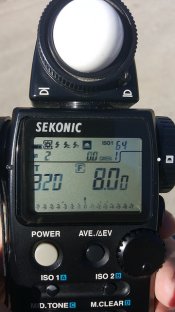
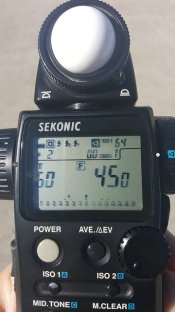
It’s odd to me but there’s only a 2.33 stop difference between spot metering the white poster board and taking an incident reading.

Metering in full midday sun, without clouds, orienting meter and white poster board the same way, meter set to ISO 64:
  • Spot on white board – 1/60th at f45
  • Incident with dome facing sunlight – 1/320th at f8 (1/10th at f45)

Why would the pure white poster board be only 2.33 stops from an incident reading, instead of 5?

Incident:
Incident.jpg

Spot:
Spot.jpg
 
Last edited by a moderator:
Photrio.com contains affiliate links to products. We may receive a commission for purchases made through these links.
To read our full affiliate disclosure statement please click Here.

PHOTRIO PARTNERS EQUALLY FUNDING OUR COMMUNITY:


Ilford ADOX Freestyle Photographic Stearman Press Weldon Color Lab Blue Moon Camera & Machine
Top Bottom