
• Welcome to Photrio!
    Registration is fast and free. Join today to unlock search, see fewer ads, and access all forum features.
    Click here to sign up

Enlarging the sides of negatives

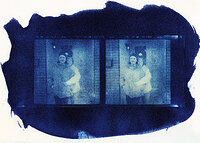
Cyanotype stereo card

A
Cyanotype stereo card

  • 0
  • 0
  • 0
IMG_0025.jpeg

A
IMG_0025.jpeg

  • 0
  • 1
  • 0

Forum statistics

Threads
203,125
Messages
2,850,240
Members
101,690
Latest member
nisherii
Recent bookmarks
0

Reticenti

Member
Allowing Ads
Joined
Mar 25, 2007
Messages
38
Location
Nevada
Format
35mm
I recently saw a framed picture that had the edge of the film developed on the print. For instance, I saw the words: Ilford hp5. I don't know what it's called, but you could see the type of film he used on the print.
My question is how did the person achieve this? When I used the enlarger, the 35mm frame fit perfectly, so how would you go about getting the entire frame edge to edge to show through?
 
The edge of the film is called the rebate. You can include the rebate in the print in two ways. One is to file out the opening of a glassless carrier. That will give you a ragged edge that will look something like this:

(there was a url link here which no longer exists)

The other option is to use a glass carrier that allows you to print the entire negative -- I do that will all of my 4x5 enlargements, and all of my 5x7 contact prints.

Sanders
 
So, you have come across the ernest anti-cropping clique in photography who insist on showing you a dark outline sometimes including frame number and film type for the sole purpose of, well, telling you it's not cropped?! I usually find this distracting and a little pretentious. As if every final picture you want to present has to be contained within a fixed aspect ratio. As if every viewfinder shows you precisely 100% of what ends up on the negative.

As Sanders said if you have a glass carrier one size up from your film format it's easy enough. You can even print the sprocket holes on 35mm if you think that turns on the viewer. :smile:
 
So, you have come across the ernest anti-cropping clique in photography who insist on showing you a dark outline sometimes including frame number and film type for the sole purpose of, well, telling you it's not cropped?! I usually find this distracting and a little pretentious.

Dear Tony,

Sometimes, yes. Other times, it's a useful 'cheat' to stop light areas near the edge of the image 'leaking out'.

Cheers,

R.
 
I agree with Tony, but Sanders' photos are much better than mine, any way I print them. That's what really counts.
 
I wouldn't do it every time, but in the pictures I saw, it really added to the picture. thanks for the info
 
Jim, I agree with you re Sanders photos and I should point out my comments were not in direct response to his work. My post was a "carry over" of a discussion I had with another photographer at an exhibition recently.

Reticenti - can you expand a bit on why you thought this technique added to the picture? I am interested. Did it make the picture seem more "authentic"? Did a "raw and unfinished" presentation augment the subject matter? Was it the "novelty" value of different kind of framing? Or was it per Rogers response a frame for a high key background? Appreciate your input. Thanks.
 
The rebate is also a very loaded aesthetic device in photography. It's either as sign of absolute-uncrop, sometimes the only alternative to sprocket holes for people who work in larger formats.

It is also a synecdoche for film taken in its material aspect. Technical icons like film rebate in turn seem to be a synecdoche for cool, macho, beautiful, etc, when it wears its technical nature on its sleeve. Witness #320: I've seen a clothes ad once for a famous brand that was styled after the look of a contact sheet, which of course shows the rebate. However, instead of the familiar "Kodak 6402" etc types of marking, it was the name of the brand, some meaningless numbers, and a few dingbats meant to imply vague technicality.

Of course you could also achieve the same effect with EXIF data.
 
I shoot a Holga and I center my negs in a 6x6 carrier and set my easel's masks outside of the black edge. I do this because aesthetically, cropping a more or less symetrically vignetted image is problematic. Not cropping it but trimming the black border would be no less an assertion of "full-framedness," agaiin due to the vignetting. I merely include the raw edge because it seems to enhance the low tech nature of the Holga. I feel no attraction to printing the rebate in any other context, with any other format.

(there was a url link here which no longer exists)
 
Synedoche?

...French guy teaching me English....

Thanks, that's cool. I won't use it anytime soon, though.

:smile:

Well, Greek first (sunekdokhe), then by way of Latin (synecdoche) which was kept as such for a long time in the French language until 1521 (sinodoche) and then 1730 (synecdoque). In English, the first recorded apparition is in Wyclif's Bible in 1388 as synodoches. So the word probably made its way in the English language with the Normans, and might have bounced back to France afterwards, unless it was vernacularized independently in each language.

The modern word in English is the Latin one, Synecdoche, and the French one is phonemically identical, having been adopted during the early Enlightenments, a moment at which it must have been fashionable to revert vernacular forms (sinodoche) to their ancestral versions (synecdoche).
 
snip
It is also a synecdoche for film taken in its material aspect. Technical icons like film rebate in turn seem to be a synecdoche for cool, macho, beautiful, etc, when it wears its technical nature on its sleeve....

Michel - I too reached for my dictionary but it's an appropriate word and I think your crisp analysis describes pretty well my feelings about use of the rebate.

Next time I'm balancing a glass of wine on my stomach at an exhibition opening I will find a way to bring that word into my critique. Pretentious? Moi?! :smile:

Thanks, Tony
 
pretentious or not - (I do it sometimes too, I guess - hell- everyone does it with polaroid negs!) - it adds an extra layer of something which can be useful at times. It's all about the tools in your kit. Pretentious is adding something because someone else does without understanding what effect it has, and not USING it to your advantage. i.e.- someone using a tripod because they think it makes them look professional - but not actually attaching the camera properly to it.
 
Hi Jonathan,
So what exactly is the "extra layer of something"?
What is the "it" you are using to your advantage?

I think Roger and Michael have given some concrete examples of "the picture looks better with a thin black frame" and their reasons why. Do you have some others? I would accept its just fashionable as an answer if fashion happens to be an important element in having work accepted or appreciated at a point in time. Is following a fashion pretension? My contention is yes, often it is.

Tony
 
Michel - I too reached for my dictionary but it's an appropriate word and I think your crisp analysis describes pretty well my feelings about use of the rebate.

Next time I'm balancing a glass of wine on my stomach at an exhibition opening I will find a way to bring that word into my critique. Pretentious? Moi?! :smile:

Thanks, Tony

Gee Tony, you should come to mine this Friday in Montreal, and I'll recite the whole dictionary for you while we finish this 4L of exhibition wine!

Cheers,
Michel
 
Reticenti - can you expand a bit on why you thought this technique added to the picture? I am interested. Did it make the picture seem more "authentic"? Did a "raw and unfinished" presentation augment the subject matter? Was it the "novelty" value of different kind of framing? Or was it per Rogers response a frame for a high key background? Appreciate your input. Thanks

It was a 2 frame picture and it was a multiple exposure abstract photo. It gave it more of a raw and unfinished look.
It is in the office of Prospective students at the university of nevada, reno.
 
I am wondering if it is considered pretensious for printers (of lithographs and other etchings) to show the edge of their prints where the edge of the stone or plate makes an impression on the paper.

Are they just showing off that they use the whole stone or plate?

Not showing the rebate is just one of the many Rules of Photography that are meant to be broken.

Vaughn

Edited to bring myself back on topic...

I have filed out 35mm and 6x6 negativer carriers (Omega) with no problems for our students. Fortunately, no one asked me to turn a 4x5 neg carrier into a full-frame carrier yet -- that's a lot of filing! Using a jewery saw and file, I have also turned 35mm neg carriers to print 2 or 3 35mm negatives in a line...it is fun to see what the students can do with those!

I draw lines on the carrier and then use a bastard file to remove up to the line -- I find that gets me a pretty good, even retangular hole.
 
Last edited by a moderator:
Photrio.com contains affiliate links to products. We may receive a commission for purchases made through these links.
To read our full affiliate disclosure statement please click Here.

PHOTRIO PARTNERS EQUALLY FUNDING OUR COMMUNITY:


Ilford ADOX Freestyle Photographic Stearman Press Weldon Color Lab Blue Moon Camera & Machine
Top Bottom
