• Welcome to Photrio!
    Registration is fast and free. Join today to unlock search, see fewer ads, and access all forum features.
    Click here to sign up

Enlarging Photographic Paper Negatives with an enlarger

Forum statistics

Threads
203,309
Messages
2,852,777
Members
101,775
Latest member
lletinsk
Recent bookmarks
5

Theodor Bader

Member
Allowing Ads
Joined
Dec 11, 2025
Messages
28
Location
Ingeberg, Norway
Format
Medium Format
Does anyone here have experiences with enlarging from photographic paper negatives using an enlarger?

What are the limitations you've encountered?

So far, I've been able to enlarge 40x50 mm paper negatives ( from my matchbox pinholecamera) to 90x140 mm quite well.
 
I think most people would ask the question;
"Why not make a larger paper negative in the first place?"
 
I think most people would ask the question;
"Why not make a larger paper negative in the first place?"


That's a good question!

I follow the advice of one of my photography mentors: "The best camera is the one I have with me!"

I've also taken photos with my 30x40cm format camera using photographic paper.

But this camera often doesn't fit in my pocket.😂 So I reach for the smaller format.

Then, every now and then, I get the urge to enlarge the print.
 
That's a BIIIIIGGGG camera! Even for a pinhole.
Heck, 40x50cm is already a big camera.

Those prints must be really nice @Theodor Bader ! What kind of exposure times do you get (for the print I mean)? I assume the original negative is on RC paper?

It is a 40x50mm format ! On RC paper.
I got 2min and 15 seconds by f8 (50mm enlargement lens and 17 cm from the ground board).
 
That's a BIIIIIGGGG camera! Even for a pinhole.
Heck, 40x50cm is already a big camera.

Those prints must be really nice @Theodor Bader ! What kind of exposure times do you get (for the print I mean)? I assume the original negative is on RC paper?

Isn't his pinhole camera from which he wants to enlarge only 40 x50mm not cms?

pentaxuser
 
Photocopy the paper negative (35mm camera/macro lens/copying stand) onto 35mm film. Process as reversal. Projection print as usual.
 
The risk I could see from using paper negatives in the enlarger is that if you have to use particularly long exposures, the RC coating could melt/burn, especially if you are using a condenser enlarger. Also, the texture of the paper (paper fibers) might start to detract from the image when projecting, as it would become more visible the larger you make your print.
 
This would actually be a good use for very outdated single-weight fb paper. The base fog wouldn't matter as much for a negative. The paper is already thin to begin with. It could also be made more translucent by oiling the back of the paper.

As for paper texture, some people consider that a desirable feature. It can make a photo more "pictorial".
 
So far, I've been able to enlarge 40x50 mm paper negatives ( from my matchbox pinholecamera) to 90x140 mm quite well.

well done But can you post a sample ???
 
I've done it a few times and didn't really encounter any problems. Obviously the exposure time is long. RC paper negatives don't have all that much paper texture. I suspect with your tiny pinhole negatives, the resolution of the negative image itself will be what limits how large a print will look good. Especially for pinhole, it's not hard to make large paper negatives, and they contact print nicely and to me they look better than enlarged versions.....

I think Joe Van Cleave also did it with similar results. You could probably find his notes about it with a search.

Don had a neat projector ( like a process camera ) to basically photograph the paper negative onto another paper negative, making a positive. This is how those "Afghan street camera's" worked too... a photo of the photo...
 
The super cheap multitone RC paper is thinner than any, so will reduce exposure times a bit. The density range of such a transmission projection is very small, so you get stuck with a high contrast filter that may not give enough contrast. Best to use pear surface, I believe, to reduce surface reflactions compared with glossy. I experimented with this a bit recently for enlarging negatives, but I was printing negatives as positive prints on paper 4x5 and enlarging onto ortho litho film, which makes enlarged negatives. The tonal range did not look good this way, due to very curvy type response curves in transmission that look better double pass just looking at a print. Low conttrast shedows and highlights with high contrast midtones.

Also possible to use opaque type projector for this, which gives more snap and tonal quality to your prints. This can be done using a view camera with paper in the film holders photographing the paper negative illuminated from the front side. Or, build a box with you print on the back wall with a couple of lamps front side attached to your LF enlarger back. Easier to just contact print onto ortho litho film, then enlarge that posive to a negative.
 
Given enough lumens, you should be able to enlarge onto as big a paper as you wish, even up to mural size. Of course, exposing through the backside introduces a fair amount of neutral density. But some commercial halogen colorheads are very powerful. I vaguely recall trying it once with 20X24 inch fiber-based paper - no problem; but I swear that colorhead ran on Kryptonite or Plutonium, or enriched uranium, or on Peet's Coffee or something like that.
 
So far, I've been able to enlarge 40x50 mm paper negatives ( from my matchbox pinholecamera) to 90x140 mm quite well.

well done But can you post a sample ???

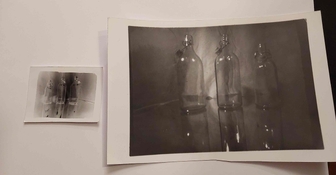
Here my first and at the moment only result. I am very happy about the result. Left: paper negativ with white frame. The picture is 40x50mm. Right: Picture 90x140mm
 

Attachments

  • Vergroesserung Flaschen von 40x50 auf 90x140mm.jpg
    Vergroesserung Flaschen von 40x50 auf 90x140mm.jpg
    1.5 MB · Views: 111
In order to be sure that bigger than 90x140mm will retain enough detail 3 glass bottles may not be the best subject but at 90 x 140mm it looks promising to me

pentaxuser
 
Does anyone here have experiences with enlarging from photographic paper negatives using an enlarger?

What are the limitations you've encountered?

So far, I've been able to enlarge 40x50 mm paper negatives ( from my matchbox pinholecamera) to 90x140 mm quite well.

I don't see how a paper negative could be enlarged successfully.
 
One doesn't ordinarily enlarge a paper negative. They enlarge an internegative onto it, in order to make a special look or cost-effective negative image on paper for sake of contact printing onto yet another medium. ...
But apparently on this thread is an exception, postulating on using paper in camera in lieu of film. Relatively uncharted territory. Get a bigger camera, or possibly a more powerful enlarger combined with a fast lens. Another fun project for someone, I guess.
But with a high-wattage halogen or xenon enlarger, I'd literally be worried about the paper negative catching on fire over a long exposure. Even all the gasketing and ducting on mine had to be pure silicone.
 
Last edited:
One doesn't ordinarily enlarge a paper negative. They enlarge an internegative onto it, in order to make a special look or cost-effective negative image on paper for sake of contact printing onto yet another medium. ...
But apparently on this thread is an exception, postulating on using paper in camera in lieu of film. Relatively uncharted territory. Get a bigger camera, or possibly a more powerful enlarger combined with a fast lens. Another fun project for someone, I guess.
But with a high-wattage halogen or xenon enlarger, I'd literally be worried about the paper negative catching on fire over a long exposure. Even all the gasketing and ducting on mine had to be pure silicone.

I remember the internegative thing from my youth, around 1970-1980. Apparently, that was the way things were done. I've been making photographic paper negatives since about 2010 and I'm very enthusiastic about them. I even got to 30x40cm for a while. A contact print is sufficient for that size. But the 30x40cm camera didn't fit in my pocket. I've written about that before. When enlarging paper negatives, the exposure time factor comes into play. Theoretically, I wouldn't expose for 2-5 minutes with a condenser enlarger. That's been discussed before. My cold-light color mixing head enlarger doesn't pose a fire hazard. After a 4-minute exposure, the glass of the negative holder (60x70mm) was still cold. Four minutes corresponds to an enlargement from 40x50mm to 180x240mm at f/8. And my enthusiasm remains undiminished. I will also buy larger, cheaper/thinner, matte photo paper, as recommended above. Perhaps that will allow me to print even larger, who knows?
 
Here my first and at the moment only result. I am very happy about the result. Left: paper negativ with white frame. The picture is 40x50mm. Right: Picture 90x140mm

This looks really nice to me. I can see why you want to push further.

I think good advice here is simply “trial & error”
 
Some years back I used to make paper negatives with my 4x5 on RC paper. I would develop and strip the emulsion off, then mount on glass for enlarging. It takes lots of very hot water and mucho practice.
 
Here my first and at the moment only result. I am very happy about the result. Left: paper negativ with white frame. The picture is 40x50mm. Right: Picture 90x140mm

OK!! looks great - the "Picture 90x140mm" is from a projection ??? how??
 
Make a Xerox copy onto rice paper. Immerse the copy into an oil to make translucent. Problem with the paper negative is that the paper support can't be made translucent.
 
Photrio.com contains affiliate links to products. We may receive a commission for purchases made through these links.
To read our full affiliate disclosure statement please click Here.

PHOTRIO PARTNERS EQUALLY FUNDING OUR COMMUNITY:


Ilford ADOX Freestyle Photographic Stearman Press Weldon Color Lab Blue Moon Camera & Machine
Top Bottom