• Welcome to Photrio!
    Registration is fast and free. Join today to unlock search, see fewer ads, and access all forum features.
    Click here to sign up

Enlarger alignment: What can I expect?

Recent Classifieds

Forum statistics

Threads
203,292
Messages
2,852,470
Members
101,766
Latest member
Onetrick
Recent bookmarks
0

Worker 11811

Member
Allowing Ads
Joined
Jan 18, 2010
Messages
1,719
Location
Pennsylvania
Format
Multi Format
I've been trying to align my Besler 23C-II and get it to focus evenly with varying amounts of success. I'm wondering whether I am doing work of no consequence, trying to squeeze the last little bit of sharpness out of it.

I have tried different lenses: Componon, El-Nikkor & Componon-S. I have made some improvements moving up to the better lens.

I have aligned and adjusted the stage and the lens carrier as well as I can with the tools I have.

I have fiddled with the negative carrier and just about everything I can think of. I am just unable to get that last little bit.

I had a chance to visit the teaching darkroom at the college where I work. They have 6 Beseler 23C-III enlargers. They are newer than mine but they seem to exhibit the same focus anomalies that mine does.

I'm just wondering. Have I pushed my enlarger to the limit? What can I expect out of it?
 
First of, you should have a level enlarging bench as a good foundation of sharpness. From there, make sure you have a baseboard, lens stage and negative stage that is level too. What I use is a negative with a shot of the screen from my back door shot on a tripod as a test neg. When all 3 planes of your baseboard, lens board as well as your negative stage are all level and parallel to each other, you should have a sharp image even with the enlarger lens wide open. I have a Beseler 45MX for over 20 years and Beseler make excellent enlargers. I don't have a 23C-II, so look at your owners manual to see how the stages can be aligned. I had the same problem when I first installed my enlarger in my darkroom, but when I aligned my enlarger with the test shot of the screen, it stayed sharp ever since. After you've got your enlarger properly aligned, you might want to secure your enlarger to the wall with a bracket. Good luck!
 
I was wondering if somebody would say that.

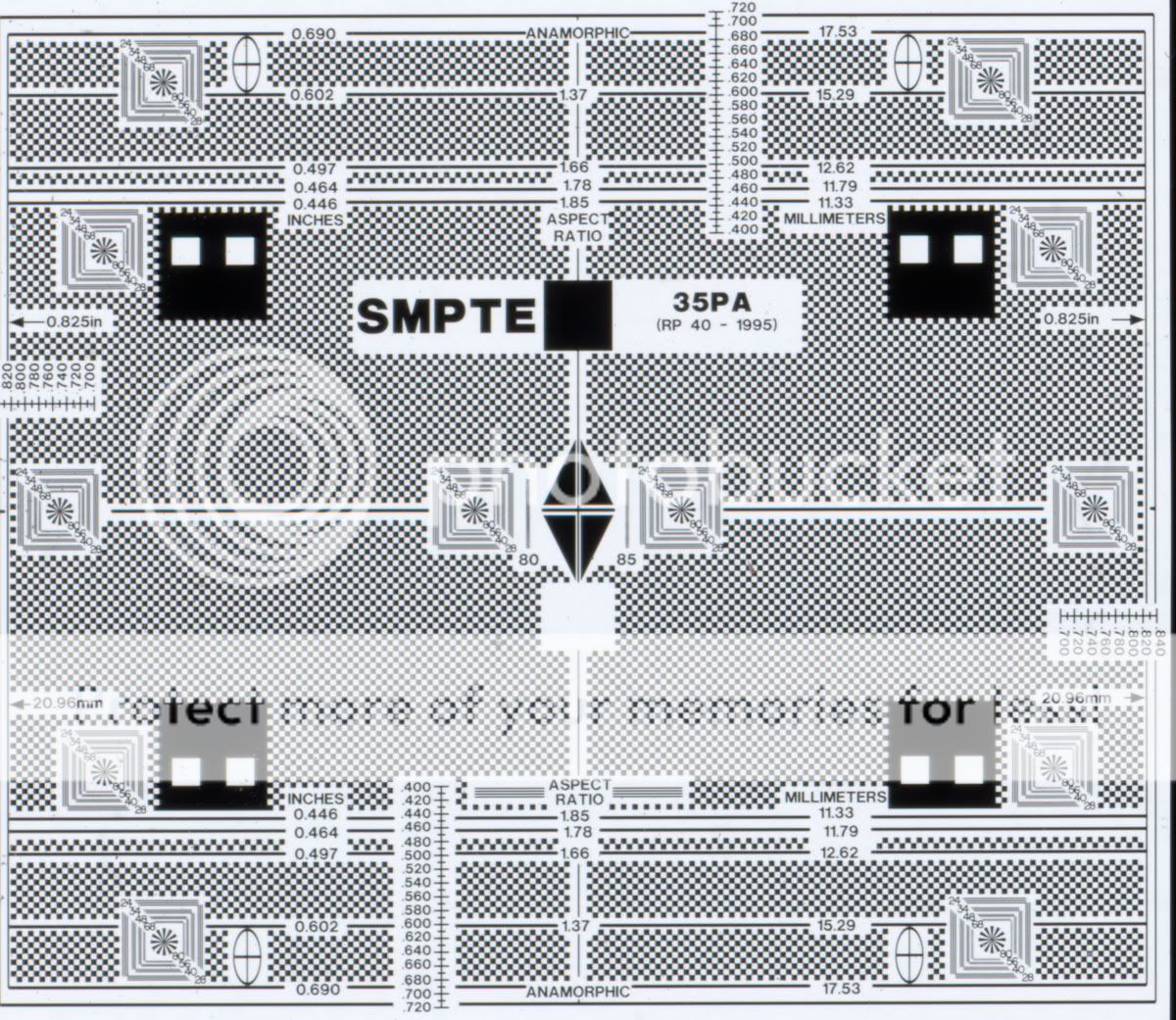
I'm using SMPTE PA-35 test film for my alignment.
pa35film-1.jpg


If I use the Componon lens I can get 56 or 68 lines of resolution on the "bullseye" targets. I can usually get 68 in the center and 56 at the edges.

If I use the El-Nikkor or the Componon-S I can get 80 lines at the center and, if you squint your eyes, you might be able to see 85 lines. At the edges, you can get a squinting-80 lines with either the Nikkor or the Componon-S.

But here's where it gets freaky. You have to rotate the negative carrier in the stage to get that.

If the negative carrier is in landscape orientation, you can get 80 lines at the center and 64 lines (or a squinting 80 lines) at the left and right edges. However, the top and bottom edges will not be focused evenly. You can focus the center and the top or you can focus the center and the bottom but you can not focus the center, top and bottom all at the same time.

Now, rotate the negative carrier in the enlarger 90º so it is in portrait orientation and the whole problem also rotates 90º.

This is why I was thinking about the negative carrier.
If the problem moves when you move the negative carrier, then the problem is probably in the negative carrier. Right?

Okay... So I've been looking on eBay. Anybody got any hints on what I should be looking for?

And, what kind of improvement should I expect out of this?
 
The grain in the corners should be just as sharp as in the center (or side-to-side) to the unaided eye when viewing a print. If you got to that point, your are all set.
 
if that a condeser enlarger, then you need to level the condensors as well for even illumination. So assuming column is perpendicular to the easel, then level condensors, then negative stage and then lens for being on axis. These all need to be done left right and top bottom. Your problem could be either neg stage or lens stage or both but probably lens stage.
 
The grain in the corners should be just as sharp as in the center (or side-to-side) to the unaided eye when viewing a print. If you got to that point, your are all set.

That is the goal all right!

It is a bit of a P.I.T.A. with any enlarger, so just stick with it. Unless the enlarger has been badly damaged at some point, there is no reason you should not be able to get it into perfect alignment.

I use a simple bubble level myself, and it seems to work perfectly.
 
The tough thing is that the pivot points the hold the lens board in place are not centered on the nodal point of the lens.
Loosening the thumbscrew under the lens and rocking the lens board side to side (Beseler 23C II) moves the entire lens focal plane. The same thing goes for the shoulder screw that the lens pivots on which you use to adjust the front/back focus.

What you have to do (as far as I can figure out) is to focus on the center of the image and pivot the lens board until you have the best overall focus. You will not get both sides and the center in focus simultaneously. Just get it as close as you can.

Next, what you do, is focus on one extreme edge and mark that spot with a pencil or something. Then, without moving the focus knob, rock the lens board until the opposite side is in focus and mark that spot with a pencil. Move the setting half way between the two marks and refocus the lens until the center is in focus again. Repeat this over and over again until you narrow down the settings as much as you can. It will probably take three or more iterations but, eventually, you will find a place where one setting of the focus knob brings everything into sharp focus.

Then, do the whole thing again for the front/back. Tighten or loosen the pivot screw to make the adjustment. You will still use the same "homing in" process to get the setting right.

If the pivot point moved the lens around its nodal point you would not have to go through all that crap. You could just make one setting and maybe a fine tuning and you'd be done.

What's worse is that, if you're not careful, you can upset the alignment of one axis while you are trying to work on the other.

It's frustrating! I've had it ALMOST THERE and, at least three times, I have messed it all up and had to start over again.

Even so, I think I have it aligned just about as well as is possible but I still have problems. I'm beginning to suspect the negative holder.
I'm probably going to have to get a glass one.
 
Nice if everything is perfect but remember that you have a lot of depth of focus on the paper so it's not as critical as people would have you beleive unless you are an out and out perfectionist. But if you were you would be checking enalrger alignment for every print just to make sure so everyone has their limits of perfection.
 
If you are not using a glass neg carrier to keep the neg flat, no amount of fiddling with alignment will get the image sharp all the way across.

You also need a good lens and a sharp neg to start with.
 
I'm going through this process as well with D-2.

Something I never hear people talk about (and not mentioned in service manual either) and I am concerned as well is.... the enlarger head height. I'm finding, the higher the head I make it, more sag I experience which affects front to back alignment. I'm adding thickness to the baseboard to mitigate this. But is there a standard on what height I use? Minimum, maximum, middle, or most used? I think, it's far more critical to get film and lens parallelism correctly than that of with baseboard because of depth of focus issue, but as long as I'm at it, I would like to do it correctly.

Also, assuming one is not using APO lens, is it really reasonable to expect edge to edge sharpness as an end result?

Adding to this thread as it is related to OP's concerns.
 
I'm going through this process as well with D-2.

Something I never hear people talk about (and not mentioned in service manual either) and I am concerned as well is.... the enlarger head height. I'm finding, the higher the head I make it, more sag I experience which affects front to back alignment. I'm adding thickness to the baseboard to mitigate this. But is there a standard on what height I use? Minimum, maximum, middle, or most used? I think, it's far more critical to get film and lens parallelism correctly than that of with baseboard because of depth of focus issue, but as long as I'm at it, I would like to do it correctly.

Also, assuming one is not using APO lens, is it really reasonable to expect edge to edge sharpness as an end result?

Adding to this thread as it is related to OP's concerns.

That is why wall mounting or at a minimum using a bracket from top of column to wall is suggested. It stops sag and also stops vibration.
 
I am kind of picky about focus but this enlarger really does need a tune up. It's pretty old and I am, at minimum, its third owner. I got it from my uncle who bought it from somebody else. The thing just needs to be cleaned up. I have spent a lot of time doing just that. This is one of the final steps, getting it all aligned correctly.

Working in movie theaters kind of makes me picky about focus but I know perfection has its limits. The lens, the film gate, the lamphouse, the screen and the film, itself, all contribute to how well you can get a picture to focus. You can tinker for a long time and never get the picture 100% perfect no matter how much you try. The machine just has its limits and there is also a point where extra effort stops paying off. For all the work you do, you will only make a small improvement over what you have already achieved. There comes a time when you just have to say, "Good enough!"

The SMPTE test film I am using was contact printed from a glass negative on a pin-registered film duplicating machine. I'm sure it is as good as can be had. (It had better be! The stuff costs $180 for 50 ft of it! $3.60/ft.)

I have tried three different lenses. I have a Componon ƒ-4.5 which came with the enlarger when I got it. It's okay but it's old and it's seen better days. I also borrowed an El-Nikkor and a Componon-S ƒ-2.8. They are much better. I have been using the Componon-S to make my adjustments with but I'd be hard-pressed to tell the difference between it and the Nikkor in a blind A/B test. I am planning to buy a new lens for myself, after I return the borrowed lenses to their owner. That, I figure will cover the optics end of the problem.

The negative holder is probably the last avenue of attack I plan to take. Right now, I have the standard, glassless negative holder that came with the enlarger. Yes, I know that the film can buckle and warp inside the enlarger. (It peeves me off to no end! :wink: ) For now, I have been sticking negatives down with non-residual film tape. I align the film in the gate and tape one end down. Then I pull the film taut and tape the other end down. It's as good as I can do for now. I plan to get a glass negative carrier as soon as I can find a good one that doesn't cost an arm and a leg.

As it stands, right now, I have "acceptable" results.

I have the enlarger cranked all the way up to make an 11x14 print. As I understand, that's about the limit of what this lens can do with 35mm film, anyway. As I crank it down to make 8x10 or 4x5 things will become less and less critical. Right?

With the lens all the way open to ƒ-2.8 you have to squint to see the difference in focus, edge-to-edge or top-to-bottom, unless you are using the grain focuser. Using the "scope" you can tell the difference pretty quickly. If you fiddle with the focus knob you can find a good middle ground where everything is acceptably sharp.

If I keep the lens stopped down to smaller than ƒ-8, I can get the image sharp all over, even at 11x14. If I stop all the way down to ƒ-16, the image appears tack sharp all over. (i.e. We're taking advantage of the lens's depth of field at small apertures.)
So, if I'm making an 11x14 print, if I don't mind having a two minute exposure time, I suppose I can stop the lens way down. Right?

At this point, I think I'm going to lock down all the settings and call it, "good enough." I've been working on this thing, on and off, for nearly a week. Without a glass negative holder, I don't think I can do any better than I already have.

Besides, I have an Omega D-II sitting on the bench waiting for a good tuneup! :wink:

I'm going through this process as well with D-2.

Something I never hear people talk about (and not mentioned in service manual either) and I am concerned as well is.... the enlarger head height. I'm finding, the higher the head I make it, more sag I experience which affects front to back alignment. I'm adding thickness to the baseboard to mitigate this. But is there a standard on what height I use? Minimum, maximum, middle, or most used? I think, it's far more critical to get film and lens parallelism correctly than that of with baseboard because of depth of focus issue, but as long as I'm at it, I would like to do it correctly.

Also, assuming one is not using APO lens, is it really reasonable to expect edge to edge sharpness as an end result?

Adding to this thread as it is related to OP's concerns.

tkamiya, By all means, do jump in. Aligning enlargers is the overall point of this topic. Right? :smile:

By the way, as far as I understand, alignment of the head to the baseboard is not as critical as alignment between the lens and film plane. Yes, it is important. When aligning an enlarger, getting everything plumb to start with is important but you have a few millimeters of play in either direction. Within the head, itself, you only have a few microns worth of play.

Example:

Film is somewhere between 130µm and 150µm thick. Let's call it 140µm. So, depending on film, you might have .140mm of leeway to get your focus sharp.

If you are using a 50mm lens to make an 8x10 print from a 35mm negative there should be somewhere in the neighborhood of 1.4mm worth of play at the baseboard. If you crank the head up to make an 11x14 print from the same negative, you will have just a hair more than 2mm worth of play at the baseboard.

So, if you use a regular spirit level that's more than enough accuracy to make the head-to-baseboard adjustments. However, when you go up to the enlarger head, you're talking about distances of just a few microns. Adjustments which might be invisible to the naked eye might very well throw the whole thing out of kilter!

 
Last edited by a moderator:
I think a wall mount is the way to go if you can. However, printing with a old Beseler 45m, the one with the struts out front, and making 20x36 prints, was not a problem. I would think the D2 is very robust, maybe something is loose or a thread bolt is stripped?
 
Fotch, I replaced the base board with 3/4" plywood on mine. Apparently, it wasn't enough. I now have double 3/4" ply glued and screwed together. Now I have much less of a sag. Still sags a little but MUCH stiffer....

I'm going to lose some more hair over this one....
 
I had major problems with this and found I have completely rectified the issues. Here is what I did:

I use glass carriers top and bottom. Always did.
Use a Laser to align everything. Spirit levels might work for very small enlargement rations but are useless for more demanding sizes and wider apertures.
I now use a slightly longer lens (60 or 63mm for 35mm). This is much better in the corners at wider apertures and is poss more tolerant to the neg not placing dead centre of the lens every time, due to larger image circle.
I realign everything for any significant change in column height. the front to back and side to side both change! When you use a laser you can see exactly what has changed and dial it out. I keep my allen key and screwdriver beside the enlarger and in 60s I have each neg set up smack bang perfect. The result is that I can print at any aperture and have a perfectly good print. The only difference is image circle and aperture on larger prints. With my 63mm Nikkor, F4 is tack sharp for 12x16s and FF prints at about 18". If printing with a higher enlargement factor, f5.6 is safer.

Now I have razor sharp grain in all my prints regardless of size. Once in a while, even with glass carriers, things just go awry and you notice a print is a touch soft. A quick check and tweak if required, or refocus and you are done. Without this you waste more paper, chasing focus, only to find out one of the shims in your baseboard slipped out, etc.

The laser alignment tool is the best thing I have ever bought for darkroom use. It was driving me mad. Now I have no stress and know all I need to worry about is being a good printer. $180 is a fraction of what most people pay for sharp taking lenses, cameras etc. Its all being wasted if you dont get the enlarging right....
 
The laser alignment tool is the best thing I have ever bought for darkroom use. It was driving me mad. Now I have no stress and know all I need to worry about is being a good printer. $180 is a fraction of what most people pay for sharp taking lenses, cameras etc. Its all being wasted if you dont get the enlarging right....

I am fine with a spirit level, matching the location of the bubble to its location when the level is placed on the baseboard. However, I completely agree that it is fundamental to realize that your prints are only as good as the weakest link in your printing process ("image-making chain," perhaps), regardless of how good all the other links may be. IMO, choosing and servicing your equipment ought to start with the stuff that is used to make the prints, and move backwards through the chain. This being said, only recently have I acquired very nice enlarging equipment (though I did perfectly fine with my B-22XL for many years, and it did have a quality lens on it for 35 mm printing).
 
Last edited by a moderator:
I think it is important to note that the Beseler 23CII does not have adjustments for aligning the lens axis. The side to side angle adjustment is actually designed for adjusting the focus on a tilted (for perspective) easel.

Some people use tape on the lensboard to shim. Also, as previously mentioned, there exists a double lensboard with three bolts to adjust and a rubber washer in between to prevent light from escaping.

Jon
 
So, if I'm making an 11x14 print, if I don't mind having a two minute exposure time, I suppose I can stop the lens way down. Right?

A while back I was making 11x14s on my DII that needed tilted up on an ammunition box to correct keystoning. In order to ensure good DOF I focused in the middle and stopped down to F22. I would turn the enlarger on, and carefully walk out of the darkroom and play on the internet for 5min while the print was exposing. They came out very well.

When aligning an enlarger, getting everything plumb to start with is important but you have a few millimeters of play in either direction. Within the head, itself, you only have a few microns worth of play.

Dude...microns? I think you need to take a break and make some prints. At f/11 (my usual aperture) I can prop one side of the easel up by entire CENTIMETERS and not notice any unsharpness. It's just not that critical. Yes, depth of focus around the negative is more important, but we're not talking microscopic tolerances. I mean, do you make sure you are aligning your enlarger when it's the proper temperature? Metal expands and contracts you know. You might need a different alignment for each exposure time!

As already mentioned, the Beseler enlarger doesn't even have adjustments. When you use your view camera, do you make sure the standards are aliigned perfectly to microns? If you are like me, you grab them and move them (sometimes entire milimeters) where you want them and then stop down until it looks good. An enlarger is basically the same thing as a camera and it's not magically more sensitive to alignment.

I think that making sure your lens and negative are reasonably close is important, and making sure the negative stays flat with a glass carrier is a given or you are just wasting time with everything else, but if you are spending a week aligning your enlarger, I think you might want to to reevaluate your priorities, or maybe even switch hobbies. There are a lot of things to worry about in this hobby and enlarger alignment is a pretty basic one.
 
Photrio.com contains affiliate links to products. We may receive a commission for purchases made through these links.
To read our full affiliate disclosure statement please click Here.

PHOTRIO PARTNERS EQUALLY FUNDING OUR COMMUNITY:


Ilford ADOX Freestyle Photographic Stearman Press Weldon Color Lab Blue Moon Camera & Machine
Top Bottom