
• Welcome to Photrio!
    Registration is fast and free. Join today to unlock search, see fewer ads, and access all forum features.
    Click here to sign up

EFKE IR820 Exposure/Development

Recent Classifieds

Forum statistics

Threads
201,770
Messages
2,829,863
Members
100,936
Latest member
rdbirt
Recent bookmarks
1

bsdunek

Member
Allowing Ads
Joined
Jul 27, 2006
Messages
1,611
Location
Michigan
Format
Multi Format
I finally got around to testing the IR820. It seems everyone talks about an I.E. of 1-3. What I wasn't sure was, is that before or after the filter is on the lens? I assumed after.
Read another thread about under exposure: (there was a url link here which no longer exists) which is interesting.
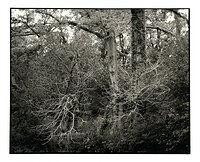
I tried exposures, at f11 of 1, 2, 4, 8, 16 & 32 sec. Developed in Ilfosol III 9 1/2 min, and the 32 sec. exposure was the only one that was even close. Took the other half of the film and developed for 15 min., and the 16 sec. exposure looks more or less satisfactory. See the scan, I haven't printed anything yet. The only adjustment in PS was to lighten it a little - it was kind of a dark scan. That would be, with the filter, an I.E. of about 0.031! I'm using a Hoya IR RM90 infrared filter - maybe it's too dark, or too much cut-off?
Those of you using IR820 - detail your experience a little if you would.
Thanks.
 

Attachments

  • IR820 16sec-15min Adjusted.jpg
    IR820 16sec-15min Adjusted.jpg
    76.5 KB · Views: 160

oldfaithful58

Member
Allowing Ads
Joined
Apr 6, 2008
Messages
21
Location
Hull, UK
Format
Multi Format
Hi Bruce
I rate the film at EI 100 BEFORE the filter. My filter is a Hoya R72, which seems to need 5 stops -> EI 3
I develop in Barry Thornton's version of 2 bath, 4 minutes in each bath at 21C
Good luck
Dave
 

Attachments

  • final.jpg
    final.jpg
    85.5 KB · Views: 151
  • Untitled-7.jpg
    Untitled-7.jpg
    120.4 KB · Views: 156
  • Untitled-9.jpg
    Untitled-9.jpg
    49.3 KB · Views: 152
Last edited by a moderator:
OP
OP
bsdunek

bsdunek

Member
Allowing Ads
Joined
Jul 27, 2006
Messages
1,611
Location
Michigan
Format
Multi Format
I may have answered my own question. There's a big difference between a R90 and an R72! An R90 passes light above 900 nm, an R72 above 720 nm. Sounds like I'm cutting our a lot more light than I have to. Looking through the filters, I can see through the R72 a bit. Looking through the R90, I barely see bright lights, quite a difference. I have used the R72 on my video camera and gotten interesting results. I have used the R90 on my digital P&S, an gotten very interesting results. Think I'll get an R72 in 52mm and try that.
Thanks, Dave.
 

nickandre

Member
Allowing Ads
Joined
Oct 22, 2007
Messages
1,918
Location
Seattle WA
Format
Medium Format
Aha! The IR820 is not sensitive to light longer than 820 nm. Using a 900nm cut filter, you have cut all the radiation the film is sensitive to leaving you with diddly squat. Using a R72 gives me good infrared effect and the blazing speed of ASA 3. Remember that the film lacks white skies so you'll think the film is really thin when in reality that's the way it should be. I print with a grade of 2.5 using the hoya 720 cut and the ASA of 3 in D76 straight for 8 or 9 minutes. Could be just a tad thin, though I'm not sure if it's development or speed. Probably development. Who knows, it works.
 

ntenny

Subscriber
Allowing Ads
Joined
Mar 5, 2008
Messages
2,513
Location
Portland, OR, USA
Format
Multi Format
I've also been using an R72, but I've found that I can often work with speeds a stop or two higher than others have reported. I've read that there's more IR available in proportion to visible light at sunrise and sunset---this would make sense, since the light at those times is generally skewed red---and those have typically been the times I've shot, which may explain the difference.

Metering through the filter has worked reasonably well for me, but when I did it I had the film rated at 100, and I think that may have been too high---the resulting negatives were pretty thin.

This film does interesting things in Diafine, by the way (at the same EI). The compensating effect helps prevent all the foliage from turning into large white blobs, and on the whole the IR effects are less extreme, though still obviously present.

-NT
 
Photrio.com contains affiliate links to products. We may receive a commission for purchases made through these links.
To read our full affiliate disclosure statement please click Here.

PHOTRIO PARTNERS EQUALLY FUNDING OUR COMMUNITY:


Ilford ADOX Freestyle Photographic Stearman Press Weldon Color Lab Blue Moon Camera & Machine
Top Bottom
