• Welcome to Photrio!
    Registration is fast and free. Join today to unlock search, see fewer ads, and access all forum features.
    Click here to sign up

Efke IR 820 - Expired/Longevity

The Chicken

A
The Chicken

  • 3
  • 4
  • 64
Amour - Paris

A
Amour - Paris

  • 1
  • 0
  • 73

Recent Classifieds

Forum statistics

Threads
203,241
Messages
2,851,911
Members
101,743
Latest member
Pablino
Recent bookmarks
0

VaryaV

Member
Allowing Ads
Joined
Dec 3, 2008
Messages
1,254
Location
Florida
Format
Multi Format
Greetings.

I have several rolls of 120 Efke IR 820. They are expired by 1-2 years. They have not been refrigerated as I read somewhere not to store IR film in cold conditions. Is this film still usable at this point and if so, how much do I compensate?

I would like to play with it this weekend as the conditions are perfect in this heat.
 
Well, give it a shot, so to speak..... be sure to use the proper IR filter and plenty of corrective exposure...6 or 7 stops .... making some added stops here for the age.... develop carefully in Diafine and see what the God of IR has in store for you.... and good luck!
Logan
 
I just shot my last roll of MACO Aura which I think is pretty close to Efke ir820 AURA. That roll was probably 3 or 4 years old. No problems. I didn't even store in the fridge.
 
Perfect, I'll give it a whirl then, thanks guys, and I do have the almost black IR filter.
 
I was thinking about getting that film. Tell me how it turn out. I have a 89b filter for my RB67 which I haven't used yet. I ashame to say it cost me $156.50 for it.(77mm size)

Jeff
 
Hi Jeff - those filters are crazy expensive aren't they. I will definitely let you know how they turn out. Haven't used the Wide Angle in ages either. What drives me nuts about using this filter though is that you can't see through it, you have to do all of your focusing with it off, a minor thing, but for someone who likes to work fast it can be a slight hindrance to slow down. :D It will be a great opportunity for me to go out and "play" with the camera. Lately, I have been painstakingly setting up shots in the studio so this will be a nice and loose venture for me.
 
I would like to point out that IR films are one of the films that really should be stored refrigerated or frozen for as long of their life before exposure as possible. The reason is that IR is heat and heat will eventually fog IR films faster than any other type of film.

PE
 
Thank you, PE for that valuable information. I will remember that the next time I buy a batch. I am relatively new to film and still learning the ropes. :smile:
 
I would like to point out that IR films are one of the films that really should be stored refrigerated or frozen for as long of their life before exposure as possible

I can only acknowledge this if you will keep your fog low with these films.

Also make a small correction for the distance because IR has another breaking index.

Best filter for Efke IR820 is 89B or 88A. It will slow down your film speed; Iso 1,5-3 is the regular speed then.

So you need a tripod.

Efke IR820 is a modified (other sensitizers) Efke 100 film so development will be pretty OK in Rodinal 1+50 - 1+100 or Beutler.
 
VaryaV; said:
Hi Jeff - those filters are crazy expensive aren't they. I will definitely let you know how they turn out. Haven't used the Wide Angle in ages either. What drives me nuts about using this filter though is that you can't see through it, you have to do all of your focusing with it off, a minor thing, but for someone who likes to work fast it can be a slight hindrance to slow down. :D

Varya, that is why rangefinder cameras are so great with IR film.
BTW, in your original post it sounded as if you wanted the film to record heat. It doesn't, but you probably knew that.
 
Uh, I seem to contradict PE here, wouldn't want to do that. So let me clarify. IR films record emitted or reflected IR wavelengths, the wavelengths are discussed above. Some hot objects will emit IR, for example a furnace or naked human skin. Others won't, like a radiator. Living foliage will reflect much IR, dead leaves not so much.
Anyway, have fun with it, and post some results. I'm still looking for a worthy replacement of HIE.
 
Phaedrus;

The IR films are sensitive to wavelengths longer than 700 nm. Heat is within that region. Therefore, heat gradually fogs IR films and varies depending on sensitizing dye.

So, an IR film, in a can, in the dark, and in the presence of heat sees that heat as visible light to it and it begins to fog slowly or rapidly depending on how much heat and the wavelengths involved.

IDK how to make this more clear. Sorry.

PE
 
It is clear, PE, and my last roll of HIE is in the fridge. Just wanted to mention that photographing on it, some rather warm objects come out with surprisingly low densities. An energy/time question, surely.
 
It should have been frozen all this time, but your experiment could help others in the future, so I would shoot it and see what happens, then let us know.

P.S. I have shot it older than that (3-4 years old) and got totally normal results, but it had been in my freezer since new.
 
Last edited by a moderator:
I recently bought some IR-820 in both 35mm and 120 to test out - it was from one of the big sellers but I don't remember which one, since I got a lot of stuff from a lot of places recently. It went straight into the freezer. It came out of the freezer a few hours before shooting, into a house with air conditioning. It was out in the (fairly warm) world inside a camera for an hour or so before coming home and being developed. After developing, the clear base looks more like a very lightly frosted acetate sheet. Is this normal? My darkroom is not built yet, so I'm scanning it, and when I do so, I can see tiny flecks (single grain sized) all over the unexposed areas of the film. You know, kind of like you do with really really old B&W film that's picked up some base fog. I haven't put it under optical magnification to try to determine if the light frostiness and the grain speckles are the same thing, or unrelated.

Is this just the way of the world with IR film - there is an unavoidable very low level of IR fog simply by running around on a warm day with it? Or did I get a bum batch of film, or UPS kept it in a hot warehouse for a day, or something like that? I shot some Kodak IR film (I assume HIE?) 30 years ago and don't remember having that problem. I remember the negative base being crystal clear.

Duncan
 
It should have been frozen all this time, but your experiment could help others in the future, so I would shoot it and see what happens, then let us know.

P.S. I have shot it older than that (3-4 years old) and got totally normal results, but it had been in my freezer since new.

You're kidding me, right? Density ranges are a bit over my head. :D:D However, I will gladly scan my negatives and post for you all to dissect and conclude. I'm a visual type gal myself.

Living foliage will reflect much IR, dead leaves not so much. Anyway, have fun with it, and post some results. I'm still looking for a worthy replacement of HIE.

Yes, I have seen others here do some beautiful things with foilage on a hot day using IR and I want to give it a go, and how can I pass up 103 and humidity. Lush! I just hope the film has held up for my backpack biking adventure into the intracoastal for tomorrow. wish me luck.
 
Last edited by a moderator:
I have been using MACO IR film (now EFKE 820IR film) since it came on the market. I have always kept my stock film frozen (-20degC) but off course when travelling and shooting the (4*5) film will be in my camera back for unknown periods of time (say up to 6 months) I do pay attention to storage conditions at home, and keep my 4*5 film in a closet, coolest place in my house, never above 20degC.

I have never had problems with fog, also not with expired (3 years0 film.

The only time I had a problem was with 35mm film, from the very first MACO IR batch, kept frozen for 4 years, and showed no sensitivity to IR light any more, I blame it on that test run of that film.

Best,

Cor
 
So nobody has a comment on whether the film base on IR820 is supposed to have a lightly frosted appearance or if it's supposed to be crystal clear? It's the exact same way on my 35mm and 120 negs and it really looks to me like it's the film base, not fog, but it reads in my scanner like fog. I suspect in a proper optical enlargement situation it wouldn't show up, but the peculiarities of the way scanners work ends up making grains of the texture sparkle enough to read on the scan. But then again, the texture is on the emulsion side so who knows. I've looked at it under magnification and with every direction of light and I just can't decide whether it's in the surface of the base (texture) or on it (fogged emulsion.)

Duncan
 
If you put a human being in a pitch black room with a roll of IR film, it doesn't fog it, therefore humans don't emit IR radiation at a wavelength that the film is sensitive to. The same goes for trees, and objects cooler than about 700K. As you'll have no doubt seen on some TV programme where a helicopter chases a criminal, you can detect the heat radiated by humans with specialised cameras. The radiation in this case is beyond even HIE's ability to record.
Heat does fog film, but the reason that IR film fogs faster has nothing to do with thermally emitted radiation. The energy of an IR photon is somewhat less than that of a visible one, so the film has to be sensitive to lower energies. Film naturally degrades over time (i.e. fogs) but this is not the same process as "exposure" (except that fogging caused by cosmic radiation).
Anywho, the result is the same, keep your IR film in the fridge and shoot it on hot days, not because the fact that the subject is at a slightly higher temperature means they emit IR, but because there's more sunlight about and thus more IR to be reflected from the foliage, in the same way that you need shorter exposures on a hot day at the beach with normal film, simply because there's more light about, not because anything is incandescently hot.
 
The important thing is to know that very few things emit IR in the wavelengths detectable by any film such as the sun, tungsten bulbs, flashes, that's about it, so it's pretty much the same as visible light sources. The only practical way to emit only IR light, e.g. for secretive photography in surveillance, is to have a massively powerful flash with an IR filter in front of it, that way you illuminate your subject with invisible radiation which the film then records an image of.
Anything else just reflects IR with efficiencies that are frequently different to their reflection of visible light, e.g. chlorophyll very strongly reflects IR, but the surface of human skin doesn't. Hence trees are bright and skin looks sort of translucent, with highly absorbent blood vessels running through it.
The confusion arises because everything between visible light and microwaves is known as "infrared", but a large proportion of that is ourside of the sensitivity of IR films (apart from HIE, most stop before 820nm and the wavelengths emitted from even fairly hot things peak at about 1200nm; lower energy).
 
Help!

Hey folks. I need help recalculating dev times. I totally miscalculated my exposures, Here is what Freestyle recommended with Red72 IR filter.

Iso - 1-1.5
f16 - 1- 8th

Soup in DDX at Iso 3 for 11.5 (from Massive Dev Chart)


What I did:
Iso 1
f4 - 1/4th

How do I adjust for dev times? and is it salvageable? I was on my way to the d/r this morning and realized my errors. Advice is much appreciate, fortunately these are just test rolls. oh, and I did not load my film in complete darkness like suggested so the first few frames will probably be fogged.
 
The wavelengths used for thermal imaging go out to the tens of microns. They use microbolometers for imaging. I believe HIE was sensitive out to maybe 1 micron.
 
Well, patience was never one of my virtues so I'm going to give it a whirl at 9 min. There are so many variables involved in this batch it's going to be tough to decipher. By the time I get it down to the last 2 rolls I should have a decent idea of usage.

Your tips have all been invaluable.
 
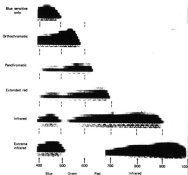
Dye sensitizations

As I said earlier, it depends on the film and the dye (speed and sensitivity range) as to the effect of heat on IR film.

From 700 nm to above 1 micron are considered to be in the normal possible IR range for films. See examples below.

Normal IR does go to 1 micron.

PE
 

Attachments

  • dye types.jpg
    dye types.jpg
    36 KB · Views: 136
Photrio.com contains affiliate links to products. We may receive a commission for purchases made through these links.
To read our full affiliate disclosure statement please click Here.

PHOTRIO PARTNERS EQUALLY FUNDING OUR COMMUNITY:


Ilford ADOX Freestyle Photographic Stearman Press Weldon Color Lab Blue Moon Camera & Machine
Top Bottom