• Welcome to Photrio!
    Registration is fast and free. Join today to unlock search, see fewer ads, and access all forum features.
    Click here to sign up

Efke IR 820 Developer

Recent Classifieds

Forum statistics

Threads
203,198
Messages
2,851,149
Members
101,717
Latest member
Ocelator
Recent bookmarks
0

herb

Subscriber
Allowing Ads
Joined
Jan 22, 2005
Messages
405
Format
Medium Format
I discovered a stash of this film in 4x5 I did not know I had, and made some test shots at iso 100 w/o filter and iso 6 with a 720nm filter.
Got really thin negatives with xtol stock replenished 30 sec agitation for 11 minutes at 73F.
My normal time for Rollei 400 IR with the filter is
8 minutes at that temp.
I am thinking xtol does not like Efke. How about Rodinal??
Any experience with Efke??
 
EFKE ir comment

forgot to mention 30 sec inital agitation, the 4 serious tilts in HP combiplan tank every 30 sec.
 
There's nothing wrong with xtol-efke combo.
More probably its the EI 6 you shot the film. It's slower than rollei ir. Most people shoot it at EI of 1.5 or less.
 
Agree with Domin. It's a really slow film with an Ir filter on the lens. Best results I had were with Rodinal 1+100 , one minute agitation and then stand for 50mns.
 
I develop it in Rodinal, shoot it @ 3 ASA to ~ - 3. Have some shots in my gallery here.
You jump in a the wild guess land with that film - it has high reciprocity @ >1 sec exposures.
For me it works ONLY with stopped down lens >4 f stops @ >1 sec exposures.
It depends on the area You are in and how IR You have around.
I have tried it @ wide apertures but it wont cut it (for me) at least not in 135 format.
Though, some folks here said it worked for them @ wide apertures...

Good luck,
G
 
wow, minus 3 iso! Won't be re ordering much of this stuff. I have some Rollei 4x5 on the way, but not here due to a backorder.

I will try again with 1.5 and minus 3 and use similar temp.
I shot a couple without the filter, and they were pretty thin even at 25 iso.
 
Yep, the 1st time I tried it in the 3 to 6 ASA and ended up with the same kind of results as Yours.
The filter I used was Heliopan RG715.
I had a few bracketed shots without the filter as well... so I know what it looks like.
Rollei IR400 is different. Both films are good. Rollei Retro 80S is interesting as well.
I develop them mostly in Rodinal (1:100) or Neofin Blue
 
Rodinal tends to lose speed, though, so it might not be the best developer for an already very slow film. I've actually gotten some decent results at EI 6, mainly in the afternoon when the ratio of IR to visible is high; in midday light it's slower than that for sure, and it also depends on your latitude. It sounds like you might have underexposed for the amount of IR light you had.

I've developed it in PC-TEA, which is generally similar to Xtol 1+2---I don't know if it's the *best*-looking developer for this film, but it worked fine. Diafine is interesting because the compensation reduces the Wood effect---the trees are still white, but they don't "bloom" into big fluffs of undifferentiated white.

-NT
 
I use EI1 (in Sunny-16 light, 90% of the time f/16, 1s) with an R72 (cheap chinese clone), soup in xtol 1+1 20C for 15:00, agitate first minute then 10s per minute. Beware reciprocity failure.

Note that the film has a really really long toe, so you need to overexpose a bit if you want to get any contrast out of it and the shadows can be pretty flat if you're not careful. At EI1, you get lovely sparkly highlights (detail retained, it's not blown out) and still have detail in fairly deeply shadowed regions of the scene - the long toe is very beneficial here. The "box speed" is optimistic because of the toe: if you shoot it at 100, you'll get thin, flat negs. Give it at least +1.5 stops and get your zones VI-VII at least up on the steep part of the curve.

If the absolute entirety of your scene was in full sun, then EI3 would be OK.
 
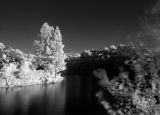
An example using the above exposure/development (click for high res):


Rodinal will work OK at 1+50 but it gives a really, really grainy result. I don't think that fits well with the IR landscape or soft-portrait aesthetic, especially with IR820 Aura, but there are certainly subjects it could work well for.
 
I ran a 120 roll of the IR820 in some tests last year and found with a 720 nm filter I needed about 6 to 8 stops over the ISO 100 reading; with a 760 filter, another stop was needed. I used HC110 dilution E (1+47), about 9 minutes at 20ºC and they were not thin negatives, although there were some features, such as a stream in shade that were like a black hole for IR.

Be advised, someone else a while back got almost nonexistent results with an IR film that seemed to point to his off-brand IR filter being mismarked. It was probably one with a cutoff up in the 800s. I must say though that the cost of the big name filters is enough I might pass on the whole idea!
 
I must say though that the cost of the big name filters is enough I might pass on the whole idea!

The Hoyas aren't that bad unless you need a really big size. (What I wish I could find economically, though, is a 720 nm *gel* that could be used over a flash.)

One thing to remember about exposure with IR films is that the EI is *not* just a function of the film and the filter---it varies with the time of day, because the ratio of IR (which the film sees) to visible (which you and the meter see) varies. You might get EI 6 in the evening (when the light skews red) and EI 1.5 at midday, or something like that.

-NT
 
For the ultimate in cheap filtration, I've got good results with this film using Lee lighting gels.

http://chazmiller.com/projects/leeir.html

Oh, that's interesting. I've experimented with a similar stack of primary-colour filters over a flash (there was a nice thread on IR flash a few months ago), but got results that suggested I was seeing *much* less IR from the flash than other people had seen with 89B gels.

Now, seeing that page, I wonder if maybe the difference was in the flash rather than the filter. More experimentation called for, obviously.

-NT
 
What I wish I could find economically, though, is a 720 nm *gel* that could be used over a flash.

Those used to be really common. Wonder what happened.

This might be of interest:

http://amasci.com/amateur/irgoggl.html

Now that I remember it, black unexposed/developed Ektachrome film can be used as an IR filter.
 
The Hoyas aren't that bad unless you need a really big size. (What I wish I could find economically, though, is a 720 nm *gel* that could be used over a flash.)

One thing to remember about exposure with IR films is that the EI is *not* just a function of the film and the filter---it varies with the time of day, because the ratio of IR (which the film sees) to visible (which you and the meter see) varies. You might get EI 6 in the evening (when the light skews red) and EI 1.5 at midday, or something like that.

-NT

I ended up with a "Bower" IR72 that seems to be OK. I was after 77 mm so it could be adapted to any lens I might want to use and that extra glass tends to hurt price a lot (as I recall, it was around $50, but others were 3 times that). I got a 67 mm 760 filter in some even more unknown brand for a lot less money. It too appears to work OK, but 760 nm cutoff is really pushing it on the Rollei IR400 I used on my first pass -- as in, add 12 or 13 stops -- you're really down on the cutoff curve. The 760 is much more usable with the EFKE material.

And yes, the effects of time of day, season of year, etc. seem to suggest no matter how carefully one meters, bracketing is a Good Thing(tm).
 
I am thinking xtol does not like Efke. How about Rodinal??
Any experience with Efke??

Last summer I experimented with IR820 120 roll and Heliopan 715 filter. I use the filter on my light meter to read the exposure (reflected light metering). I set the light meter to ASA80 as I usually like to overexpose all films for a better shadows details. I developed the test roll in Xtol 1+2 for 16 minutes, 30 seconds agitation at beginning and 3 slow inversion at each minutes. The highlights are very dense, too dense for printing while the shadows are OK.
 
Photrio.com contains affiliate links to products. We may receive a commission for purchases made through these links.
To read our full affiliate disclosure statement please click Here.

PHOTRIO PARTNERS EQUALLY FUNDING OUR COMMUNITY:


Ilford ADOX Freestyle Photographic Stearman Press Weldon Color Lab Blue Moon Camera & Machine
Top Bottom